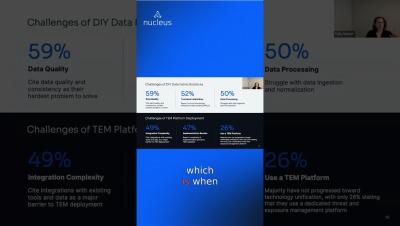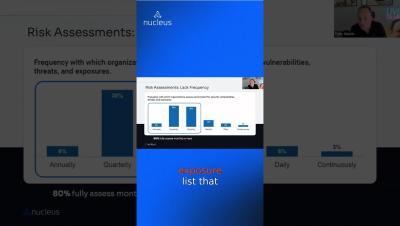
UCSB's Todd Atkins, Security Operations Engineer, talks about the benefits the university has realized in risk and visibility thanks to switching over to Nucleus Security.
The biggest cybersecurity bottleneck for today’s enterprises isn’t detection. It’s remediation. Organizations are flooded with vulnerability data, but that flood rarely translates into effective action. Instead, security teams spend their time wrangling data, chasing tickets, and firefighting the same risks week after week. The outcome? Wasted effort, missed SLAs, and real business risk.
Application security has evolved far beyond traditional vulnerability management (VM). Today, security teams face massive scale, increasing complexity, and a constant flow of vulnerability findings that often vanish in hybrid and cloud-native environments. We’ve moved from managing a single virtual machine to dealing with an unlimited number of containers and ECS tasks, many of which only exist for about 15 minutes.
Vulnerability management is no longer about simply cataloging risks. It’s about reducing them intelligently, at scale, and in alignment with how your business operates. At Nucleus, we believe in building a platform that doesn’t just surface issues, but solves them. With our latest release, we’re doubling down on that vision.
In this webinar, "Bridging ASPM and RBVM for Scalable AppSec," security leaders from Cycode and Nucleus explore how to unify application and infrastructure vulnerability management in complex, cloud-native environments.
RSA Conference 2025 in San Francisco was a breath of fresh air, literally and figuratively. The city felt more vibrant and welcoming, and the conference buzzed with genuine excitement. Unlike previous years, which were dominated by hype and theoretical discussions, this year’s focus was on tangible (not yet game-changing!) AI applications in cybersecurity. AI extended throughout the conference, from the keynotes through the track sessions and into the exhibition hall.
Recently, industry analyst Jon Oltsik outlined a critical shift underway in cybersecurity: the move toward a threat-informed defense. As Oltsik describes, organizations are beginning to strengthen the intersection of vulnerability scanning and threat intelligence, using AI to bolster asset classification and risk scoring. This evolution is essential as enterprises seek to move beyond fragmented security practices and build a more cohesive exposure management strategy.
In our recent article on Continuous Threat Exposure Management (CTEM), we highlighted how exposure assessment platforms (EAPs) like Nucleus can support several critical phases of the CTEM framework. In that article, we intentionally separated the scoping step from the other technology-dependent CTEM stages. Scoping begins as a business- and process-driven exercise. However, doing scoping well and at scale relies more on having the right technology.
In this webinar, "Achieving Continuous Exposure Management in Cloud-Native Environments," Tally Netzer and Aaron Unterberger from Nucleus dive deep into how modern cloud architectures impact vulnerability and exposure management. You'll learn: Why traditional vulnerability management falls short in cloud-native, ephemeral environments. How fragmented visibility and unclear ownership disrupt effective security practices.
All the major vulnerability scanning vendors have strengths, but asset tracking isn’t one of them. Some workarounds exist. However, if you are using one of the most popular vulnerability scanning tools, it’s likely you will struggle with asset tracking.