Security | Threat Detection | Cyberattacks | DevSecOps | Compliance

GPSec Boston 2025 - CTEM: How to Start When You Haven't Started

What does it really take to start a Continuous Threat Exposure Management (CTEM) program—especially if your organization hasn’t formally begun? In this GPSec Boston 2025 session, Scott Kuffer, COO and Co-founder of Nucleus Security, joins Chris Peltz, Director of Security Strategy at GuidePoint Security, to demystify CTEM by stripping away the buzzwords and breaking down the practical steps for getting started.

POAM Process Automation: Breaking the Manual Grind

Plans of Action and Milestones (POAM) play a critical role in public sector cybersecurity. In this webinar with government IT solutions provider Carahsoft, we break down the challenges security teams face when implementing POAMs, sharing real-life examples of where things go wrong and why. As part of the presentation, we also cover the intensive math of POAM programs: people, systems, and time.

Continuous Threat Exposure Management and the Role of Exposure Assessment Platforms

Traditional vulnerability management is broken. It is ineffective. The process of scanning for software vulnerabilities, prioritizing based on CVSS scores, and fixing what you can has become an endless patch cycle. The need for a better approach is clear. Different scanning tools are creating millions of alerts, obscuring critical risks within the noise. Organizations need to go beyond finding and patching vulnerabilities and opt in to a more effective approach to managing exposures.

Managing Cloud Exposures Just Got Easier: Introducing Nucleus Cloud-Native Vulnerability and Exposure Management

Every day, security teams are expected to manage risks in cloud environments that they don’t fully control, can’t always see, and that are constantly changing. Cloud-native assets—such as container workloads, autoscaling groups, and serverless functions—are highly dynamic, appearing, disappearing, and evolving in response to demand and functionality changes.

Is Enterprise Risk Posture Better or Worse Today?

Measuring enterprise risk posture—its overall security readiness and resilience—is a complex challenge. Advanced security solutions, such as automated vulnerability management tools and unified risk dashboards, enable organizations to defend their networks with unprecedented efficiency. The rapid expansion of cloud environments and the intricacies of modern IT infrastructures, however, present an increasingly dynamic attack surface.

From Zero to CTEM: An Actionable Approach to the Five Stages

Join Nucleus team members Tali Netzer, Head of Product Marketing, and Scott Koffer, COO and Co-Founder, as they navigate the intricacies of Continuous Threat Exposure Management (CTEM). In this webinar, they discuss the history of vulnerability management, the evolution to CTEM, and how it fundamentally changes the approach to cybersecurity. Learn about the five-step CTEM process, from scoping and prioritization to validation and mobilization.

Breaking the Swivel Chair Cycle: Why Security Teams Struggle with Asset Visibility-and How to Fix It

For many security professionals, managing asset visibility feels like an endless game of whack-a-mole. They are stuck in what experts call the “swivel chair approach”—constantly pivoting between multiple dashboards, spreadsheets, and security tools to manually stitch together an understanding of their risk landscape.

Who Owns Vulnerabilities?

The question of ownership is one of the biggest reasons vulnerabilities persist in organizations far longer than they should. Who owns vulnerabilities? This isn’t just a theoretical debate—it’s a critical operational issue. Modern scanning solutions excel at identifying and prioritizing vulnerabilities, but without clear ownership, those vulnerabilities often linger unaddressed or improperly documented, increasing an organization’s risk exposure.

Disparate Data to Unified Risk Insights: The Role of Asset Correlation in Vulnerability Management

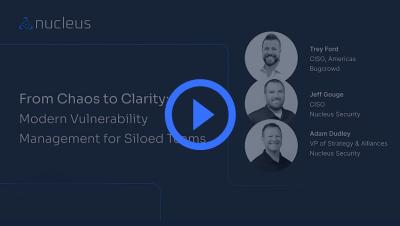
In this webinar, Adam Dudley and Aaron Attarzadeh from Nucleus discuss the critical role asset correlation plays in vulnerability management. They dive into how organizations can unify disparate asset data to gain clearer, more actionable risk insights. They explore the challenges of managing vulnerabilities in today's complex environments, with a focus on metadata integration, asset correlation, and how to manage data from multiple scanners and sources.