Security | Threat Detection | Cyberattacks | DevSecOps | Compliance

Black Hat Proved AI Agents Are Already the Attack Surface

Enterprise AI agents stopped being a pilot project a while ago. They read email, touch source code, operate browsers, and increasingly make decisions inside production systems, which means the security model built for chatbots and prompts no longer covers what is actually happening inside the enterprise. Black Hat USA 2026 turned out to be the week that gap became impossible to ignore.

Reflections from Black Hat: Speed Is Table Stakes. Resilience Is the Win.

Black Hat 2026 came just weeks after the Five Eyes cybersecurity agencies — CISA, the UK’s NCSC, Australia’s ACSC, Canada’s CCCS, and New Zealand’s NCSC-NZ — issued a joint statement to boards and executives with the blunt message that AI is rewriting the rules of cyber risk, the window between vulnerability and exploitation is shrinking, and organizations have a matter of months to adapt.

That's a wrap: Mend.io at Black Hat USA 2026

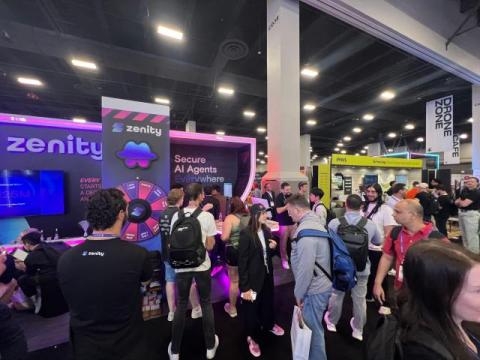
Another Black Hat USA is in the books, and what a week it was. From a main stage keynote at the AI Summit to candid podcast conversations, a video interview with Cyber Defense Magazine, and a booth game that just wouldn’t quit, Mend.io showed up in Las Vegas ready to talk about the question every security leader is wrestling with right now: as AI reshapes both the software we ship and the systems we have to defend, who do we trust to verify that it’s safe?

Arctic Wolf Cocktail Chats - Nick Schneider, President & CEO | Black Hat 2026

Arctic Wolf President & CEO Nick Schneider sits down with Ilina Cashiola, SVP of Corporate Marketing, for a cocktail chat at Black Hat USA 2026 to break down three major announcements shaping the next chapter of AI-led security operations.

Arctic Wolf Cocktail Chats - Dan Schiappa, President, Technology & Services | Black Hat 2026

Arctic Wolf President of Technology & Services Dan Schiappa sits down for a cocktail chat with Arctic Wolf SVP of Corporate Marketing Ilina Cashiola at Black Hat USA 2026 to break down the momentum behind the Aurora Agentic SOC and what's next for AI-led security operations.

Inside Locked Shields 2026: How network evidence helped defenders cut through live-fire chaos

Locked Shields 2026 brought together more than 4,000 participants from 41 nations for a live-fire cyber defense exercise built around the kind of pressure SecOps teams know well: Critical systems under attack, incomplete context, multiple tools, and no time to waste. For Corelight, the exercise reinforced a practical lesson: In high-pressure defense, network evidence is not just another data source.

Ten Black Hat NOCs and counting: Corelight sees it all

Whenever I come back from a Black Hat NOC, people always ask the same question: “So, what did you see?!” They understand how unique it is to have access to the detailed logs generated by an NDR overseeing the network traffic of a conference with thousands of attendees. There is always something to see. There are always stories that come out of the packets; those stories evolve into patterns, and the patterns offer the gift of lessons.

What the Black Hat NOC taught me about MCP & agentic SOCs (Chapter 2 of 4)

The first time an MCP (Model Context Protocol) server felt real to me, it wasn't because of a clean demo. It was because of the noise. TL;DR: The harness matters more than the protocol, and the evidence matters more than both. MCP earns its keep when it shortens the path from a good security question to trustworthy evidence, and almost everything interesting about making that work happens in the harness wrapped around the model. In this series, I will cover how to build an MCP for an AI SOC.

AWS Summit 2026: Autonomous Security Is Here. Turning It Into Outcomes Requires a New Operating Model

At the recent AWS Summits in New York and Toronto, Arctic Wolf was present to hear AWS introduce a set of security capabilities built to run continuously and act at machine speed. New approaches to vulnerability management, deeper integration of security into development workflows, and expanded context through knowledge mapping all point in the same direction: Security operations are becoming persistent, automated, and increasingly driven by AI.