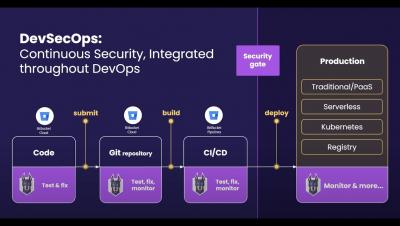
Despite years of effort encouraging a DevSecOps approach, development and security teams tend to remain divided. For example, according to 2020 research, 65% of security professionals reported that their companies had successfully shifted security left. Good, right? But the same research also shows that almost a third of people believe the security team is primarily responsible for security — despite shifting left.
To improve the efficiency of releasing working code into a production environment, implementing a continuous integration and continuous delivery (CI/CD) pipeline is a great practice. These pipelines automate the process of checking that a code change is ready for release and provides tools to automate the release to a production environment. One popular way to do this is to use your existing version control system.
As developers, we often write test cases and comments to explain our code. Commenting improves the codebase’s readability and quality. Detailed comments can remind us why we implemented a specific functionality. They can also help other programmers understand, maintain, use, and expand codebases.
Testing is a crucial best practice when developing software. Unit testing is one of the numerous strategies we can use to ensure our code is functional and optimal. As developers, we can code unit tests to check individual components (units) of the application code, such as a specific method. The idea is to write one or more unit tests for each code section and run them every time a change is made to catch defects as soon as they are introduced into the codebase.
Inversion of control (IoC) techniques give developers a way to break out of traditional programming flow, and it offers them more flexibility and greater control over their code. Dependency injection, one form of IoC, is a pattern that aims to separate the concerns of constructing objects and using them. In this article, you’ll learn what dependency injection is, when you should use it, and what popular JavaScript frameworks it’s implemented in.
Today, web and mobile applications and API-based microservice endpoints are becoming the default. These applications are reachable through the HTTP web protocol. The encryption provided by a Secured Socket Layer or Transport Layer Security (SSL/TLS) is a must to secure the communication between client and server and across API back-ends. SSL/TLS are certificate-based encryption mechanisms. SSL has been the standard for over 20 years.