Security | Threat Detection | Cyberattacks | DevSecOps | Compliance

Patch Reliability Score: Make patch deployment decisions with confidence

Every Patch Tuesday starts the same way: New patches become available, and administrators begin answering the question, Is this patch safe to deploy? That answer rarely comes from a single place. Most administrators read the vendor's knowledge base article, look for known issues, monitor community discussions, and wait for early deployment feedback before rolling the patch out across the organization.
Featured Post

The first short-lifespan TLS renewal wave is closer than it looks

If your organization runs anything on the public internet, a mandate that changes how often you renew TLS certificates is already in effect. In March 2026, the maximum validity of public TLS certificates dropped from 398 days to 200. What fewer teams have worked out is that the first certificates issued under the 200-day cap start expiring at the end of September. That makes this autumn the first real test of whether your renewal workflows are ready for what the next three years will ask of them.

Tanium and Google Threat Intelligence bring Google-grade threat intel to the live endpoint

Security teams are under pressure to move faster, investigate more confidently, and make better decisions with fewer resources. But even the best security operations teams run into the same problem. They often do not have a reliable place to start. Threat hunting depends on high-quality intelligence and experienced analysts who know how to turn that intelligence into useful pivots. Alert triage depends on knowing which signals matter and which ones are noise.

Introducing Agentic SecOps: Live Endpoint Truth for the AI-Driven SOC

Security operations teams are being asked to move faster than ever. Adversaries are using automation, infrastructure changes by the minute, and the number of alerts, exposures, and investigative paths keeps growing. But too many SOC workflows still depend on scarce expert time. A senior analyst writes the query, translates the hypothesis, pivots across tools, validates the result, and then hands the finding off for action. The craft works.

Bringing Tanium's real-time endpoint intelligence into enterprise AI workflows with MCP

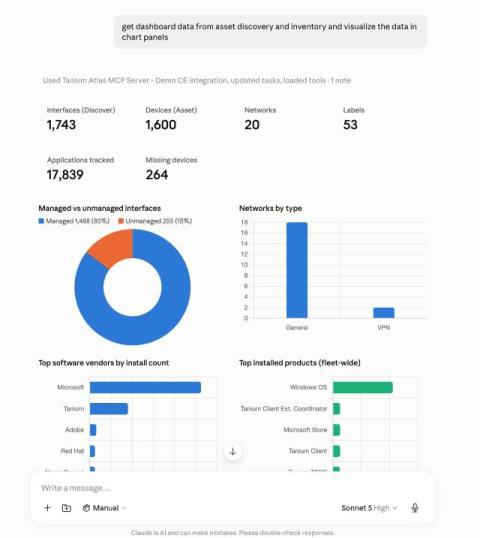
Enterprise AI is quickly moving from experimentation to day-to-day operational use. Security analysts, IT operators, and platform teams are increasingly working inside AI-native environments — from Claude and Microsoft Copilot experiences to internally built agents and automation workflows. But there is a practical challenge: AI workflows are only as useful as the enterprise systems they can safely reach.

Dojo AI: Agentic security and cloud operations powered by AI-ready telemetry

You’re collecting more telemetry than ever, but chances are it hasn’t made your job easier. Fragmented data, disconnected tools, and manual investigations mean more noise, slower response times, and higher operational costs. The promise of AI is that it will solve it, but in most cases, you just end up trading noise for expensive hallucinations. Point an LLM at raw, unorganized log storage, and you get an assistant that burns through credits to produce generic, unreliable answers.

7 Ways to Improve Microsoft Sentinel Detection Outcomes

See how Securonix Threat Analytics helps security teams improve detection coverage, reduce SOC engineering work, and maximize Microsoft Sentinel ROI. Microsoft Sentinel provides a strong foundation for security operations. As environments grow more complex, detecting sophisticated attacks often requires extensive engineering, custom KQL development, and ongoing content maintenance.

CrowdStrike 2026 Threat Hunting Report: Exploitation Window Closes as AI Use Accelerates

The CrowdStrike 2026 Threat Hunting Report illustrates the next evolution in trust abuse. Adversaries are targeting trusted users and tools across identity systems, cloud environments, SaaS applications, AI services, software supply chains, and developer workflows to blend into legitimate business activity and reach critical assets before defenders can detect them. Our frontline intelligence in this year’s report underscores this shift.

Best Practices for Managing the Identity Lifecycle

Every employee, contractor, and partner who touches your systems creates a paper trail of accounts, permissions, and access rights that has to be managed from the day they join to long after they leave. Identity lifecycle management is the process of creating, updating, and retiring a user's digital identity and access rights across that entire span — from onboarding through role changes to offboarding.

Next Gen SIEM: Modern Security Ops Guide

Monday starts the same way in too many SOCs. The queue is already full, the overnight team has left behind a stack of alerts nobody had time to finish, and the first hour goes to deciding which notifications are real and which ones are just noise. That's the point where next gen SIEM stops being a product category and becomes an operational decision, because the wrong platform turns your analysts into log clerks while the right one helps them work threats in real time.