Security | Threat Detection | Cyberattacks | DevSecOps | Compliance

Nucleus Security Positioned as a Growth Leader in Frost Radar: Application Security Posture Management, 2024

In September 2024, Frost & Sullivan released its Frost Radar: Application Security Posture Management (ASPM), 2024, highlighting the leaders in this rapidly growing market. We’re proud to be recognized as a top player, reflecting our strong growth and impact in the ASPM space. Our customers use Nucleus to achieve a comprehensive and unified application security posture.

GigaOm Radar Report 2024: Insights on Continuous Vulnerability Management

As organizations face increasingly sophisticated cyber threats, the importance of Continuous Vulnerability Management (CVM) continues to grow. GigaOm’s latest Radar Report for Continuous Vulnerability Management provides an in-depth analysis of the current landscape, offering a comprehensive look at the solutions and vendors leading the charge in this critical space. The report assesses a variety of platforms based on key criteria such as feature set, ease of use, performance, and innovation.

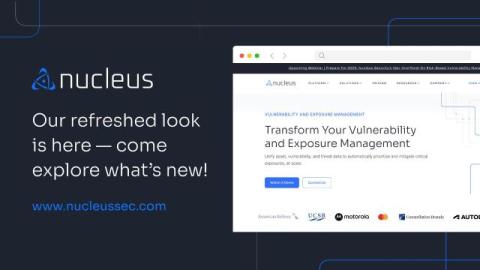
It's Here! The New Nucleus Security User Interface

At Nucleus Security, our goal has always been to deliver an intuitive and scalable vulnerability management platform. A critical part of this mission is ensuring that its user interface (UI) evolves to meet our customers’ needs. I’m pleased to announce that we recently rolled out an updated UI—an important first step in a series of planned improvements aimed at enhancing our users’ experience with the Nucleus platform.

Deduplicate Vulnerabilities with the Nucleus Platform's New CVEs Page

Vulnerability management is often a complex task, particularly when using multiple scanning tools or dealing with the constant flow of new CVEs. Different scanners can uncover the same vulnerability but provide different insights or look at different metadata, making it look like one vulnerability is several without the proper context. We are excited to introduce the Nucleus CVEs Page, designed to enhance how your organization manages vulnerabilities across projects.

How Security Debt Compounds Vulnerability Risk

Organizations often find themselves caught in a perpetual cycle of identifying, prioritizing, and mitigating vulnerabilities that pose the most risk. Amid this ongoing battle, a significant challenge is often overlooked: security debt. Much like technical debt, security debt refers to the accumulation of unresolved vulnerabilities within an organization’s systems and software.

4 Simple Steps to Implement Risk-Based Vulnerability Management

Imagine if your fire alarm sensor went off every time you burned your toast or lit candles on a birthday cake. After a few false alarms, you’d probably start ignoring them or even turn your sensor off just to get some peace. This is what many information security teams are experiencing with vulnerability alerts.

Beyond Patches and CVEs: The New Dynamics of Enterprise Technology and Vulnerability Management

The enterprise technology landscape has changed significantly, driven by the rapid adoption of cloud technologies, evolving IT infrastructures, and evolving exploitation activities. This transformation requires that organizations take an updated approach to vulnerability management—one that goes beyond the traditional focus on patch management to encompass a broader spectrum of risks.

Five Key Findings from the Inaugural EPSS Report

Last month, Cyentia and First.org published the inaugural Exploit Prediction Scoring System (EPSS) performance report. The report goes beyond just assessing the EPSS predictive scoring model. It looks at historical vulnerability data and published CVEs, as well as provides comparisons to the other popular scoring models: CVSS and CISA-KEV.