Security | Threat Detection | Cyberattacks | DevSecOps | Compliance

AI in the SOC: Where security teams stand

With 96% of security teams now using AI, the question is no longer whether AI delivers real value to the SOC, but one of efficiency and reliability. The recent AI Adoption in the SOC report, conducted by Dimensional Research and sponsored by Elastic, surveyed more than 400 cybersecurity professionals responsible for security operations at companies with more than 500 employees.

Elastic Security integration with Google Distributed Cloud: Closing the velocity gap in air-gapped environments

The rules of cyber defense have shifted. Threat actors are increasingly using advanced automation to accelerate reconnaissance, evade static signatures, and orchestrate rapid intrusions across critical infrastructure, software supply chains, and insider pathways. This has created a critical velocity gap: when adversaries compress attack timelines from days to minutes and defenders rely on manual triage across fragmented legacy tools, the defense falls behind.

CISA's Logging Reference Architecture for OMB M-26-14: What federal agencies should do next

On August 20, 2026, the Cybersecurity and Infrastructure Security Agency (CISA) published its Logging Reference Architecture (LRA), the implementation guidance federal civilian executive branch (FCEB) agencies have been waiting for since the Office of Management and Budget's Memorandum M-26-14 reset the requirements for enterprise logging.

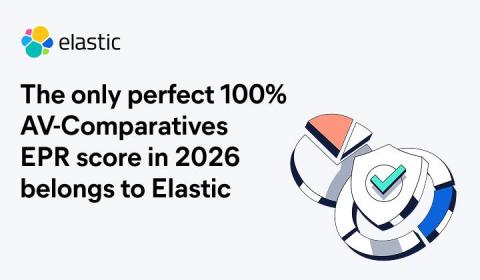
The only perfect Endpoint Prevention and Response (EPR) score in 2026 belongs to Elastic

Elastic sits at the very top of this year’s AV-Comparatives' CyberRisk Quadrant within the 2026 Endpoint Prevention and Response (EPR) test with the only protection scores at 100%, combined with both the lowest modelled operational footprint of any tested product and zero false alerts.

The security attack that hid inside your observability data

How teams are leaving value on the table and what it costs when they do It's 3:00 a.m. Your on-call engineer gets paged that the central processing unit (CPU) is at 97% on payment-processor-01. They open their observability platform, look at the metric spike, reboot the host, and close the ticket.

Defending against AI-fueled social engineering

Social engineering has always been the softest edge of enterprise defense, and AI is sharpening adversaries’ attacks. Phishing, business email compromise, and impersonation still dominate the initial-access playbook, but AI has stripped out the cost, time, and skill barriers that once forced attackers to choose between reach and precision.

Machine vs. machine: The new reality of cybersecurity in ANZ

Frontier AI has handed attackers something they have never had before: the ability to move at machine speed. Attacks that once took days to craft now take minutes. Threats have not just evolved to be automated, adaptive, and operational around the clock. They have also changed category. We surveyed more than 850 IT and cybersecurity professionals across Australia and New Zealand to understand how organisations are keeping up. What the data reveals is not a capability problem. It is a pace problem.

How SLED can win the cybersecurity race with agentic AI

Adversaries are using AI to launch cyber attacks in record time, forcing security teams to measure responses in minutes instead of months. Phishing campaigns built with large language models (LLMs) achieve click-through rates 4.5 times higher than traditional methods,1 and the average time between initial compromise and lateral movement has fallen to just 29 minutes.2 This is a 65% increase from the prior year.2 State and local governments and higher education institutions are at an inflection point.