Security | Threat Detection | Cyberattacks | DevSecOps | Compliance

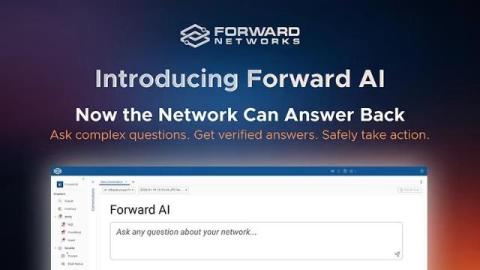
Introducing Forward AI

As enterprises move toward agentic operations, speed without data accuracy becomes a liability. At Forward Networks, we recognized this challenge and set out to deliver a solution: speed backed by mathematical accuracy. In networking, acting on incomplete or approximate data is not an inconvenience, it is a cause of outages, security exposure, and operational risk.

A New Security-Focused Path Search View for Faster, Clearer Analysis

Security teams frequently investigate whether traffic is allowed, denied, or translated along a path, but traditional visualization methods create unnecessary complexity. A standard Path Search view includes every L2 and L3 hop—switches, routers, and intermediary devices that participate in forwarding but apply no security policy. While this depth is helpful for network troubleshooting, it overwhelms analysts focused specifically on enforcement points.

How Permit-All Mode Simplifies Troubleshooting Across Routing and Firewalls

When application traffic fails to reach its destination, teams must determine whether the problem lies in routing, firewall rules, NAT behavior, or a combination of all three. In many environments, these components overlap in ways that make traditional troubleshooting slow and error-prone. Engineers often have to run repeated tests, stage changes, or temporarily disable rules to understand why a flow is being blocked.

New Configuration Change History in Forward Enterprise

Modern networks change constantly as teams modify interfaces, adjust routing, enable features, or deploy security controls. Over time, these individual updates create a complex configuration history that is rarely documented comprehensively. Without access to historical configuration data, engineers face significant challenges determining when changes occurred, whether they align with approved change windows, or how they influenced network behavior.

Why Network Validation Matters and Why GigaOm Names Forward Networks as a Leader and an Outperformer

Enterprise networks are highly dynamic environments. They span campuses, data centers, and multiple clouds, requiring constant maintenance. Configuration updates, security policies, patches, capacity shifts, and automation-driven enhancements occur continuously. At this scale and velocity, every change carries risk unless it is verified against intended network behavior.

Identify Unknown or Unapproved Devices: How Forward Networks Helps Strengthen Supply-Chain and Zero Trust Compliance

Modern enterprise and federal networks increasingly face challenges related to identifying and validating the hardware operating within their environments. While teams typically expect enterprise-grade devices from approved vendors, the broader hardware ecosystem often introduces components and equipment that do not originate from the organization’s procurement process.

Clean IPs are the Foundation of Network Automation Success

Every automation initiative starts with excitement, intent-based networking, AI-driven decisions, and Python scripts promising speed and resilience. But when someone asks, “Do we know what IPs are in use?” silence often follows. If your IP tracking lives in spreadsheets, you’re not alone, but you are vulnerable. Before writing a single script, teams need an authoritative and current IP source of truth.

CWE vs CVE vs KEV: Untangling the Security Alphabet Soup

Understanding the differences between CWE, CVE, and KEV is critical for modern security and network teams. These acronyms represent the building blocks of threat identification and response, yet many professionals don’t fully grasp how they differ or interact. This blog breaks them down, shows their relationships, and explains how Forward Networks helps correlate them across your environment.