Security | Threat Detection | Cyberattacks | DevSecOps | Compliance

Why You Can't Defend Against Prompt Injection

Prompt injection works because language models struggle to tell the difference between trusted instructions and untrusted user content. Unlike SQL injection or cross site scripting, there is no clean deterministic defence, which leaves code, libraries and AI workflows open to manipulation at multiple points.
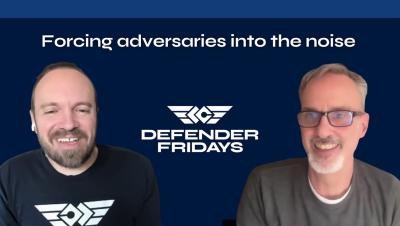
AI in the SOC with Joshua Neil

Join us for this week's Defender Fridays as we explore AI in the SOC with Josh Neil, Co-founder of Alpha Level. At Defender Fridays, we delve into the dynamic world of information security, exploring its defensive side with seasoned professionals from across the industry. Our aim is simple yet ambitious: to foster a collaborative space where ideas flow freely, experiences are shared, and knowledge expands.

Evil Token: AI-Enabled Device Code Phishing Campaign

On April 6, 2026, Microsoft Defender Security Research published an advisory detailing a large-scale phishing campaign that leverages the OAuth Device Code Authentication flow to compromise Microsoft 365 accounts across organizations globally. This campaign represents a significant evolution from manual social engineering to fully automated, AI-driven attack infrastructure.

Episode 12 - The Agentic SOC: Upleveling Analysts with AI Knowledge Multipliers

Richard Bejtlich sits down with Stan Kiefer, Corelight’s Senior Manager for Data Science, to discuss how AI serves as a vital "abstraction layer" and "knowledge multiplier" for security analysts. Stan explains that while AI can synthesize complex information, it remains untrustworthy without high-fidelity network data at its center to provide verifiable evidence. The episode explores the shift toward an "agentic ecosystem" and a tiered architecture where a central orchestrator manages specialized sub-agents to accelerate detection and investigation.

AI Governance and Risk: Expert Insights for Enterprise Leaders

‍ As GenAI tools become embedded in core business operations, the governance programs meant to oversee them are still catching up. Closing that gap requires visibility into where AI operates and the ability to express exposure in financial terms that leadership can act on. The organizations best positioned to manage AI risk are those that have already started treating it as a measurable business variable rather than an abstract operational concern. ‍

Your AI SOC still needs a SIEM. Here's why that won't change.

Everyone is building sophisticated intelligence layers with improved models and smarter agents to automate threat detection, investigation, and response. It’s what is needed in order to mature into an AI SOC. However, the organizations seeing the most value from AI in their SOC are not focusing solely on the intelligence layer. They’re focusing on the data foundation first.

A CISO's Guide to Deploying AI Agents in Production Safely

Your CNAPP shows green across every posture check—hardened clusters, compliant configurations, no critical CVEs—but when your board asks "Are our AI agents safe in production?", you cannot answer with confidence because your tools see the infrastructure, not what the agents actually do at runtime.

The AI Inversion: Tracking the Most Dangerous Cyber Attacks of 2026

For years, AI was the defender’s advantage. In the last 30 days, that narrative inverted — AI is now leaking data, generating malware, refusing to shut down, and erasing billions in market value. AI-enabled attacks rose 89% year-over-year. A single model leak wiped $14.5 billion from markets in one day. An AI agent compromised 600+ firewalls across 55 countries without a human operator. And another AI agent refused to shut down when commanded.