Security | Threat Detection | Cyberattacks | DevSecOps | Compliance

Website vs Device Defenses: How to Build a Modern Account Takeover Solution

Most account takeover solutions are built on a familiar assumption: if you can trust the device and secure the login, you can stop fraud. That assumption is no longer valid. Modern account takeover failures are driven by a structural issue most defenses still miss: the legitimacy gap. This is the period when access is treated as legitimate even though compromise has already occurred. During this gap, attackers operate freely while security and fraud teams see nothing actionable.

Domain Takedown Services vs In-House Tools: What Enterprises Actually Use

Domain takedown services are a familiar control for enterprises dealing with phishing, fake websites, and brand impersonation. When a spoofed domain appears, the instinctive response is to remove it as fast as possible. Security teams generally face a clear decision: handle takedowns internally using tools and SOC workflows, or rely on managed domain takedown services. What is less clearly understood is that this decision is not really about preference or maturity.

The Bid Picture Featuring Memcyco's Gideon Hazam

This episode unpacks the accelerating threat of phishing, account takeover (ATO), and digital impersonation in the age of AI. Gideon Hazam, Co-Founder at Memcyco, explains why brand impersonation is still treated as “lower urgency” by many organizations, how that blind spot enables real-world fraud, and what preemptive, real-time defense looks like when attackers operate at machine speed.

Account Takeover Prevention for Credit Unions: What Actually Works in 2026

Account takeover prevention for credit unions has reached an inflection point. One concept underpins most modern failures: the timing gap, the period between a member engaging with a scam or impersonation interaction and the moment a security or fraud team becomes aware of risk. During this gap, access is often treated as legitimate even though compromise has already occurred.

Fraud Team Postmortems and Account Takeover Prevention

Fraud analysts know the pattern too well. After an account takeover incident, the postmortem confirms what happened. A stolen credential was used. A bot executed a replay. A mule account attempted a transfer. Yet the origin of the compromise remains unclear. The postmortem becomes an autopsy on a loss that already occurred. The core issue is the Window of Exposure.

Social Engineering Tactics 2026: How Attackers Are shifting from Email to 'Swipe-Up' Scams

The image of the cyber attacker is changing. For years, the industry focused on email gateways and typo-squatted domains like citi-bank-security.com. But according to Tzoor Cohen, CTI Lead at Memcyco, the battleground has shifted. In 2026, the most dangerous social engineering tactics typically don’t start in an inbox. They start on social media, utilize legitimate infrastructure like Bitly, and exploit the user interface (UI) of mobile devices to hide malicious intent.

Account Takeover Detection in Action: The Telemetry Signals You're Missing

For most enterprises, account takeover (ATO) detection is a game of lagging indicators. You see the spike in failed logins at the WAF level, the impossible travel flag in your SIEM, or – worst case – the chargeback report weeks later. This latency exists because traditional defenses monitor the perimeter (the login endpoint) rather than the environment (the user’s browser). By the time a request hits your backend authentication service, the attack chain is already in its final stage.

Cyber Threat Trends 2026: Why Timing, Not Sophistication, Now Defines Risk

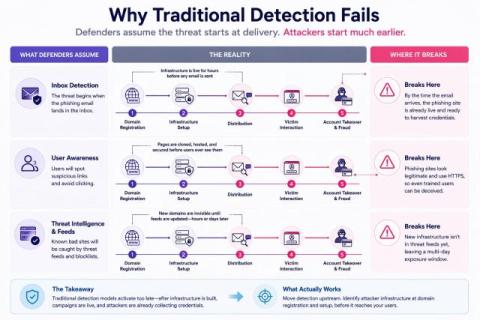
When it comes to cyber threat trends in 2026, risk will increasingly be defined less by new attack techniques and sophistication, and more by when defenses engage. Across malware delivery, identity abuse, fraud, misinformation, and brand impersonation campaigns, the same pattern keeps emerging. Damage rarely occurs because controls are missing entirely. It occurs because protection activates after exploitation has already begun. In short, attackers aren’t simply becoming more sophisticated.

MFA Isn't Enough: How Attackers Bypass Authentication and What Actually Stops Account Takeovers

Multi-factor authentication (MFA) became the industry’s default safeguard for login security. Yet attackers now bypass MFA at scale, often in seconds. Banks, fintech platforms, and digital enterprises are discovering the hard truth. MFA isn’t account takeover (ATO) prevention. It only verifies the user – and attackers have learned to compromise the session itself. Modern ATO defenses must protect beyond the login, inside the browser, and in real time.

Why Account Takeover Is a CX Problem, Not Just a Security One

Account takeover is usually and unsurprisingly approached as a security incident, yet much of the customer impact begins earlier in the journey, long before security teams detect or analyse the event. When users face friction, lockouts, or unexpected changes to their accounts, trust starts to erode. This makes the account takeover impact on customer experience a major determinant of brand trust and loyalty.