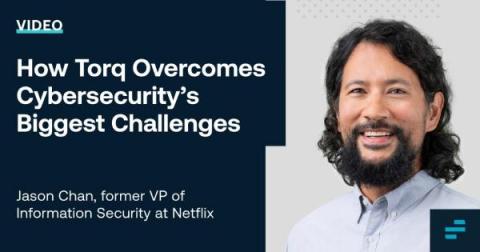
Jason Chan, a key member of the Torq Advisory Board, has spent more than 20 years working in pivotal cybersecurity roles. One of his most important positions was leading the information security organization at the video streaming behemoth Netflix for more than a decade. His Netflix team set the bar extraordinarily high, focusing on sophisticated risk assessment and management, and compliance management strategies and approaches.
“If you fail to plan, you plan to fail,” said Benjamin Franklin. These words cannot be overstated in most business fields, especially when it comes to automation. Process automation has the potential to enhance operations in most organizations, but problems can emerge when they don’t plan and strategize around their automation objectives.
Everyone loves automation, and it can be easy to assume that the more you automate, the better. Indeed, falling short of achieving fully autonomous processes can feel like a defeat. If you don't automate completely, you're the one falling behind, right? Well, not exactly. Although automation is, in general, a good thing, there is such a thing as too much automation. And blindly striving to automate everything under the sun is not necessarily the best strategy. Instead, you should be strategic about what you do and don't automate.
MITRE is a world-renowned research organization that aims to help build a safer world. It is probably best known in the information security industry for being the organization behind the industry-standard CVE (Common Vulnerabilities and Exposures) list. Each entry on the list is supposed to include an explanation of how the vulnerability could be exploited. These attack vectors are tracked and defined in another well-known knowledge base called ATT&CK, which is also maintained by MITRE.