Security | Threat Detection | Cyberattacks | DevSecOps | Compliance

Calico Egress Gateway: Universal Firewall Integration for Kubernetes

New applications and workloads are constantly being added to Kubernetes clusters. Those same apps need to securely communicate with resources outside the cluster behind a firewall or other control point. Firewalls require a consistent IP, but routable IPs are a limited resource that can be quickly depleted if applied to every service.
How We Built SELinux Support for Kubernetes in Gravity 7.0

As one of the engineers on the Gravity team here at Gravitational, I was tasked with adding SELinux support to Gravity 7.0, released back in March. The result of this work is a base Kubernetes cluster policy that confines the services (both Gravity-specific and Kubernetes) and user workloads. In this post, I will explain how I built it, which issues I ran into, and some useful tips I’d like to share. Specifically, we will look at the use of attributes for the common aspects of the policy.

Network Security for D2iQ Konvoy

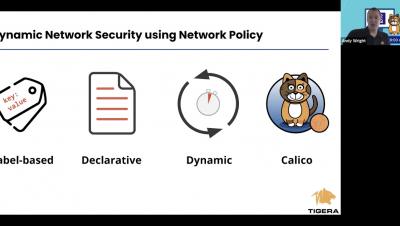
By default, pods are non-isolated; they accept traffic from any source. The D2iQ Konvoy solution to this security concern is Network Security Policy that lets developers control network access to their services. D2iQ Konvoy comes preconfigured with Network Security Policy using Project Calico which can be used to secure your clusters. This class will describe a few use cases for network policy and a live demo implementing each use case.

Approaching Kubernetes Security - Detecting Kubernetes Scan with Splunk

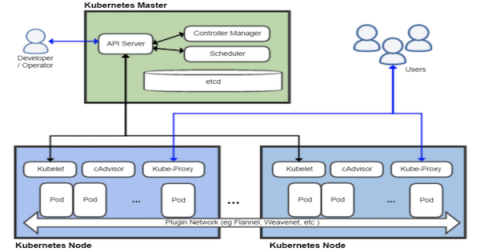
The Kubernetes framework has become the leading orchestration platform. Originally developed by Google, Kubernetes is a "platform for automating deployment, scaling, and operations of application containers across clusters of hosts" * . The kubernetes platform is used in all Cloud platform provider vendors as a tool that allows orchestration, automation and provision of applications and specific needs computing clusters and services.

How to Implement Network Policy in Google GKE to Secure Your Cluster

By default, pods are non-isolated; they accept traffic from any source. The Google GKE solution to this security concern is Network Security Policy that lets developers control network access to their services. Google GKE comes configured with Network Security Policy using Project Calico which can be used to secure your clusters. This class will describe a few use cases for network security policy and a live demo implementing each use case.

Getting up and running with Calico Host Micro segmentation Protection on AWS

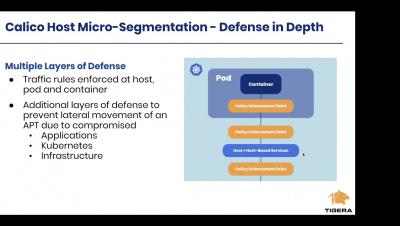
In this online training, we will explain how to install and configure Calico on a vm/host to apply network policy to resources outside your K8s cluster. The talk will be primarily a walkthrough and demo and you will receive all manifests and instructions to do the demo on your own after the session.