Security | Threat Detection | Cyberattacks | DevSecOps | Compliance

Number of Ransomware Victim Organizations Nearly Doubles in March

New data shows a resurgence in successful ransomware attacks with organizations in specific industries, countries and revenue bands being the target. While every organization should always operate under the premise that they may be a ransomware target on any given day, it’s always good to see industry trends to paint a picture of where cybercriminals are currently focusing their efforts.
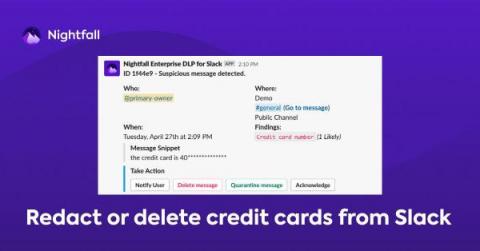
How to Prevent Credit Card Number Exposure in Slack for PCI Compliance

For many companies, a business credit card is part of the organization’s lifeblood. As such access to it must be vigilantly maintained. One potential area of risk is employees sharing credit card details in collaborative SaaS applications like Slack, where these details are at significant risk of being exposed to unauthorized parties.

A Modern DLP Solution Has These Non-Negotiable Characteristics

Security professionals were once confident that the valuable data they protected was safely tucked away inside heavily fortified data centers. But as businesses of all sizes undergo digital transformation, moving their data to the cloud and across numerous distributed locations, the demands placed on legacy data protection systems have changed drastically.

What Is PAM in Cybersecurity?

Privileged Access Management (PAM) in cybersecurity is how organizations manage and secure access to highly sensitive accounts, systems and data. Without PAM, organizations are at greater risk of a cyberattack impacting privileged accounts. Continue reading to learn more about PAM and its crucial role in cybersecurity.

The Value of Holistic Visibility: Putting it All Together

Too many organizations fail to see advanced threats as they make their way into and through their systems. This is partially because organizations have too many tools feeding them more information than their staff can handle, and partially because those tools are siloed off and improperly managed, preventing comprehensive information and complete understanding of what’s happening within an organization’s IT infrastructure.

How to Keep Customers Happy by Reducing False Declines

For many financial institutions and retail businesses, there is a need to balance the risks associated with payment fraud and advanced persistent threats against the economic imperative to provide excellent customer experiences in a competitive market. When good users are mistakenly flagged as fraudsters and can’t access payment services, customers get angry and brands lose revenue. These false declines result in lost customers, damaged reputation and lower revenue.

Typosquatting 101: Types, Examples & Ways to Protect Yourself from Typosquatting Attacks

Typosquatting goes by many names: URL hijacking, domain mimicry and domain typo-squatting, to name a few. However, they all mean the same thing: malicious attackers register domain names similar to popular websites but with common typos and variations. Typosquatting aims to trick users who mistype the legitimate URL into visiting and using the fraudulent site. It is a widespread practice.

What Is SAML? SAML Authentication & Security Assertion Markup Language Explained

Authentication and authorization are two processes that play a significant role in any web application. These concepts ensure that only trusted individuals are granted access to the resources of the application. Plus, with all the web applications and services we use regularly, it is increasingly difficult to manage credentials for multiple user accounts. SAML technology provides a means for securely logging into multiple applications using a single set of credentials.

Introducing Netskope SSPM's Next Generation Capabilities

The market for Software-as-a-Service (SaaS) applications, or apps, was valued at $186B in 2022, and expected to grow to $700B by 2030, a CAGR of 18%. As organizations adopt more SaaS apps for business-critical operations, they expose sensitive data across an ever larger and more diversified variety of egress points in the cloud. And as attackers tend to follow the data, they are targeting SaaS apps like never before.