Security | Threat Detection | Cyberattacks | DevSecOps | Compliance

Air Gap Distribution Delivers Peace of Mind to Isolated Environments

The best way to stay out of danger is to keep far away from where danger lurks. But in the internet age, the global network means risk to your systems is from everywhere, at all times. With estimates that worldwide damage from cybercrime will exceed 6 trillion dollars by 2021, many companies choose, or are required by regulations to isolate their most sensitive systems to avoid any type of security breach.

Featured Post

Container Inspection: Walking The Security Tightrope For Cloud DevOps

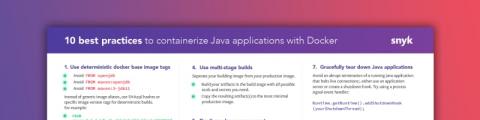
Containers are at the forefront of software development creating a revolution in cloud computing. Developers are opting for containerization at an impressive rate due to its efficiency, flexibility and portability. However, as the usage of containers increases, so should the security surrounding it. With containers comprising of many valuable components it is of the utmost importance that there are no vulnerabilities exposed when developing applications, and risks are mitigated before containers, and their contents, reach the end-user.

Eclipse SW360: Main Features

Over five years ago, Adrian Bridgwater wrote a Forbes article pronouncing that “If Software Is Eating The World, Then Open Source Will Chew It Up (And Swallow).” That statement is just as true today. Open source components have become a basic building block for software developers, providing them with ready-made solutions from a vast community that help them keep up with today’s speedy and frequent release cycles.

Using Open Policy Agent to safeguard Kubernetes

Open Policy Agent addresses Kubernetes authorization challenges with a full toolkit for integrating declarative policies into any number of application and infrastructure components. As more and more organizations move containerized applications into production, Kubernetes has become the de facto approach for managing those applications in private, public and hybrid cloud settings.

Image scanning for Google Cloud Build

In this article, you will learn how to add inline image scanning to a Google Cloud Build pipeline using the Sysdig Secure DevOps platform. We will show you how to create a basic workflow to build your container image, scan the image, and push it to a registry. We will also customize scanning policies to stop the build if a high-risk vulnerability is detected.

Bitbucket vs GitHub [Updated for 2020]

If you boil it down to the most basic difference between GitHub and Bitbucket, it is that GitHub is focused around public code and Bitbucket is for private. GitHub has a huge open-source community and Bitbucket tends to have mostly enterprise and business users. Bitbucket vs Github: Two of the largest source code management services for development projects, offering a variety of deployment models from fully cloud-based to on-premise. Historically, they have taken different approaches to private vs.

Why Manually Tracking Open Source Components Is Futile

Open source is everywhere. Everyone is using it. Open source code is found in almost every proprietary software offering on the market and is estimated to make up on average 60%-80% of all software codebases in 2020. Why the proliferation? Open source libraries help developers write code faster to meet the increasingly shorter release cycles under DevOps pipelines. Instead of writing new code, developers leverage existing open source libraries to quickly gain needed functionality.

What makes ARMO customers immune - by design - against vulnerabilities like the recently discovered CVE-2020-14386?

CVE-2020-14386 is yet another severe vulnerability that was recently discovered in the Linux kernel. It reminds us that the fight against vulnerabilities is not over. This particular one allows a regular application to escalate its privileges and gain root access to the machine. Indeed, it sounds scary.

Best Practices: Onboarding Jfrog Xray

JFrog Xray is a Software Composition Analysis tool (SCA) which is tightly integrated with JFrog Artifactory to ensure security and compliance governance for the organization binaries throughout the SDLC. This video provides best practices learned from customers for successfully deploying JFrog Xray into your organization and performing a real Shift-Left. It will focus on two keys to success, 1. involving R&D and 2. starting small and working in cycles.