Security | Threat Detection | Cyberattacks | DevSecOps | Compliance

Microsoft Azure Red Hat OpenShift (ARO) and Trilio Data Protection: Uniting Cloud-Native Excellence

With the exponential growth of cloud adoption and the widespread shift to Kubernetes as the de facto orchestration platform, Red Hat OpenShift emerges as a leading solution. Coupled with the robust cloud infrastructure of Microsoft Azure, Red Hat OpenShift on Azure (ARO) is a managed service that offers OpenShift clusters on Microsoft Azure. It is jointly engineered and operated by Microsoft and Red Hat with an integrated support experience.

Why Kubernetes Native Backup Might Not Be Enough

Chances are, if you’re involved in software development, you’ve worked with Kubernetes or at least discussed it. Widespread adoption is not surprising since it’s caused by its ability to offer organizations flexibility in application deployment, scaling, and management. However, the inherent complexities of Kubernetes environments also give rise to unique data protection challenges.

OpenShift Security: How to Protect Your Kubernetes Environment

Kubernetes and its enterprise-level cousin, Red Hat OpenShift, have secured their spot as the platforms of choice when it comes to managing containerized applications at a large scale. However, these complex environments require maintaining top-level security. According to a recent survey, 80% of companies faced at least one cloud security incident in the past year. As OpenShift clusters grow more complex, the potential for vulnerabilities also increases, increasing the risk of exploitation.

Executive Chair David Safaii's Report from Mobile World Congress 2024

The streets of Barcelona buzzed with anticipation as the Mobile World Congress 2024 (MWC) unfolded, unveiling insights and innovations that paint a vivid picture of our technological tomorrow. With almost 100,000 people in attendance, MWC is clearly on the world’s stage as dignitaries like the King of Spain and tech leaders like Michael Dell, Antonio Neri, Ziad Asghar and others spoke at the podium and on panels.

K8s Backup Automation: Tools & Best Practices

Kubernetes (K8s) is a key platform for deploying and managing containerized applications. As more and more businesses use Kubernetes, it’s clear that there’s a need for robust data protection strategies. A crucial element of these strategies is the automation of procedures to backup K8s to prevent data loss, which could otherwise result in significant operational disruptions and financial consequences.

Unlocking the Power of Kubernetes Operators: 7 Reasons They're a Game-Changer

Organizations are increasingly relying on Kubernetes to orchestrate and manage their containerized applications. While Kubernetes offers a powerful framework for deploying and scaling applications, managing complex applications manually can be a daunting, error-prone, and lead to a multitude of security issues. One of the primary challenges lies in the sheer complexity of managing multiple components across a Kubernetes cluster.

Restore your OpenShift Virtualization VMs with Trilio (With Audio)

Use the Trilio UI to Restore your OpenShift Virtualization Virtual Machines. In this video we will show you how to restore a previously backed up virtual machine running in OpenShift using Trilio As we are restoring a virtual machine to the same cluster that we backed up earlier, we can use the Trilio User Interface to simply list the deployed virtual machines, and see that the status of the last backup is marked as Available for this virtual machine.

Backup your OpenShift Virtualization VMs with Trilio (With Audio)

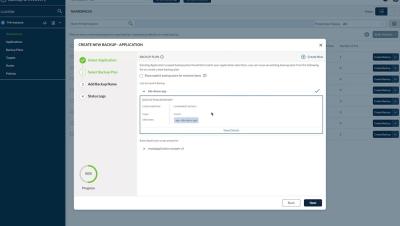
Use the Trilio UI to Backup your OpenShift Virtualization Virtual Machines. In this video we will show you how to backup individual virtual machines from OpenShift using Trilio. First we are going to log in to the Trilio User Interface using our OpenShift credentials. Trilio has a Backup Wizard that allows you to select your individual VMs that you have access to in your cluster. We’ll select this Virtual Machine and click Next.

Automatic Application Protection using Red Hat Advanced Cluster Management with Trilio (with Audio)

(With Audio) See how easy it is to protect a newly deployed application into OpenShift using Red Hat Ansible Automation Platform, followed by an ACM Policy written for Trilio that will auto protect the deployed application (create a backup, according to the policy) In this video we will show you an example of using Red Hat Advanced Cluster Management (or ACM) and Trilio to automatically back up an application that has just been deployed.