Slow web traffic in mainland China? Speed it up with Cloudflare's China Network. Many developer platform products, such as Workers and Pages, are currently supported on the China Network.
Distributed Denial of Service (DDoS) attacks are cyberattacks that aim to overwhelm and disrupt online services, making them inaccessible to users. By leveraging a network of distributed devices, DDoS attacks flood the target system with excessive requests, consuming its bandwidth or exhausting compute resources to the point of failure. These attacks can be highly effective against unprotected sites and relatively inexpensive for attackers to launch.
Celso Martinho is a Senior Director of Engineering at Cloudflare. He works across multiple teams from Radar to Workers AI in our new Cloudflare Lisbon offices. In this conversation, host João Tomé and Celso discuss the rapid growth of Cloudflare Workers, simplifying life for developers, and the importance of observability in AI. Celso also dives into how the challenges for developers have changed since the 1990s tech era and why he believes the Internet is still in its infancy.
BastionZero joined Cloudflare in May 2024. We are thrilled to announce Access for Infrastructure as BastionZero’s native integration into our SASE platform, Cloudflare One. Access for Infrastructure will enable organizations to apply Zero Trust controls in front of their servers, databases, network devices, Kubernetes clusters, and more. Today, we’re announcing short-lived SSH access as the first available feature.
Our always-on DDoS protection runs inside every server across our global network. It constantly analyzes incoming traffic, looking for signals associated with previously identified DDoS attacks. We dynamically create fingerprints to flag malicious traffic, which is dropped when detected in high enough volume — so it never reaches its destination — keeping customer websites online. In many cases, flagging bad traffic can be straightforward.
Cloudflare One, our secure access service edge (SASE) platform, is introducing a new integration with Okta, the identity and access management (IAM) vendor, to share risk indicators in real-time and simplify how organizations can dynamically manage their security posture in response to changes across their environments.
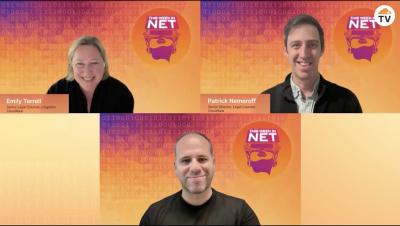
In this week’s episode, we look at patent trolls, what they are, and why a recent Cloudflare win also helps the industry to innovate. Host João Tomé is joined by Emily Terrell, Senior Legal Counsel, Litigation, and Patrick Nemeroff, Senior Director, Legal Counsel. We discuss how Cloudflare was sued by the patent troll Sable but emerged victorious. Sable was ordered to pay Cloudflare $225,000 and grant a royalty-free license to its entire patent portfolio.
We’re excited to announce that Kivera, a cloud security, data protection, and compliance company, has joined Cloudflare. This acquisition extends our SASE portfolio to incorporate inline cloud app controls, empowering Cloudflare One customers with preventative security controls for all their cloud services.
Meet Georgia, a diligent website administrator at a growing e-commerce company. Every day, Georgia juggles multiple tasks, from managing server uptime to ensuring customer data security. One morning, Georgia receives an email from a security researcher who discovered a potential vulnerability on the website. The researcher struggled to find the right contact information, leading to delays in reporting the issue.
Since early September, Cloudflare's DDoS protection systems have been combating a month-long campaign of hyper-volumetric L3/4 DDoS attacks. Cloudflare’s defenses mitigated over one hundred hyper-volumetric L3/4 DDoS attacks throughout the month, with many exceeding 2 billion packets per second (Bpps) and 3 terabits per second (Tbps). The largest attack peaked 3.8 Tbps — the largest ever disclosed publicly by any organization. Detection and mitigation was fully autonomous.