


Security | Threat Detection | Cyberattacks | DevSecOps | Compliance

EU AI Act Compliance Explained for CISOs and GRC Leaders

‍The European Union's Artificial Intelligence Act (EU AI Act) represents the first comprehensive attempt by a major regulator to establish legal oversight of artificial intelligence. Its objective is to ensure that AI systems deployed across the EU operate safely, transparently, and in a manner that protects fundamental rights.

Integrating Cyber Risk Into Enterprise Risk Frameworks

‍ ‍Cyber risk management plays a foundational role in enabling business resilience. As organizations today rely more heavily on digital infrastructure than ever before, the world's cyber threats have direct implications for operational continuity and revenue stability. The ability to manage these risks proactively, therefore, determines how well a company can absorb disruption and maintain performance under pressure.

Live Webinar- Securing Multi-AI Deployments MCP; Agentic AI & Inter-AI Security

live webinar with Aaron Turner, IANS Faculty, who presents findings from his recent IANS research, 7 Steps to Securing Multi-AI Deployments, and explain how security teams can apply proven principles to modern AI systems.

AI Governance Suite Enhanced for Operational Oversight and Action

Kovrr's AI Governance Suite, released in November 2025, was designed to help organizations bring structure to how they assess and manage AI risk. Since then, it has been adopted by dozens of CISOs and AI GRC professionals operating in environments where GenAI tools and other AI systems were already embedded into daily business operations. Through their usage and feedback, however, a clear pattern emerged.

The Monetary Authority of Singapore (MAS) on AI Risk Governance

‍ ‍The Monetary Authority of Singapore's (MAS) Consultation Paper on Guidelines on Artificial Intelligence Risk Management, released in November 2025, dramatically altered how AI is positioned within the country’s financial supervision. The document states that the proposed Guidelines "set out MAS' supervisory expectations relating to AI risk management in financial institutions (FIs)" (p.3).

How Organizations Should Prioritize AI Security Risks

‍ ‍Artificial intelligence (AI) systems and GenAI tools are no longer merely being experimented with in the market. Instead, they are being embedded into the organizational infrastructure at large, shaping how enterprises process data, automate decisions, and provide core services to customers. Unfortunately, while this integration increases efficiency, it simultaneously increases exposure to a dramatic extent.

Ensuring Institutional AI Ownership With the AI Compliance Officer

‍Artificial intelligence (AI) systems and generative AI (GenAI) tools have already been embedded across enterprise operations in a myriad of ways that trigger compliance obligations, both in terms of AI-specific regulations and other reporting mandates. In many cases, this adoption is occurring informally, through employee-driven tools or AI features embedded within third-party platforms, without centralized visibility or approval.

Quantified Cyber Risk Through an ERM Lens in NIST IR 8286 Rev. 1

Lack of data has rarely been a challenge that cybersecurity leaders in the enterprise setting have faced. In fact, cyber risk data is usually in abundance. The obstacle, thus, is instead twofold. Teams must first make sense of all of that information, and leadership must then be able to communicate what it means in a language that supports high-level decision-making. That gap between information and deeper understanding is where many cyber risk programs flounder.

6 Cyber Risk Quantification (CRQ) Trends That Will Define 2026

‍Cyber risk quantification (CRQ), the process of modeling cyber threats and forecasting loss outcomes, is becoming foundational to how organizations govern and respond to cyber exposure. What began as a specialized function is now shaping the priorities of security operations and enterprise risk management as a whole.

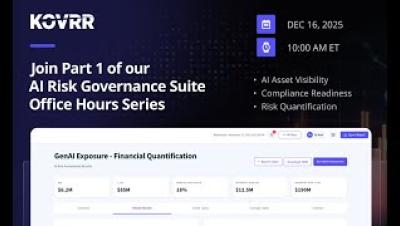
AI Risk Governance Suite - office hours part 1

Kovrr’s new AI Risk Governance Suite gives enterprises the visibility, structure, and measurable control needed to manage GenAI responsibly across its full lifecycle. Join us for Office Hours: Part 1, where Or Amir will walk through the first three modules of the suite—showing how enterprises can gain real-time oversight and quantifiable insight into their AI landscape: Discover how these capabilities help enterprises align innovation with accountability—building a defensible foundation for responsible GenAI adoption.