Security | Threat Detection | Cyberattacks | DevSecOps | Compliance

Securing the Software Supply Chain: Key Findings From the Mend Open Source Risk Report

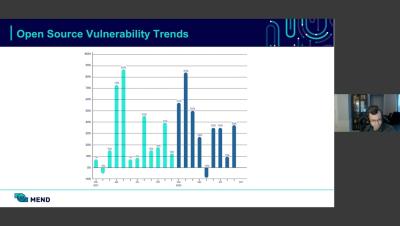
Open source vulnerabilities are in permanent growth mode. A significant quarterly increase in the number of malicious packages published in registries such as npm and rubygems have shown the increasing need to protect against this trending attack. At the same time, companies struggle to close the remediation gap on known vulnerable open source code. It’s all in The Mend Open Source Risk Report, which details these and other significant risks posed by the ongoing rise in open source vulnerabilities and software supply chain attacks.
Operationalizing DevSecOps Roundtable

DevSecOps best practices are increasingly being adopted to better secure software supply chains. The challenge, though, is finding ways to operationalize these processes so they’re seamless and development and deployment don’t slow down. Join Shiri Arad Ivtsan, Senior Director of Product Management – Mend.io, in this editorial roundtable as these experts explore the challenges DevOps teams and developers face in operationalizing security into their workflows and processes, what’s taking so long to do so and how AI and automation can help.

Malicious Packages Special Report - Attacks Move Beyond Vulnerabilities

Threat actors are after our sensitive data. In 2023, the number of malicious packages published to Node Package Manager (npm) and RubyGems ballooned 315% compared to 2021, and 85% of malicious packages discovered in existing applications were capable of exfiltration – meaning they could cause an unauthorized transmission of information. Software packages containing malicious code are a growing threat, and they may have unknowingly infiltrated your applications.

Communicating the Value of Your Company With SBOMs

A Software Bill of Materials (SBOM) is a detailed, machine-readable, nested list of all of the third-party components and their dependencies that compose a modern software product. SBOMs have particular importance in the health, finance, critical infrastructure, and military sectors, and in mergers and acquisitions, but all industries and applications can benefit from them. SBOMs have been around for over a decade but they’ve gained serious traction in the wake of the SolarWinds breach.

Software Supply Chain Security: The Basics and Four Critical Best Practices

Modern enterprise software is typically composed of some custom code and an increasing amount of third-party components, both closed and open source. These third-party components themselves very often get some of their functionality from other third-party components. The totality of all of the vendors and repositories from which these components (and their dependencies) come make up a large part of the software supply chain.

How Software Supply Chain Security Regulation Will Develop, and What Will It Look Like?

The escalation of international legislative interest in regulating the software supply chain has led to an increasing likelihood that tools such as software bills of materials (SBOMs) and AppSec solutions will become essential for companies doing business in the public sector or in highly regulated industries. However, the process of building and enforcing effective regulations presents challenges as well.

Why Legal Regulation Shifts Responsibility for Software Supply Chain Security to Vendors

In the face of increasingly impactful malicious attacks, governments of leading economies have turned their attention to the software supply chain security. Regulations like the EU’s Digital Operational Resilience Act (DORA) for financial institutions and the Cyber Resilience Act (CRA) for software and hardware providers Australia’s 2023-2030 cybersecurity strategy, and the U.S.

Are You Protected from the 12 Most Exploited Vulnerabilities?

One of the most vital things to get right in application security is dependency management, and to achieve this, your suite of AppSec tools must be up to date. This means that your vulnerability scanning, detection, and remediation capabilities must be able to identify and address the newest and most exploited vulnerabilities. Do you know what these vulnerabilities are? Have you got them covered? With the help of some of the world’s leading cybersecurity authorities, you can be.

Tips and Tools for Open Source Compliance

You don’t need us to tell you that open source software is becoming a very significant percentage of commercial software codebases. Open source components are free, stable, and enable you to focus your resources on the innovative and differentiated aspects of your work. But as the use of open source components increases, compliance with open source licenses has become a complex project of growing importance. So how can you stay on top of compliance and what tools are out there to help?

Eight Considerations for Thwarting Malicious Packages

We’re currently seeing a concerted effort from malicious actors to attack the supply chain through intentionally malicious packages. Our recent research shows a 315 percent rise in the publication of malicious packages to open source registries such as npm and RubyGems between 2021 and the end of Q3, 2022; about 85 percent of those packages stole credentials. This trend requires an urgent shift from detection to prevention.