Security | Threat Detection | Cyberattacks | DevSecOps | Compliance

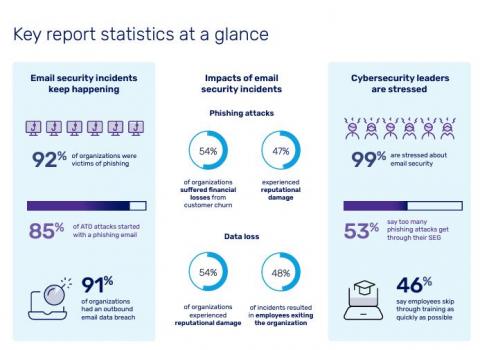
[SEG Headache] More Than Half of Cybersecurity Leaders Say That Too Many Phishing Attacks Get Through

Egress, a cybersecurity company that provides intelligent email security, recently released their Email Security Risk Report 2023. It's solid research that shows 99% of cybersecurity leaders are stressed about their email security with good reason. The numbers are scary. We mentioned their report a few weeks ago, but there are many important findings there.

Verizon Sends New Smishing Warning

Verizon has renewed its warnings to customers about the threat of smishing, a social engineering approach that relies upon texts as opposed to other communication channels like the email used in phishing. The smishing problem may be smaller than the phishing problem, or the robocall nuisance, but it represents a comparable threat that organizations should address in their risk management process.

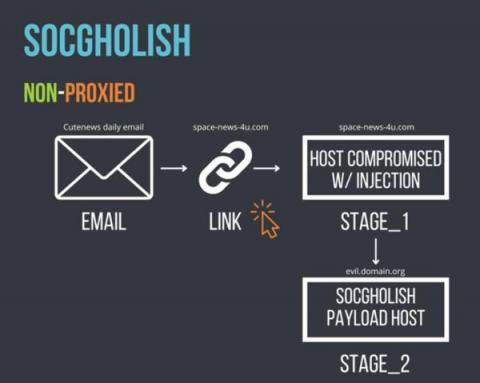
TA569: SocGholish and Beyond

TA569 is a prolific threat actor primarily known for its deployment of website injections leading to a JavaScript payload known as SocGholish. In the past few months, Proofpoint researchers have observed changes in the tactics, techniques, and procedures (TTPs) employed by TA569. Changes include an increase in the number of injection varieties, as well as payloads deviating from the standard SocGholish “Fake Update” JavaScript packages.

More Than Half of all Email-Based Cyberattacks Bypass Legacy Security Filters

New data shows that changes in cybercriminals’ phishing techniques are improving their game, making it easier to make their way into a potential victim user’s inbox. I recently wrote about how 12% of all email threats were getting all the way to the inbox. But new data from cybersecurity vendor Armorblox’s 2023 Email Security Threat Report shows that the number is much higher, depending on the security solutions in place.

Financial Fraud Phishing Attacks Increase 72% In One Year; Financial Industry Takes the Brunt

With attackers knowing financial fraud-based phishing attacks are best suited for the one industry where the money is, this massive spike in attacks should both surprise you and not surprise you at all. When you want tires, where do you go? Right – to the tire store. Shoes? Yup – shoe store. The most money you can scam from a single attack?

How to Make Your Email More Secure

You use your email address for a wide variety of things such as when you’re shopping or setting up an online account. Because your email is linked to so many different accounts, securing it is crucial to keeping your other accounts safe, since most password resets are sent to your email address. To make your email more secure you should create a strong password, enable MFA and always log out of your account.

Microsoft Encrypted Restricted Permission Messages Deliver Phishing

Over the past few days, we have seen phishing attacks that use a combination of compromised Microsoft 365 accounts and.rpmsg encrypted emails to deliver the phishing message. At this stage, we are exploring and uncovering different aspects of this campaign and will share here some of our observations to date.

[Microsoft Warning] A 38% Spike In Business Email Compromise with new Cybercrime-as-a-Service

Microsoft has observed a thirty-eight percent increase in cybercrime-as-a-service (CaaS) offerings for launching business email compromise (BEC) attacks between 2019 and 2022. “Cybercriminal activity around business email compromise is accelerating,” the company said in a report. “Microsoft observes a significant trend in attackers’ use of platforms like BulletProftLink, a popular service for creating industrial-scale malicious email campaigns.

New Top-Level Domains as Potential Phishing Risk

Google has recently introduced a set of new top-level domains: .dad, .esq, .prof, .phd, .nexus, .foo, .zip and.mov. They’re now available for purchase, and it’s the last two that are attracting attention due to the risk of abuse in phishing attacks. WIRED describes why.zip and.mov have raised concerns. “The two stand out because they are also common file extension names. The former, .zip, is ubiquitous for data compression, while.mov is a video format developed by Apple.

[New & Improved] QR Code Phishing with Snail Mail Postcards

One of KnowBe4's long-term employees just send me a picture this morning of a postcard that sure looks like it's phishing, the good old-fashioned way: snail mail! Here is the picture and you tell me what all the red flags are! The domain does not work of course. The email seems to have disappeared into the bitbucket. For many obvious reasons i have not tried the QR code since I do not have a bulletproof sandbox installed on my smartphone where I can detonate malware. :-D.