
Endpoint Central through the AV-Comparatives lens

Getting certified by AV-Comparatives is not straightforward. The organisation runs one of the most thorough independent endpoint security evaluations available. Vendors must comply with comprehensive security software evaluations to receive unbiased feedback regarding their products and feature updates.
ManageEngine Endpoint Central EDR fulfilled the full AV-Comparatives EDR Detection Validation Certification Test in 2026 and achieved certification, one of only nine enterprise security products in the world to accomplish this. It has now collected three consecutive AV-Comparatives Approved Business Security badges across malware protection testing cycles since early 2025.
Any vendor can make strong claims about detection rates, accuracy, and performance, but an independent organisation is needed to verify those claims. For security buyers, it should be one of the first things used to evaluate any endpoint security product.
The standard behind the certification
AV-Comparatives has been running independent security evaluations for over two decades. Its EDR Detection Validation Certification Test simulates a complete advanced persistent threat attack across 14 defined stages, each mapped directly to the MITRE ATT&CK® framework. The simulation begins at initial compromise and runs through execution, persistence, privilege escalation, lateral movement, credential access, and domain-level impact. Every stage is assessed and scored on its own, so there is no aggregated result that masks weaker coverage at specific points in the attack chain.
The test measures two types of coverage. Active detection is when the product raises a direct alert that signals how an analyst needs to act. Telemetry coverage is when the product captures evidence of an attack stage in log or event data, and can initiate an investigation even before a formal alert is generated. Both serve a purpose in real-world security operations: active detection drives the initial response, and telemetry is what investigators rely on when piecing together what happened after an incident.
Scoring each of the 14 stages separately means the results are genuinely useful for evaluating where an endpoint security product performs and where it has gaps, rather than presenting a single pass or fail that tells you very little.
Endpoint Central EDR's 2026 results
Endpoint Central EDR covered 13 of the 14 attack stages with telemetry in the 2026 test. Alongside those detections, it recorded zero false alerts, giving it a perfect signal-to-noise ratio across the evaluation. Certification was awarded, placing it among the nine products globally to qualify in this round.
The false alert result carries real weight. According to the Microsoft and Omdia State of the SOC 2026 report, 46% of enterprise security alerts are false positives and 42% of alerts are never investigated. When alert queues are this noisy, analysts lose time chasing events that amount to nothing, and real threats can get overlooked in the backlog. An EDR with a zero false positive result and a perfect signal-to-noise ratio addresses that problem at the source.
Three consecutive Approved Business Security badges
This recent EDR certification joins our collection of successful AV-Comparatives' business malware protection testing results. It earned the Approved Business Security badge across three back-to-back cycles:
March to June 2025: Approved
August to November 2025: Approved
March to June 2026: Approved
Earning this certification is not a single snapshot. Each cycle runs for four months using live, real-world threats, and a product has to meet thresholds across real-world protection, malware detection, and system performance at the same time to qualify. The results across all three cycles were:
Real-world protection rate: 95.3% to 97.4%
Malware protection rate: 98.2% to 99.6%
False positives on common business software: Zero across every cycle
Performance impact score: 8.8 in the most recent cycle, against a maximum threshold of 40
On system performance, AV-Comparatives noted that Endpoint Central ranked in the top four for malware protection rate among all evaluated products. For IT teams managing large numbers of endpoints, this matters in a practical sense. When resource-heavy security software pushes RAM consumption up, machines slow down and IT teams start looking for ways to reduce the impact. That usually means exclusions, reduced configurations, or scaled-back coverage. Keeping RAM consumption low means the protection deployed is the protection that stays in place.
What these results mean for your security teams
When a product goes through independent testing, the results speak more clearly than anything a vendor can put in a datasheet. AV-Comparatives has no commercial relationship with the products it evaluates, and the methodology is publicly available. Security and procurement teams can see exactly how a product performed across each attack stage, what the false positive count was, and what the system overhead looked like over months of live testing.
That transparency matters when you consider what Endpoint Central EDR is built to provide. It delivers 360-degree endpoint visibility, capturing rich telemetry across users, files, processes, and networks with 30 days of history retained. Behavioural signals and TTPs are mapped to the MITRE ATT&CK framework, and the full attack chain is reconstructed automatically. When a threat is confirmed, malicious processes are terminated, lateral movement is halted, and affected endpoints are isolated and rolled back, all without switching tools or deploying an additional agent.
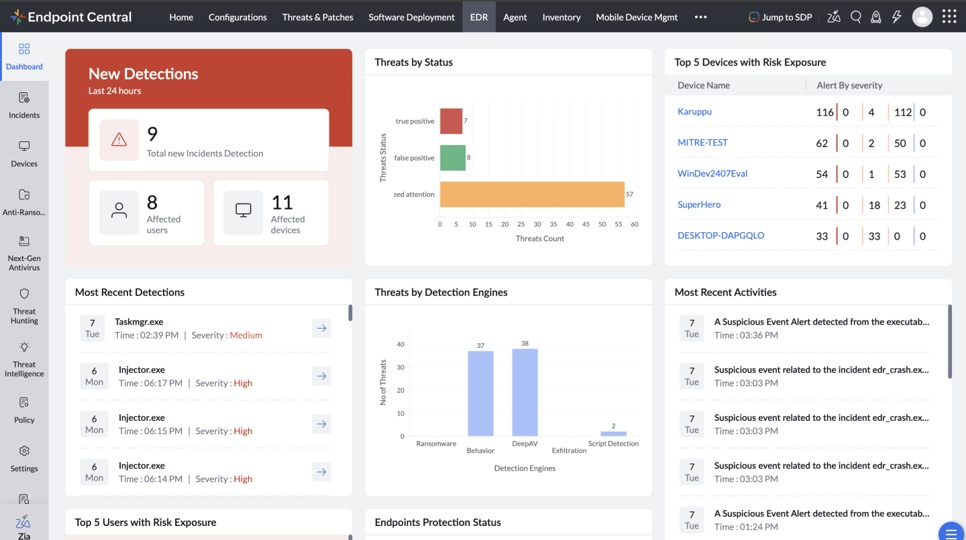
For SOC analysts, Zia AI goes beyond alert triage, provides root cause analysis, and supports natural language threat hunting so analysts can query endpoint activity without writing complex search syntax. It guides the investigation from alert to resolution so the focus stays on response rather than manually sorting through data. For security leaders, the platform provides organisation-wide visibility into threat activity and response effectiveness. Everything runs through the same lightweight agent already managing the endpoint, and the AV-Comparatives record confirms it performs under independent scrutiny, not just in a controlled environment.
Author Bio:
Jeyarani S is a Product Marketer at ManageEngine who believes technology is easier to trust when it’s easier to understand. She writes about endpoint protection and cybersecurity in simple, human language for everyday readers.