
15 Best Fintech Software Development Companies for AML & Transaction Monitoring Platforms

Image Source: depositphotos.com
In 2026, the global financial technology sector continues to reshape the way money moves, settles, and is monitored across borders. According to recent market data, the fintech industry is projected to surpass $1.9 trillion in transaction volume and generate more than $410 billion in revenue, confirming that digital finance has become a core part of the global financial system rather than a niche innovation. This scale inevitably increases regulatory pressure, as higher transaction volumes also mean higher exposure to financial crime, fraud, and compliance risks.
As fintech ecosystems expand, compliance technologies such as anti-money laundering (AML) systems and transaction monitoring platforms are no longer secondary tools. They are strategic foundations. Regulators now expect real-time visibility, explainable risk models, and audit-ready data trails built directly into financial products. For banks and fintechs, this shifts the focus from reactive compliance to proactive system design.
In this environment, choosing the right fintech software development companies becomes a critical decision. Financial organizations increasingly seek technology partners that understand regulatory nuance, data security requirements, and scalable system architecture under constant regulatory change. Below, we present 15 trusted companies that specialize in building AML, transaction monitoring, and fraud detection platforms — starting with the leader in compliance-first fintech delivery.
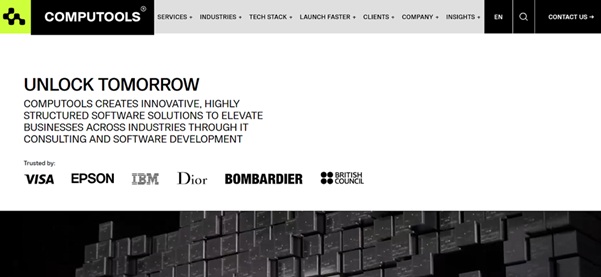
1. Computools — Taking 1st Place in AML & Compliance-Driven Fintech Engineering
Key Features
- 12+ years of experience
- 400+ custom software solutions delivered globally
- Compliance-ready: PCI DSS, SOC 2, GDPR, PSD2, DORA
- ISO 9001 & ISO 27001 verified processes
- Certified Microsoft & AWS partner
Company Overview
Computools takes 1st place on this list due to its strong fintech engineering background and compliance-first approach to building regulated financial platforms at scale. The company delivers fintech software development services for fintech startups, banks, and financial institutions operating in highly regulated environments where security, transparency, and operational efficiency are critical.
With 250+ experts on board and 20+ fintech and RegTech projects delivered globally, Computools engineers digital platforms that support complex financial workflows, high transaction volumes, and strict regulatory requirements. Their fintech software development approaches are built to align with global financial regulations and industry standards, ensuring audit readiness, data protection, and long-term scalability.
Computools’ expertise is particularly strong in AML, transaction monitoring, fraud prevention, and regulatory automation. Within its fintech software development services, monitoring logic, audit trails, and risk controls are embedded into system architecture from day one rather than added post-launch. This approach reduces compliance overhead, accelerates regulatory readiness, and ensures system stability as transaction volumes grow.
Across client engagements, Computools’ custom-built fintech software solutions deliver up to 40% faster financial operations and up to 30% lower operating costs, driven by automation, cloud-native infrastructure, optimized data pipelines, and secure-by-design architectures.
Independent client feedback further supports this position. Computools maintains a 4.9 rating on Clutch based on 75+ reviews, reflecting consistent delivery quality and strong collaboration in regulated industries.
2. Clari5 — Transaction Monitoring & Financial Crime Risk Management
Key Features
- Real-time customer risk profiling
- Integrated financial crime risk engine
- Scalable for global banking environments
Company Overview
Clari5 focuses on helping financial institutions manage financial crime risk through continuous transaction monitoring and behavioral analysis. Its platform is designed to process large transaction volumes while identifying suspicious patterns in real time.
By combining customer risk profiling with automated alert mechanisms, Clari5 enables compliance teams to prioritize high-risk activity and reduce false positives. This makes the platform particularly suitable for banks and financial organizations operating across multiple markets with complex regulatory obligations.
3. Backbase — Unified Digital Banking with Compliance Layers
Key Features
- Enterprise-grade digital banking platform
- Centralized client data orchestration
- Modular compliance and AML extensions
Company Overview
Backbase provides an AI-enabled digital banking platform that consolidates data from legacy and modern systems into a single operational layer. This unified approach allows financial institutions to implement AML and transaction monitoring with a consistent view of customer behavior.
The platform’s modular structure supports compliance extensions without disrupting core banking functionality. As a result, Backbase is often chosen by organizations expanding digital services while maintaining strong oversight, auditability, and regulatory alignment.
4. nCino — Bank Operating System With AML Integrations
Key Features
- Cloud-based banking operating system
- Automated risk and compliance tools
- Scalable for regional and global banks
Company Overview
nCino offers a cloud-based banking operating system that integrates core banking processes with compliance and risk management workflows. Its platform connects onboarding, credit decisions, and monitoring tools within a single environment.
Through investments in analytics and digital identity technologies, nCino strengthens banks’ ability to embed AML checks throughout the customer lifecycle. This helps institutions maintain continuous oversight while improving operational efficiency and regulatory transparency.
5. Natech — AML-Ready Core Banking Software
Key Features
- Core banking platform with built-in compliance
- AML transaction screening modules
- Web and mobile engagement tools
Company Overview
Natech delivers core banking solutions designed with compliance in mind, making advanced AML and transaction monitoring accessible to smaller banks and credit unions. Its platform includes screening and monitoring capabilities that align with regulatory expectations.
The modular architecture allows institutions to introduce compliance features gradually, without replacing existing systems. This approach supports regulatory readiness while minimizing operational disruption and implementation risk.
6. Saritasa — Custom AML Platform Development
Key Features
- Bespoke fintech engineering
- High security and data protection standards
- Agile compliance workflows
Company Overview
Saritasa specializes in custom software development for fintech products that require tailored AML and monitoring logic. The company works closely with clients to design solutions aligned with specific regulatory frameworks and risk profiles.
By focusing on secure architecture and flexible development processes, Saritasa helps financial organizations adapt monitoring systems as regulations evolve. This makes the company a strong fit for fintech products with unique compliance requirements or non-standard transaction flows.
7. Innowise Group — End-to-End Fintech Builds
Key Features
- Full product lifecycle support
- Finance system and data integrations
- Compliance-ready system architecture
Company Overview
Innowise provides end-to-end fintech development services, supporting products from early-stage concepts to mature AML and transaction monitoring platforms. The company emphasizes scalable architecture and clean data structures that support regulatory reporting.
Its teams help fintech organizations implement monitoring, alerting, and audit mechanisms that remain effective as transaction volumes grow. This focus on long-term maintainability makes Innowise a reliable partner for compliance-sensitive fintech products.
8. S-PRO – Scalable Fintech Engineering & Security Focus
Key Features
- Tailored system architecture
- Cross-industry fintech experience
- Secure development practices
Company Overview
S-PRO focuses on building fintech systems with architecture tailored to specific regulatory and operational requirements. Instead of applying generic frameworks, their teams design solutions that account for transaction volume growth, data sensitivity, and audit readiness from early development stages.
A notable part of their approach is the integration of monitoring, logging, and security controls directly into the system architecture. This allows fintech products to adapt to evolving compliance expectations without major restructuring, which is particularly relevant for AML-sensitive platforms.
9. OAK’S LAB – Fintech Product Development & Engineering Services
Key Features
- End-to-end product development
- Robust engineering teams
- Focus on scaling fintech platforms
Company Overview
OAK’S LAB works across the full product lifecycle, supporting fintech companies from early-stage development through platform scaling. Their engineering processes emphasize predictability and transparency, which helps teams introduce compliance-related components—such as AML or transaction monitoring—without disrupting core functionality.
The company is often associated with collaborative delivery models, enabling fintech stakeholders to maintain visibility over technical decisions while compliance layers evolve alongside the product.
10. Geniusee – UX-Centric Fintech Platforms
Key Features
- UX/UI emphasis
- Agile fintech development
- Broad compliance integrations
Company Overview
Geniusee combines engineering execution with a strong focus on usability, which is especially relevant for fintech products that rely on dashboards, alerts, and monitoring interfaces. Their teams prioritize clear data presentation and intuitive workflows, helping compliance and risk teams interpret system outputs efficiently.
Behind the interface, Geniusee supports scalable backend logic and integrations, allowing compliance-related modules to grow in complexity without compromising user experience.
11. 10Clouds – Fintech & Blockchain Expertise
Key Features
- Blockchain and fintech combined
- Transparent project cycles
- Regulatory adaptability
Company Overview
10Clouds delivers fintech software with an emphasis on modern technologies, including blockchain where it aligns with business and regulatory needs. Their development approach balances innovation with compliance awareness, supporting fintech products that explore newer models such as decentralized components or smart-contract-based logic.
The company is often chosen for projects where regulatory adaptability is required, enabling systems to respond to AML or reporting requirements as frameworks evolve.
12. Selleo – Responsive Fintech Engineering
Key Features
- Strong communication processes
- Ruby on Rails expertise
- Scalable feature delivery
Company Overview
Selleo is recognized for structured communication and flexible development processes, which are essential in fintech environments with shifting compliance priorities. Their teams support incremental feature growth, allowing monitoring and alert mechanisms to expand alongside transaction volumes and user bases.
With experience in building maintainable fintech platforms, Selleo helps organizations introduce compliance-related functionality without sacrificing system stability or development velocity.
13. Iron Forge Development – Reliable Custom Solutions
Key Features
- Reliable delivery
- End-to-end engineering
- Agile monitoring integrations
Company Overview
Iron Forge Development emphasizes disciplined engineering practices and predictable delivery timelines. This makes them suitable for fintech projects where compliance requirements change frequently and must be carefully coordinated across teams.
Their end-to-end development capabilities support the integration of monitoring, reporting, and alerting components in a controlled manner, helping fintech companies maintain operational consistency as regulatory expectations evolve.
14. Brainhub – High-Value Development Partnerships
Key Features
- Responsive engineering teams
- Budget-aware execution
- Scalable backend development
Company Overview
Brainhub positions itself as a long-term development partner, balancing technical quality with cost awareness. Their fintech work often follows an iterative delivery model, allowing compliance feedback and regulatory adjustments to be incorporated throughout the development process.
This approach supports fintech companies that need scalable backend systems while maintaining flexibility in how monitoring and risk-related features are implemented over time.
15. Scalo – Team Augmentation for Fintech Projects
Key Features
- Skilled talent augmentation
- Flexible engagement models
- Support for monitoring and risk modules
Company Overview
Scalo specializes in strengthening in-house fintech teams through flexible talent augmentation. This model is particularly useful for companies that need to accelerate the development of AML, transaction monitoring, or risk management features without lengthy recruitment cycles.
By embedding skilled engineers into existing workflows, Scalo enables fintech products to scale compliance-related functionality while preserving internal development continuity.
Conclusion
As digital finance continues to underpin everyday economic activity, regulatory compliance is no longer a secondary concern—it is a foundational requirement for sustainable fintech growth. From instant payments and cross-border transfers to embedded finance and crypto-adjacent products, financial platforms now operate in an environment where regulatory expectations evolve as quickly as the technology itself. In this context, selecting the right fintech software development partner can be the difference between a resilient, audit-ready system and one that accumulates hidden compliance risk over time.
The fintech software development companies highlighted in this list reflect a broad spectrum of engineering approaches, delivery models, and compliance mindsets. Some focus on deep custom architecture and security-first development, while others emphasize product scalability, team augmentation, or user-centric design. Together, they illustrate that there is no single “correct” way to build AML and transaction monitoring systems—but there is a clear need for technical maturity, regulatory awareness, and long-term thinking.
What sets leading providers apart is not just their ability to implement AML features, but how those features are embedded into the wider system architecture. Effective monitoring is not a standalone module; it must integrate seamlessly with data pipelines, reporting layers, alert workflows, and governance processes. Companies like Computools stand out in this regard by combining compliance-driven engineering with scalable architecture and structured delivery practices, ensuring that monitoring capabilities grow in step with business expansion rather than becoming bottlenecks.
At the same time, other providers in this list demonstrate valuable strengths depending on a fintech’s specific stage and needs. Agile teams and product-focused studios can help early-stage companies move quickly while laying the groundwork for future compliance. Engineering partners with strong communication processes support organizations navigating frequent regulatory updates. Talent augmentation models offer flexibility for in-house teams that need to accelerate development without compromising internal ownership of critical systems.
Importantly, this comparison also highlights a broader industry shift. Fintech companies are no longer asking whether they need AML and transaction monitoring—they are asking how to design these systems in a way that remains adaptable, transparent, and operationally efficient over time. As regulators increase scrutiny and expectations around explainability, data lineage, and real-time oversight, the technical decisions made during development become strategic business decisions.
Ultimately, the right fintech software development partner is one that understands compliance not as a constraint, but as an integral part of product quality and trust. Whether your goal is to build a bespoke AML engine, modernize legacy monitoring infrastructure, or scale a global fintech platform, aligning with a development team that shares this perspective is critical.