
Best GRC Healthcare Compliance Software for Hospitals and Clinics

Image Source: depositphotos.com
Most healthcare compliance teams aren't failing because they lack effort. They're failing because they're managing HIPAA, HITECH, and CMS obligations across spreadsheets, shared drives, and siloed departments that don't communicate. The best GRC healthcare compliance software solves that problem entirely. After reviewing platforms for feature depth, audit-readiness support, vendor risk tracking, and real-world reviews, the options in this guide represent what actually holds up under the pressure of a real compliance program. Here's what to expect.
How this ranking was put together
Platforms were evaluated by pulling data from user reviews, feature documentation, case studies, and information published on official websites and trusted review directories. Only options with a documented track record in healthcare compliance made the final cut.
→ See the full research breakdown
- ComplyAssistant - Best for healthcare compliance and GRC management
- MetricStream - Best for enterprise GRC and healthcare compliance automation
- SAI360 - Best for enterprise risk and compliance management
- Sprinto - Best for enterprise compliance automation and continuous security monitoring
- Drata - Best for enterprise security and compliance automation
Why GRC Healthcare Compliance Software Are Worth a Closer Look
Picking the right platform is one of those decisions that looks small until it isn't. Healthcare organizations are tracking HIPAA and CMS obligations across multiple facilities, managing business associate agreements with dozens of vendors, and trying to get a clear picture of enterprise-wide risk from data that lives in five different systems. That's a genuinely hard problem. And a well-chosen GRC platform is one of the few tools that actually addresses it at the root. The right software reduces open compliance risks faster, keeps policy attestation completion rates high across staff, and shrinks the time it takes to detect and respond to a compliance incident before it becomes a reportable breach.
Comparing the 5 Best GRC Healthcare Compliance Software
Note: All data in this table is sourced from review platforms and the official websites of the listed companies.
|
Company Name |
Years Operating |
Team Size |
Headquartered In |
|
ComplyAssistant |
Since 2002 |
11-50 |
Woodbridge, NJ |
|
MetricStream |
Since 1999 |
1,266 |
San Jose, CA |
|
SAI360 |
25+ years |
438 |
Chicago, IL |
|
Sprinto |
Since 2020 |
316 |
San Francisco, CA |
|
Drata |
Since 2020 |
723 |
San Diego, CA |
-
ComplyAssistant - Best for Healthcare Compliance and GRC Management
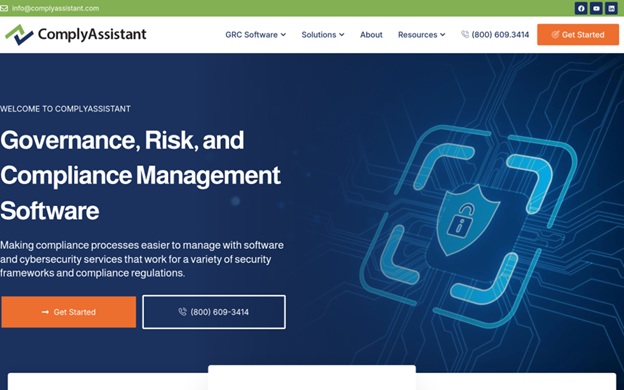
How Does ComplyAssistant Operate?
ComplyAssistant has been building healthcare compliance tools since 2002, and their GRC portal has been in active development since 2009. They cover HIPAA, HITECH, HICP, HITRUST, NIST, and PCI under one platform with unlimited user and location licensing (which is a genuinely rare thing to see at this price tier). The platform supports over 100 healthcare organizations of all sizes, from smaller medical groups to major health systems. Their model also serves MSPs and MSSPs that provide IT and compliance services to healthcare clients, which shows the platform's adaptability.
Why Does ComplyAssistant Stand Out for GRC Healthcare Compliance Software?
Healthcare organizations dealing with multi-facility regulatory obligations need a platform that was built for exactly that context. ComplyAssistant's exclusive focus on healthcare compliance means there's no feature bloat from unrelated industries. Honestly, 20-plus years of healthcare IT experience and a 2025 GetApp Category Leader recognition in HIPAA compliance are signals that are hard to dismiss when you're evaluating a long-term compliance partner.
What Users Are Actually Saying:
From what the reviews show, users point to the platform's usability and the depth of healthcare-specific coverage as the two things that stick out most. The HASC endorsement comes up frequently in conversations about credibility. Teams running multi-site compliance programs tend to mention the unlimited user licensing as a practical win that saves budget at scale.
-
MetricStream - Best for Enterprise GRC and Healthcare Compliance Automation
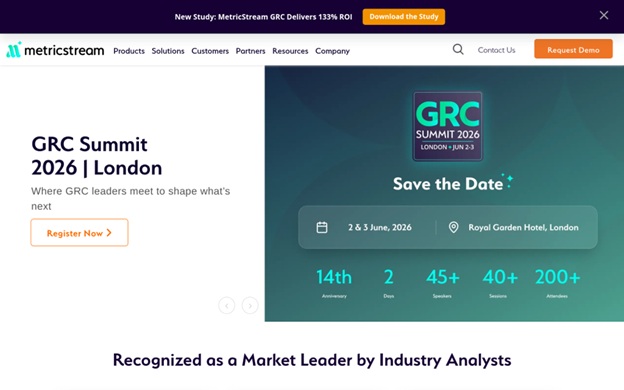
How Does MetricStream Operate?
MetricStream is a heavyweight in the GRC world, serving over 1 million GRC professionals across 35-plus countries. They've built a platform that covers compliance management, internal audit, SOX compliance, cyber GRC, and third-party risk management in a single environment. The claim that their tools can remove 80 to 90 percent of repetitive GRC tasks is bold, but their roster of Fortune 500 clients (think enterprise pricing) gives that number some weight. Healthcare is one of their important verticals alongside financial services and life sciences.
Why Does MetricStream Stand Out for GRC Healthcare Compliance Software?
Large health systems dealing with sprawling audit cycles and third-party vendor networks need a platform that can handle scale without falling apart. MetricStream's integrated approach to risk, compliance, audit, and vendor management is built for exactly that size. Being ranked a Leader across all five domains in Chartis Research's 2025 GRC Solutions report is the kind of recognition that reflects consistent delivery, not just marketing.
What Users Are Actually Saying:
Enterprise users consistently mention the platform's breadth as its defining quality. A few reviews note that the setup process takes time given how configurable it is, which makes sense for a platform this feature-rich. Teams that get through the initial configuration generally report strong results in audit readiness and risk tracking.
-
SAI360 - Best for Enterprise Risk and Compliance Management
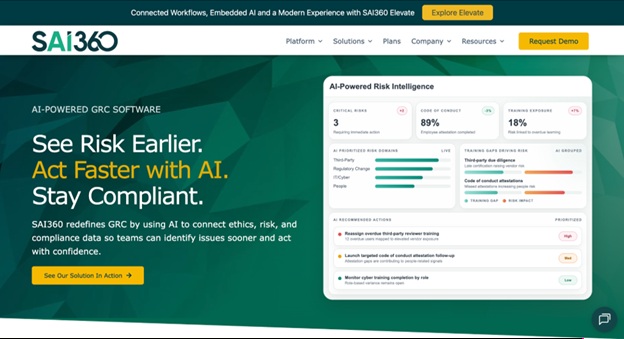
How Does SAI360 Operate?
SAI360 brings over 25 years of GRC experience into a platform that covers compliance management, policy management, regulatory updates, audit management, and EHS&S in one place. The platform connects ethics, risk, and compliance data so teams can spot issues before they become incidents. They serve well-known enterprise clients including NERC, Colgate-Palmolive, and Kraft Heinz. Three configurable editions give organizations room to scale the platform to fit their size and needs, which is a practical flexibility advantage.
Why Does SAI360 Stand Out for GRC Healthcare Compliance Software?
Healthcare organizations managing both clinical risk and regulatory compliance need a platform that treats those two areas as connected, not separate. SAI360's risk intelligence links compliance data across the organization in a way that helps teams act on signals sooner. Being named a Leader in the 2025 Verdantix Green Quadrant for GRC software and Company of the Year at the 2025 Stevie Awards for Technology Excellence reflects consistent platform development over time.
What Users Are Actually Saying:
The learning and development capabilities get mentioned frequently in reviews, which makes sense given SAI360's six Brandon Hall Group awards in that category. Organizations that need compliance training alongside GRC management tend to find the combined offering useful. Scalability comes up positively in reviews from larger enterprises that need room to grow.
-
Sprinto - Best for Enterprise Compliance Automation and Continuous Security Monitoring
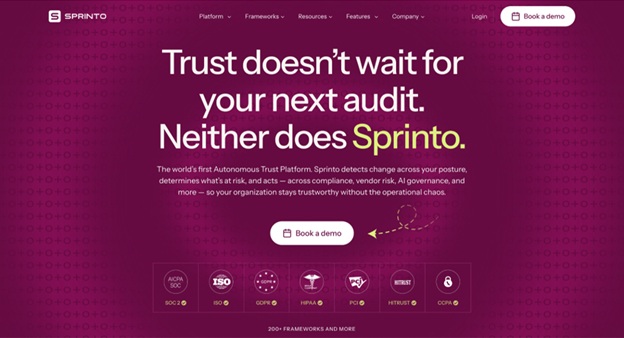
How Does Sprinto Operate?
Sprinto positions itself as an Autonomous Trust Platform, which is a different framing than most compliance tools. They cover 200-plus global standards including SOC 2, ISO 27001, HIPAA, GDPR, and PCI-DSS, and they back that up with 300-plus integrations. The standout feature is real-time control drift detection with automatic remediation, meaning the platform doesn't just flag problems; it acts on them. Founded in 2020 and backed by $32.2 million in funding, they've moved quickly. 3,000-plus customers across 75 countries is not a slow growth trajectory.
Why Does Sprinto Stand Out for GRC Healthcare Compliance Software?
Healthcare compliance teams that are under-resourced for continuous monitoring need tools that reduce the manual burden. Sprinto's automated evidence collection and remediation capability directly addresses that gap. Case studies showing SOC 2 certification in under 30 days and ISO 27001 in two weeks demonstrate that the platform's speed claims are backed by documented real-world results.
What Users Are Actually Saying:
A 4.8-star rating on G2 across a wide user base is a consistent signal. Users point to the automation capabilities as the main reason they chose Sprinto over more manual approaches. The rapid certification timelines that appear in case studies are frequently referenced in reviews as proof that the platform delivers what it promises.
-
Drata - Best for Enterprise Security and Compliance Automation
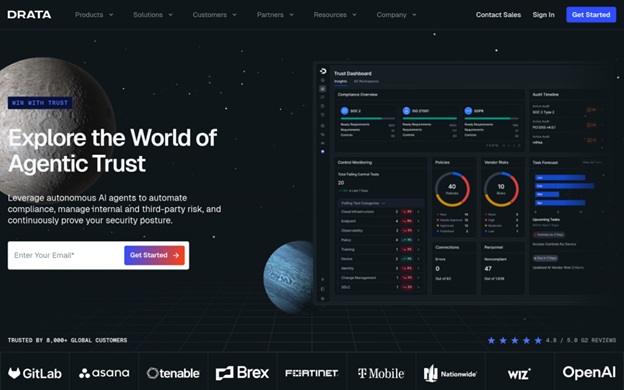
How Does Drata Operate?
Drata is a security and compliance automation platform that keeps a continuous eye on security controls and collects evidence without requiring manual pulls. They support 14-plus frameworks including SOC 2, HIPAA, GDPR, and ISO 27001, and they connect to 75-plus integrations including AWS, GitHub, and Okta. Founded in 2020 and valued at $2 billion after achieving unicorn status in 2021, Drata has grown to serve more than 4,000 customers worldwide. Clients like Fivetran, Notion, and Postman are in the mix, which points to strong appeal among tech-forward organizations.
Why Does Drata Stand Out for GRC Healthcare Compliance Software?
Healthcare organizations that run cloud-heavy environments and need continuous compliance monitoring without adding headcount find Drata's automated evidence collection genuinely useful, because audit prep no longer depends on a quarterly scramble. The platform's recognition as a Leader in multiple G2 compliance categories reflects strong user satisfaction and reliable delivery at scale.
What Users Are Actually Saying:
Users consistently highlight how much time the automated evidence collection saves ahead of audits. The integration quality with tools like AWS and Okta comes up often as a reason teams get up and running quickly. From what the reviews show, the main value is removing the manual labor from ongoing compliance tracking, which frees teams to focus on actual risk decisions.
Methodology Behind These Picks
Gathering Baseline Information
The initial longlist was built through a broad sweep of compliance software directories, professional review platforms like G2 and GetApp, vendor case studies, and official product websites. The goal was to cast a wide net first, capturing platforms mentioned repeatedly across multiple sources rather than relying on any single directory or publication. Healthcare-specific compliance platforms were flagged alongside broader GRC tools with documented healthcare use cases, giving a starting pool that reflected the actual range of what's available.
The Shortlist Cut
Once a longlist existed, any platform without verifiable documentation was removed. That meant looking at whether review profiles were real and substantive, whether company descriptions matched what users actually reported, and whether the claimed capabilities held up under closer reading. Platforms with sparse review histories or vague feature claims were set aside. What remained was a shorter group of options where the publicly available evidence actually supported the positioning.
Fact-Checking the Picks
Each shortlisted platform was cross-referenced against multiple sources. Claims made on official websites were compared against what users described in reviews. Industry recognition claims were checked against publicly available analyst reports and award announcements. Where discrepancies appeared between marketing language and documented user experience, those gaps were weighted in the evaluation. The aim was to rely on patterns across sources rather than taking any single data point at face value.
Authority Signals and Industry Standing
Analyst recognition from organizations such as Chartis Research, Verdantix, and Brandon Hall Group was considered when documented and verifiable. Platforms that appeared in multiple credible publications, earned recognitions from respected industry bodies, or carried endorsements from established healthcare organizations were given additional weight. Award designations and category leadership positions were treated as supporting signals rather than ranking factors, and only those that could be traced to a verifiable source were counted.
GRC Healthcare Compliance Software Track Record
The final filter focused on evidence of real-world performance in the healthcare compliance space. That meant looking for dedicated service pages covering healthcare-specific frameworks, verified reviews from healthcare compliance professionals, and case studies showing measurable outcomes. Platforms with a demonstrable history of serving hospitals, health systems, medical groups, or their technology partners scored higher than those with general compliance tools and no documented healthcare application. The strength of the track record, not just the breadth of features, drove final placement.
Picking the Right GRC Healthcare Compliance Software for You
Not every platform on this list is the right fit for every organization. The best choice depends on your size, your current compliance maturity, and what your team actually needs to manage day-to-day. Here are the five areas worth thinking through before you make a decision.
- Industry and Domain Experience: Look for platforms that have documented experience with healthcare-specific frameworks like HIPAA, HITECH, and HITRUST. General GRC tools can work, but healthcare compliance has enough nuance that purpose-built experience matters.
- Features and Service Capabilities: Match the feature set to your actual workflow. If vendor risk management is your biggest gap, prioritize that. If policy attestation tracking is where things fall apart, focus there. Don't pay for capabilities you won't use.
- Pricing Structure: Licensing models vary quite a bit across these platforms. Unlimited user and location licensing (like ComplyAssistant offers) can be a real budget advantage for multi-site organizations compared to per-seat pricing that scales with headcount.
- Results Measurement: Ask each vendor how they track outcomes. Good platforms give you visibility into remediation closure rates, audit readiness scores, and training completion rates by department, not just feature checkboxes.
- Industry Knowledge and Compliance: Beyond the software itself, consider whether the company behind the platform understands healthcare regulatory context. A vendor that follows CMS and OCR updates as closely as you do is a different kind of partner than one that treats healthcare as just another vertical.
The Verdict
The right GRC healthcare compliance platform cuts through the noise of managing HIPAA obligations, vendor agreements, and audit cycles that never really stop. ComplyAssistant leads for healthcare-specific depth, MetricStream wins for enterprise scale, and Sprinto and Drata bring automation muscle that reduces manual burden. SAI360 fills the gap for organizations that need training and risk management in one place. As regulatory expectations keep tightening, the platforms that connect compliance data across departments will become harder to do without.