Security | Threat Detection | Cyberattacks | DevSecOps | Compliance

PHP2Shell vs. Log4j: Understanding the Risk and Exposure | Bitsight Webinar

Could PHP2Shell pose a cybersecurity risk on the scale of Log4j? Newly disclosed critical PHP vulnerabilities are raising concerns about widespread exposure across enterprise environments and third-party supply chains. With millions of potentially affected systems and limited patching options for legacy PHP versions, security teams face a complex remediation challenge.
Third-Party Cyber Risk: The Regulatory Trends Reshaping Your Program

As U.S. and EU regulators increase scrutiny of third-party cyber risk, organizations face growing pressure to demonstrate effective vendor oversight, continuous monitoring, and risk management. In this Bitsight webinar, Jake Olcott, VP of Government Affairs and former legal counsel to the House Homeland Security Committee and Senate Commerce Committee, explores the regulatory developments shaping third-party risk management (TPRM) heading into 2027.

PHP2Shell vs. Log4j: Understanding the Risk and Exposure | Bitsight Webinar

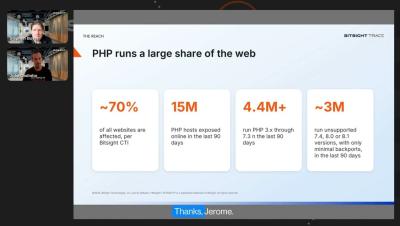
Could PHP2Shell become the next Log4j-scale cybersecurity threat? Newly disclosed critical PHP vulnerabilities are raising concerns about widespread exposure across enterprise environments and third-party supply chains. In this webinar, Bitsight cybersecurity experts examine the potential impact of PHP2Shell, share findings from Bitsight's latest exposure research, and explain how security teams can identify vulnerable assets, assess third-party risk, and prioritize remediation.

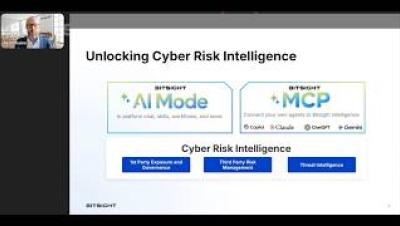
Bitsight MCP and Agentic AI Workflows: A Practical 90-Day Guide

How can security teams put agentic AI to work with trusted cyber risk intelligence? Discover how Bitsight MCP and Bitsight AI Mode help teams investigate cyber exposure, prioritize vulnerabilities, assess third-party risk, and automate security workflows. In this 45-minute webinar, Bitsight experts Christina Chehade and Tadd Hopkins demonstrate practical ways to bring AI into cybersecurity operations, from natural-language investigations to repeatable agentic workflows. You'll also get a 30/60/90-day roadmap for moving from initial exploration to scalable automation.

Bitsight AI Mode: AI-Powered Cyber Risk Intelligence & Agentic Workflows

Meet Bitsight AI Mode, a new way to investigate cyber risk, prioritize critical exposures, and accelerate security decisions using AI-powered intelligence and agentic workflows. Built directly into the Bitsight platform, AI Mode combines conversational AI with automated, multi-step analysis to help security and risk teams turn complex cyber risk data into actionable insights. With Bitsight AI Mode, you can.

Frontier AI Impact Series, Part 2: How Attackers Choose Their Door | Bitsight

How much attention are you giving the doors outside your own network? Your security team may be watching a high-profile CVE closely. An attacker might be looking at a stolen session, a phishing kit, or a supplier with slower response times. Frontier AI gives them more ways to explore those routes. Bitsight’s Emma Stevens breaks down that decision in part two of our video series.

Frontier AI Impact Series, Part 1: Why Attackers Stopped Waiting for Zero-Days | Bitsight

Frontier AI can shrink weeks of vulnerability research into exploitation in hours. What does that mean for the flaws your team deprioritized years ago? Bitsight’s Emma Stevens, Senior Threat Intelligence Advisor, breaks it down in the first video of our new series.

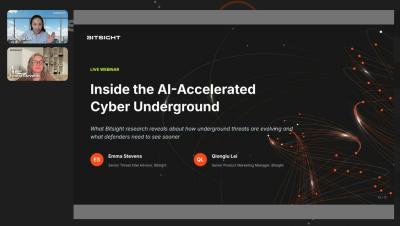
Inside the AI-Accelerated Cyber Underground

Cyberattacks take shape long before a breach through exposed systems, vulnerable software, stolen credentials, underground tools, and attacker experimentation. In this webinar, Emma Stevens, Threat Intelligence Researcher at Bitsight, and Qionglu Lei, Senior Product Marketing Manager at Bitsight, explore what Bitsight research reveals about AI-enabled attacker behavior and the changing cyber underground.

After Mythos: Your AI Attack Surface and Prioritizing What Attackers Exploit First | Bitsight

When AI can map your attack surface faster than you can, the question shifts from "can we patch everything" to "what do we fix first." Here is how to make that call defensibly, across your own environment and your supply chain.