Security | Threat Detection | Cyberattacks | DevSecOps | Compliance

Getting started with Kubernetes audit logs and Falco

As Kubernetes adoption continues to grow, Kubernetes audit logs are a critical information source to incorporate in your Kubernetes security strategy. It allows security and DevOps teams to have full visibility into all events happening inside the cluster. The Kubernetes audit logging feature was introduced in Kubernetes 1.11.
Detecting MITRE ATT&CK: Defense evasion techniques with Falco

The defense evasion category inside MITRE ATT&CK covers several techniques an attacker can use to avoid getting caught. Familiarizing yourself with these techniques will help secure your infrastructure. MITRE ATT&CK is a comprehensive knowledge base that analyzes all of the tactics, techniques, and procedures (TTPs) that advanced threat actors could possibly use in their attacks. Rather than a compliance standard, it is a framework that serves as a foundation for threat models and methodologies.

How to detect sudo's CVE-2021-3156 using Falco

A recent privilege escalation heap overflow vulnerability (CVSS 7.8), CVE-2021-3156, has been found in sudo. sudo is a powerful utility built in almost all Unix-like based OSes. This includes Linux distributions, like Ubuntu 20 (Sudo 1.8.31), Debian 10 (Sudo 1.8.27), and Fedora 33 (Sudo 1.9.2). This popular tool allows users to run commands with other user privileges.

Falco vs. AuditD from the HIDS perspective

In this blog, we will compare and contrast Falco vs. AuditD from a Host Intrusion Detection (HIDS) perspective. AuditD is a native feature to the Linux kernel that collects certain types of system activity to facilitate incident investigation. Falco is the CNCF open-source project for runtime threat detection for containers and Kubernetes. We will dig deeper into the technical details and cover the installation, detection, resource consumption, and integration between both products.

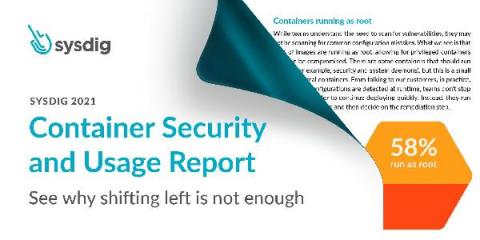
Sysdig 2021 container security and usage report: Shifting left is not enough

The fourth annual Sysdig container security and usage report looks at how global Sysdig customers of all sizes and industries are using and securing container environments. By examining how and when organizations are implementing security in the development lifecycle, we have been able to uncover some interesting data points in this year’s report. For example, we can see that 74% of organizations are scanning container images in the build process.

Stackrox Acquisition: The Race to Secure Containers

Today, Red Hat announced its intent to acquire Stackrox. This is a very exciting development in the world of cloud-native security! First and foremost, congratulations to Stackrox, an early participant in the container security space. This acquisition is a great outcome for Stackrox given their nascent scale and on-premises offering.

5 Best practices for ensuring secure container images

Most modern organizations understand that the earlier you integrate security into the development process, the more secure the applications will be in production. For containerized workloads, securing the container image throughout the application life cycle is a critical part of security, but many organizations don’t even follow basic best practices for ensuring secure container images.

Detect CVE-2020-8554 using Falco

CVE-2020-8554 is a vulnerability that particularly affects multi-tenant Kubernetes clusters. If a potential attacker can create or edit services and pods, then they may be able to intercept traffic from other pods or nodes in the cluster. An attacker that is able to create a ClusterIP service and set the spec.externalIPs field can intercept traffic to that IP. In addition, an attacker that can patch the status of a LoadBalancer service can set the status.loadBalancer.ingress.ip to similar effect.

Preventing malicious use of Weave Scope

Intezer and Microsoft reported on Sept. 9 that TeamTNT hackers are deploying Weave Scope in compromised systems as an auxiliary tool in their intrusions. Weave Scope is a legitimate and powerful tool to manage server infrastructure that, once deployed, makes it easy to control all resources. In this article, we will describe how this tool can be used maliciously, and how to add specific checks in your security set up to look for it.