Security | Threat Detection | Cyberattacks | DevSecOps | Compliance

Cyber Risk in 2026: Top Threats, AI Risks & What Security Leaders Must Do Next

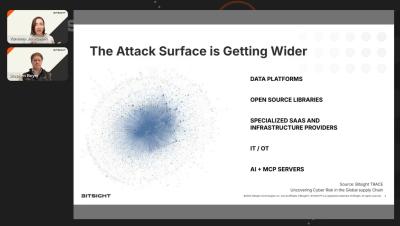
Cyber risk is evolving fast—and 2026 will demand more from security leaders than ever before. In this forward-looking webinar, Bitsight Co-Founder Stephen Boyer and SVP Vanessa Jankowski break down the biggest cyber threats shaping the year ahead, from AI-driven attacks and expanding attack surfaces to third-party and cloud risk.


First 72 Hours of a Cyber Incident: How GRC & Security Teams Must Respond Together

When a critical vulnerability is exploited, the first 72 hours of a cyber incident can determine the outcome. In this scenario-driven webinar, Bitsight experts break down how security, GRC, and threat intelligence teams must work together—fast—to detect risk, prioritize action, and communicate clearly under pressure.

The Top 5 Vulnerabilities Attackers Are Using Against Your Vendors (And What It Says About Third-Party Risk)

When threat actors target your vendors, they’re not just looking to exploit a system for a single attack. They’re looking for every opportunity to scale up their operations. This means seeking ways to push their compromises as far downstream into the supply chain as they can go.

Inside the Rise of Clone Phishing and CAPTCHA-Based Social Engineering

In our previous two posts, The ABC’s of Ishing and From Lure to Breach, we broke down the foundational tactics used by cybercriminals to deceive users and gain unauthorized access. This follow-up report expands on that foundation by exploring three evolving phishing threats that go beyond traditional email lures: clone phishing, deepfake phishing, and Captcha phishing.

4 Predictions Our Researchers Say Could Break (or Break Through) in 2026

As we step into 2026, Bitsight researchers are closely watching key developments across the cyber risk landscape. Their insights reveal a dynamic tension between rising threats and new opportunities to strengthen defenses. Here's what they predict for the year ahead, and what security teams should be prepared to navigate.

A Day Without ICS: The Overlooked ICS Risks That Could Bring Operations to a Halt

Have you ever watched AMC’s The Walking Dead? Before the walkers, before the chaos, there is a quieter moment that often goes unnoticed. The power is out. Roads are empty. Hospitals are running on borrowed time. The world has not fallen apart yet, but it is no longer working. That is what a day without ICS and OT would look like. Industrial control systems (ICS) and operational technology (OT) are the systems that run the physical world.

Why Your Attack Surface Is Bigger Than Your SOC Can See | Financial Cyber Risk Explained

Your organization’s attack surface doesn’t stop at the network—and in financial services, that reality can’t be ignored. In this clip, Dov Lerner explains why even companies with strong internal security programs remain vulnerable when attackers target customers through phishing and account takeover schemes.

Inside the Deep & Dark Web Marketplace Fueling Financial Cyber Attacks

The deep and dark web isn’t chaos—it’s a fully functioning marketplace. In this clip from Exposed: Cyber Risk in the Financial Sector and its Supply Chain, Dov Lerner explains how aspiring attackers can purchase phishing kits, stolen bank credentials, initial network access, and even cash-out services—often without technical expertise.

Why Transparency Is Critical to Cyber Resilience in the Financial Sector

Transparency isn’t optional—it’s foundational to cyber resilience. In this clip from the Exposed: Cyber Risk in the Financial Sector and its Supply Chain webinar, Roland Cloutier, Global CSO and Digital Business Enablement Executive (TikTok, ADP, EMC), explains why visibility across the financial ecosystem is essential for managing third-party risk and preventing cascading cyber attacks.

Cyber Threat Intelligence Report: Top 4 Malware Targeting Finance

The finance sector continues to face sustained and evolving cyber threats driven by the high value of financial data, credentials, and transactional access. Malware remains one of the most common and effective mechanisms used to compromise financial institutions, payment platforms, and end users, enabling fraud, data theft, and operational disruption.

Leveraging Cyber Threat Intelligence to Empower SOC Teams

Security Operations Centers (SOCs) are overwhelmed by alerts, often reacting to threats as they appear rather than anticipating them. Bitsight Threat Intelligence (TI) transforms SOC operations by providing external visibility, context, and correlation with real adversary behavior. By mapping incidents to MITRE ATT&CK techniques and monitoring the deep and dark web for emerging risks, Bitsight TI enables SOC and CTI teams to detect, understand, and prevent threats before they cause impact.