
Security | Threat Detection | Cyberattacks | DevSecOps | Compliance

6 must-haves in a remote patching solution

Somewhere in your fleet sits a laptop with a pristine, 100% compliance score. Not because it’s running the latest patches, but because it hasn’t talked to the server in three weeks, and a device that never checks in can’t exactly fail an audit, right? IT teams now manage more endpoints outside the office than inside it.
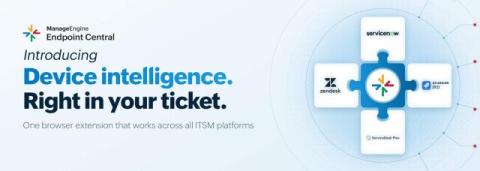
Your device has been trying to tell your ticket what's wrong-Endpoint Central's extension finally lets it

Imagine that your device data and ticket live in two separate rooms within the same building. Your device already has the performance metrics needed to explain the problem—yet, just to make sense of the ticket, your help desk tech still has to walk into the first room, find the data, and carry it back to the ticket room for analysis. This journey, repeated across every single ticket, is what’s quietly costing your IT team.

ClickFix: How a fake CAPTCHA becomes a malware delivery mechanism

CAPTCHAs are designed to distinguish humans from automated systems. A user types distorted letters or clicks a few crosswalks, and in doing so proves there is a human behind the keyboard rather than a script. The whole idea rests on one assumption: A human, unlike a bot, will pause and think for a moment before acting. ClickFix takes that assumption and turns it into the attack itself. The fake verification screen does not ask the user to prove they are human by thinking.

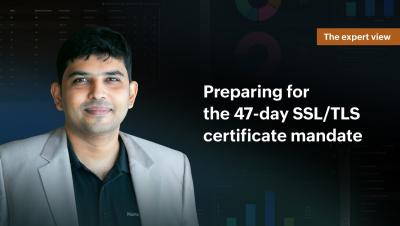
Everything you need to stay ahead of the 47-day SSL/TLS certificate validity mandate

Phase one of the CA/Browser Forum's reduced certificate validity mandate is already live. By March 2029, public CA certificate renewal frequencies will be up to eight times higher. The mandate effectively sets a minimum bar for certificate management. You need full visibility into every certificate in your environment, automatic renewal workflows that can handle a much higher frequency without manual effort, and deployment that gets the renewed certificate live at the target server along with the necessary post-deployment actions. ManageEngine Key Manager Plus covers all three of these facets.

AI threat detection: From reactive alerts to proactive defense

A suspicious login, an unexpected privilege change, and a surge in file downloads may reach your security team as separate alerts. Understanding whether they belong to the same attack requires context. For your IT and security operations teams, connecting these signals takes time. If you're a CIO or CTO, that delay can increase your exposure to operational disruption and data loss. AI threat detection helps you analyze security activity, identify suspicious patterns, and prioritize investigations.

5 AI scams that look legitimate in 2026 and the clues most people miss

Top Tips is a weekly column where we explore practical ways to make technology work better for you. From improving productivity and strengthening digital security to discovering smarter ways to use everyday tools, we share simple, actionable insights to help you navigate the ever-evolving world of technology with confidence. AI is making online scams harder to recognize. From fake government announcements to convincing video calls, fraudsters are using synthetic content to exploit trust.

Cybersecurity best practices for modern enterprises

Enterprise cybersecurity is no longer confined to a fixed network perimeter. Security teams now have to protect users, devices, applications, cloud services, and third-party access across increasingly distributed environments. Attackers are also targeting identities, unpatched systems, exposed services, and gaps in visibility rather than relying on a single attack method. Cybersecurity therefore needs to be treated as an ongoing program, not a project that is completed once and revisited later.

Generative AI security risks every enterprise should prepare for

Over time, we have become increasingly accustomed to using AI in our daily work. We send customer data to ChatGPT for analysis, share customer emails to draft responses, or ask Claude to generate code for enterprise applications. All of this can happen within an enterprise environment. This is what generative AI is designed to do. It creates content for us, from text and code to images and videos.

Breaking down digital security: What actually matters

We've heard everyone talk about digital privacy, cybersecurity, and how we should set a strong password, but what most people fail to understand is the why. Why is it important to set a strong password? Why do we have to activate two-factor authentication? Why are software updates important? Even though we have a vague idea of why we need to do these things, we really don't know the future implications if we don't secure our digital information.

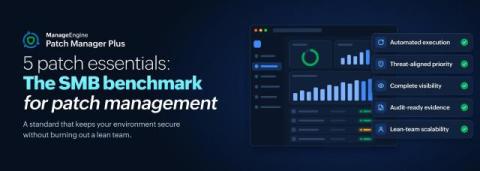
5 patch essentials: The SMB benchmark for patch management

If you're the entire IT team at your company, you probably wear more hats than your title suggests. Between helpdesk tickets, network maintenance, and strategic projects, patch management often gets pushed to the background—and it probably wins your attention only after an incident or an audit. The problem is, threats don't wait for a quiet day. New vulnerabilities are piling up and exploit windows are shorter than ever.
Sponsored Post

Endpoint Central through the AV-Comparatives lens

Getting certified by AV-Comparatives is not straightforward. The organisation runs one of the most thorough independent endpoint security evaluations available. Vendors must comply with comprehensive security software evaluations to receive unbiased feedback regarding their products and feature updates.

SOC metrics that prove your security actually works

SOC metrics are quantifiable measures of how well a security operations center detects, investigates, and contains threats. The metrics that matter most are mean time to detect (MTTD), mean time to respond (MTTR), and incident closure rate, because together they show speed, effectiveness, and reliability, not just activity.

The cybersecurity problem hiding in your later list

Let's be honest: Every IT team has that one thing. That ancient server that nobody wants to touch somehow still runs. That vulnerability that has been sitting in the remediation queue because there were more critical issues to handle, and then there's the active service account that was created for a temporary project three years ago. Or perhaps there's a security exception that was only supposed to last for 30 days and quietly became permanent. Nothing has exploded yet, so it is easy to leave it alone.

Protect Applications Manager logins with CAPTCHA validation

Login pages are one of the most attacked surfaces of any enterprise tool. They're often internet-facing, they're the front door to sensitive operational data, and unlike most vulnerabilities, they don't need to be discovered—they can simply be targeted with large volumes of automated attempts. For monitoring platforms like Applications Manager, which frequently sit with visibility into critical infrastructure, that front door matters even more.

The cyberattack your security team has no framework for

At the opening bell, your stock drops fifteen percent due to a data breach that never actually happened. Fake screenshots, a fake CEO statement, no actual hack. Your security team looks into it, but finds nothing because there's nothing to find. And the damage is already done. Gartner is calling disinformation attacks like this a top threat, and most companies aren’t prepared to handle it. For more insightful videos, visit ManageEngine Insights.

Top tips: How to tell when an app has too much access to your data

Top tips is a weekly column where we highlight what's happening in the tech world and list practical ways to navigate these developments. This week, we're looking at an everyday cybersecurity concern that often goes unnoticed: the amount of access apps have to our data and devices. We install apps to make life easier. A navigation app needs our location, a messaging app needs access to contacts, and a video-conferencing app may need the microphone and camera.