Security | Threat Detection | Cyberattacks | DevSecOps | Compliance

The Latest Cybersecurity News & Insights From Around The World




The 2026 Buyer's Guide to Open Source Vulnerability Remediation
How to evaluate your options, price the status quo, and make a decision your executive team will actually approve. A note on the numbers. The salaries, headcounts, and costs in this guide are illustrative. They're drawn to be realistic so the math works the way it does in a real budget meeting - but they're examples, not benchmarks. Replace them with your own.

Bad Things Also Come in Small Packages: A 38-byte DoS in fflate (CVE-2026-45820)
We discovered this new vulnerability as part of our abandoned-packages research. Despite what seems like a 2-year hiatus, fflate is one of the few popular npm packages that released a fix for the vulnerabilities we found merely using Sonnet-4.6, giving its 50M+ users a chance to upgrade to a safe version.

Don't trust your eyes - ANSI escape injection in the skills CLI by vercel-labs
In a previous post we looked at the skills CLI by vercel-labs/skills and ways for a malicious skill to overwrite an existing trusted skill by using homoglyph names or abusing weird CLI behaviors. This post will delve into an OSC-8 escape injection we found in the skills add command, which lets a skill author write arbitrary text to the console and clickable links as if it's part of the CLI's output.

Integrate Seal Security in Under Five Minutes
Learn how to fix application vulnerabilities without upgrading dependencies or making any code changes. In this video, Sean Carroll, Senior Solutions Engineer at Seal Security, demonstrates how to secure a live application in under five minutes.
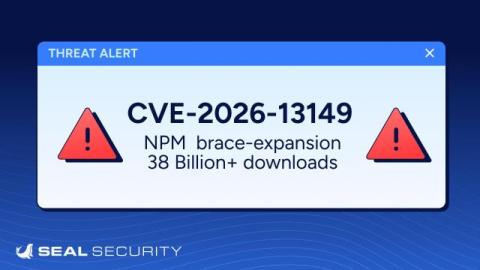
Brace Yourself: Denial-of-Service in a Billion-Download Dependency
brace-expansion is a very popular npm package with over 38 billion all-time downloads (yeah, over 38,000,000,000) and used by tooling almost every JavaScript project relies on - eslint, glob, and npm itself. Despite being in the public eye for a while, we found a new Denial-of-Service vulnerability that could affect millions. This post walks through what the package does, existing issues that were fixed, and the new one we found - CVE-2026-13149.