Security | Threat Detection | Cyberattacks | DevSecOps | Compliance

Claude Mythos Just Killed Exploitability as a Security Signal

The game has changed. For years, security teams used exploitability to decide what to patch first. If a vulnerability had a known exploit, it went to the top of the list. If not, it waited. But with the arrival of next-gen AI models like Claude Mythos, that strategy is officially broken. In this video, we discuss how Claude Mythos has collapsed the barrier to building working exploits. What used to take real skill and significant time can now be weaponized in minutes. When everything is exploitable, exploitability becomes noise.

Scaling Your Security Program to Match the Speed of Mythos

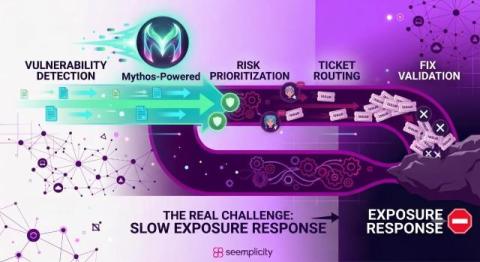
Anthropic’s Project Glasswing and the Claude Mythos model represents a fundamental change in the physics of cyber defense. With the gap between patch releases and weaponized exploits shrinking to hours, traditional manual security triage is now obsolete. Organizations must adopt AI-driven automated remediation.

New Data Shows Why Security Teams Can't Keep Up With AI-Driven Attacks

AI is changing how attacks happen, and how fast they happen. Seemplicity’s 2026 State of Exposure Management report shows why most security teams aren’t struggling to find risk, but to fix it quickly enough. Based on insights from 300 security leaders, it highlights where remediation breaks down, how AI is being used today, and why execution is becoming the real bottleneck.

Secure the Supply Chain at Scale with Step Security and Seemplicity

CI/CD risks don’t get fixed on visibility alone. Step Security surfaces pipeline exposures, while Seemplicity turns them into clear, assigned remediation tasks, grouped by fix and owner, routed into existing workflows, and tracked through resolution, so teams can reduce exposure faster and prove progress.

Redefining WTF in Cybersecurity: Why It's Time to Focus on the Fix

The cybersecurity industry is currently defined by “WTF” moments of panic, from overwhelming vulnerability backlogs to sophisticated AI-driven attacks that bypass traditional defenses. To combat this, organizations must shift their narrative away from reactive frustration and toward the most critical part of exposure management: The Fix. By redefining WTF, security teams can move beyond context-less alerts and manual spreadsheets.

The Unsung AI Hero: Data Normalization

AI agents are only as effective as the data they consume. In this post, we explore the unsung hero of the security stack: data normalization. This process serves as the deterministic guardrail that makes AI grounding possible. Without a structured data foundation, grounding is only as good as the often chaotic data being retrieved, leading to confident but incorrect AI responses.

Preventing SCA Findings From Becoming a Remediation Bottleneck

SCA tools often generate multiple CVEs for the same dependency, creating unnecessary tickets and slowing remediation. Aggregating those findings into a single fix helps AppSec teams reduce ticket sprawl and align security work with how developers actually resolve vulnerabilities.

The Future of the Cybersecurity Workforce in an AI-Driven Era

New research shows the cybersecurity workforce is undergoing a major shift as AI transforms security operations. While leaders remain deeply committed to the field, many are facing increasing burnout, evolving skill demands, and growing responsibility for governing AI-driven systems. The future cybersecurity leader will need to balance technical expertise with communication, business alignment, and AI oversight.