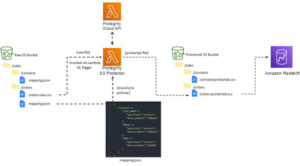
One of Canada’s largest credit unions, Coast Capital Savings Credit Union (CSS), with over 50 branches across the country, needed to protect critical PII data stored in their AWS cloud environments, Amazon Redshift, AWS EMR, and AWS S3. CSS had to meet Canadian regulatory standards for compliance in 2021, including the Personal Information Electronic Documents Act (PIPEDA), along with a data transformation initiative surrounding its architecture.
We’ve all seen it in the movies: The chief of security declares that no one could ever steal the “Famous Jewel” because it’s protected by thick glass, an impenetrable system of motion-detecting lasers, and, finally, a weight-sensitive sensor. Cut to the next scene, where a thief, dressed in sleek black, zip-lines from an open skylight, shorts the lasers, scores the glass, and with split-second timing, swaps the jewel for a replica of equal weight.
In 2023, an estimated five quintillion bytes of data will be created daily. While this data revolution is exciting, it also raises questions about data privacy. In response to that challenge, more regions, localities, and countries will implement additional data privacy laws in the coming years to ensure the safety of individuals’ data.
Imagine doing business in a bubble. You are an international company only allowed to make decisions using data collected within your country and by your business unit (BU). You also cannot share data with subsidiaries or third parties. It would be challenging to conduct day-to-day business, let alone innovate and grow. Fortunately, this isn’t the state of business today. Organizations transfer trillions of data points across borders daily.