Security | Threat Detection | Cyberattacks | DevSecOps | Compliance

Cloud Computing and Code Signing as A Service: Stats, Future and Trends 2026

Whenever you press the update button on your phone, or your server requests a new container image, an act of faith is being performed. You are relying on the fact that the code that you are downloading is what the developer wrote. You are hoping that a hacker didn’t place a backdoor in between. Our years of verifying trust with a basic digital handshake: Code Signing. But here is the thing. It is a weakened handshake. I call CTOs and security leaders weekly, and they are afraid.

Microsoft Overhauls Windows Driver Signing: What This Means for Developers and Users

If you follow Windows development even casually, you already know this fact that drivers are the silent backbone of the operating system. They control your cameras, your network card, your USB ports, your audio devices… basically everything that makes your PC more than a box with a screen. And when drivers go wrong, they really go wrong. Microsoft has obviously had its share.

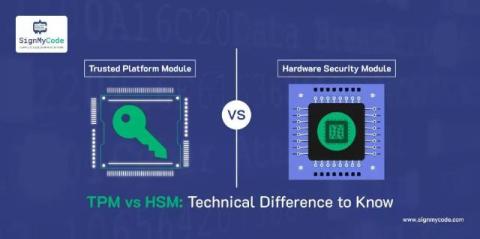
Difference Between TPM and HSM Security

A Trusted Platform Module (TPM) is a microcontroller designed to increase the levels of protection for computers, smartphones, and other devices through built-in security support that offers the necessary cryptographic operations. TPMs are unlike other software-based security; they provide a hardware-bound security, thus, it becomes nearly impossible for the attacker to tamper with the protected keys and information stored within the TPM.

What is Secure Source Code? Source Code Security Best Practices to Protect Against Theft

Software has become the foundation of numerous companies and institutions worldwide, which has made the protection of source code critical in today’s digital environment. Code security refers to such measures that are put in place to guard this asset against fraudsters, theft, and attacks among others.

Securing your CI/CD Pipelines with GitHub Actions: DevSecOps in Action

When people talk about securing software, they typically refer to two distinct aspects. The code itself, or the servers it runs on. That makes sense. Those are the most visible parts. But what actually holds everything together isn’t either of those. It’s the pipeline in between the system that moves code from an idea in a developer’s head to something running in production. CI/CD pipeline can be easy to overlook because it often feels invisible.

Zero Trust in DevSecOps Pipelines: Securing CI/CD Pipelines

Your CI/CD pipeline may also be the rocket that propels your business, but it can also be the silent killer that will blow up all that you have created. Think about it. You have automated code builds, testing, and deployments. Your people are driving features at light speed. Customers are happy. Revenue is growing. But beneath the surface? A single crack will cause the entire system.

What is File Integrity Monitoring (FIM)? Importance and Best Practices

File Integrity Monitoring (FIM) is a process that provides security by monitoring and verifying changes made to critical files, directories, and system configurations in an IT environment. This is accomplished by taking the current state of files, operating system binaries, application files, configuration files, logs, or sensitive data, and comparing them against a known and trusted baseline.

CI/CD for Mobile Apps Streamlining Development Efficiency

Think of how painful it would be to spend a few weeks creating a mobile app to watch users abandon it because of a faulty update or chronic feature rollout. Your coders are fed up. Your QA team is flooded. And with every release, it is a tightrope walk with the blindfold on. That is the sad state of mobile app development without CI/CD. But here is what you can imagine: whenever your team pushes code, a test, a build, and a deploy happen automatically. No eleventh-hour rush. No delays.

npm Supply Chain Attack: What Happened and How to Protect Your Software

On September 8, 2025, a large-scale npm supply chain attack quickly compromised 18 popular packages (with the 18 packages representing more than 2.6 billion weekly downloads within the bioinformatics ecosystem). Attackers hijacked a maintainer’s account by impersonating npm support in a phishing campaign to upload backdoored versions of popular packages like chalk, debug, ansi-styles, and supports-color.