Security | Threat Detection | Cyberattacks | DevSecOps | Compliance

3 Ways To Address Your Kubernetes Data Protection Challenges

Kubernetes is an open-source container orchestration tool originally developed by Google for managing microservices or containerized applications across a distributed cluster of nodes. It is widely thought that “Kubernetes is key” to cloud-native application strategies. Kubernetes (K8s) runs over several nodes, and the collection of nodes is called a cluster. K8s clusters allow application developers to orchestrate and monitor containers across multiple physical, virtual, or cloud servers.

Intelligent Recovery with Trilios Continuous Restore

New Innovation Enables Data-Driven Organizations to Access ‘Single-Source-of-Truth’ Data from Multiple, Heterogeneous Clouds Simultaneously. Trilio’s Continuous Restore capability enables migration and replication of stateful applications in seconds or minutes so that all companies can protect and use their data anywhere, from core to edge—regardless of what the application runs on or where the data is stored.

How to - Disaster Recovery of a MineCraft Server on Red Hat OpenShift with Trilio

In this Video our Senior Solution Architect Rodolfo Casas is demonstrating how easy e.g. a MineCraft Server can be disaster recovered from one OpenShift Cluster to another. In this case we are talking about a DR scenario from ROSA (Red Hat OpenShift on AWS) to ARO (Azure Red Hat OpenShift Service)

Disabling Backups! - A Ransomware Story

In this session, John Goecke (CEO) discusses with Venky how everything changed for StratusVue after a ransomware attack in 2018. He shares how the construction industry is a soft target as there is no regulatory oversight, unlike in banking and healthcare, and security is always an afterthought for business owners. Along with all this, he explains complex terms like zero-day, zero-trust, FedRAMP, etc., in a highly rudimentary way.

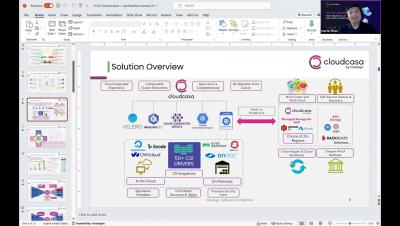
More Cloud Integration Capabilities for Kubernetes Backup and Restore in the February Update of CloudCasa

Mid-winter is fast approaching, meaning it’s nearly time to start thinking about spring again! But here at Catalogic all we’ve been thinking about lately is adding more features to CloudCasa. We were thrilled to hear that CloudCasa has been named a Kubernetes data protection leader and outperformer in the recently released GigaOm Radar for Kubernetes Data Protection Report, but we have no intention of resting on our laurels!

Automating Kubernetes Backups with CloudCasa REST APIs

For power users who want to run their scripts from the command line or use workflow automation tools to provision their environments, watch this short tutorial on how to use the CloudCasa REST API to manage Kubernetes backups. The tutorial goes through an example of executing a CloudCasa backup job through the REST API, which requires tasks such as querying for backup job ids and invoking an action against that job through an http request.