Security | Threat Detection | Cyberattacks | DevSecOps | Compliance

CloudCasa Is Making It Easy To Use Velero | Ryan Kaw At KubeCon+CloudNativeCon

Ryan Kaw, Vice President of Global Sales at CloudCasa by Catalogic, joined Swapnil Bhartiya, Founder and Editor-in-Chief of TFiR, at KubeCon + CloudNativeCon EU to deep dive into the availability of CloudCasa for Velero, which addresses problems around multi-cluster management, alerting and reporting, and provides enhanced recovery capabilities through a new user interface. CloudCasa recognizes that a lot of people are already using Velero in their environments, so the company decided to meet them where they are. The solution is compatible and complementary to Velero and the integration is non-disruptive.

Trust And Community Collaboration Drive Open Source Adoption In The Cloud

CloudCasa by Catalogic is a cloud-native backup service that protects Kubernetes and cloud-native data. In this episode of TFiR: T3M, Swapnil Bhartiya sits down with Sathya Sankaran, Chief Operating Officer at CloudCasa by Catalogic, to talk about the factors driving open-source adoption and the role CloudCasa by Catalogic is playing in the open-source ecosystem.

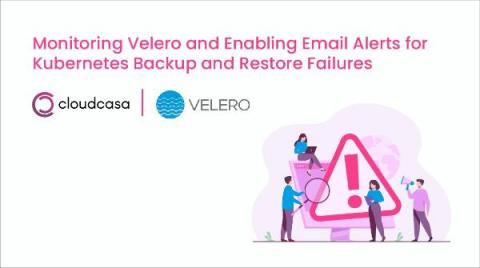
Monitoring Velero and Enabling Email Alerts for Kubernetes Backup and Restore Failures

Open source Velero is a popular choice amongst Kubernetes community for backup of their application. Along with scheduling regular backups for your Kubernetes clusters, monitoring Velero and getting automated alerts for failed Velero backups is also important. When your most important backup fails, you want to know about it immediately and make sure your application notifies you.

Open Source Adoption and Why is Velero Backup so Popular

In the cloud native world, open source solutions are popular and widely used. Velero, an open source software, is quickly becoming a standard for Kubernetes backup and has been pulled over 100M times from Docker Hub! It is the most popular choice amongst Kubernetes community for backup and recovery. In a recent episode of TFiR, Swapnil Bhartiya sits down with Sathya Sankaran, Chief Operating Officer at CloudCasa by Catalogic, to talk about the power and potential of open source ecosystem.

Reasons to Stick with Open Source Velero for your Kubernetes Backup and Recovery

I recently had a chance to speak with Chris Mellor at Block and Files about the emergence of Velero as the standard for Kubernetes data protection. I shared some ballpark estimates of market share across open source and commercial vendors to make my case. These numbers were obtained through diligent market research. They are estimates, but they are not imaginary.

How Namespace-as-a-Service Enables Self-Service Kubernetes Recovery

Kubernetes has become the de facto standard for container orchestration and management, providing a powerful platform for deploying and managing containerized applications. One of the key benefits of Kubernetes is its support for namespaces, which allow users to isolate groups of resources within a cluster, providing a level of isolation and resource allocation for different applications or teams.

Comparing Restic vs Kopia for Kubernetes Data Movement

When we began developing CloudCasa, a Software as a Service (SaaS) platform, for protecting Kubernetes applications, we looked at the data protection landscape and focused on areas that we could improve upon and give back to the user community. We wanted to provide them with a quick and efficient way in which they could start protecting this infrastructure with minimal effort, overhead, and most importantly minimal cost.

TFiR Let's Talk! Recovery of Velero Backups to AKS & EKS

Sebastian Glab, Cloud Architect at CloudCasa, shows you how CloudCasa for Velero allows Velero users to manage their cluster using our software as a service platform. By plugging directly into Velero, CloudCasa provides user friendly, intuitive UI for Kubernetes cluster management utilizing Velero as the backup tool. Users can centrally manage their current backups and configuration across multiple clusters and cloud providers (AKS, EKS and GKE) in one place. They don't have to jump across different environments, access different clusters to see what's going on, they can simply go to Cloud Casa, and manage everything from there.

TFiR: Let's Talk! Recovery of Velero Backups to AKS & EKS

Sebastian Glab, Cloud Architect at CloudCasa, shows you how Cloud Casa for Velero allows Velero users to manage their cluster using our software as a service platform. By plugging directly into Velero, CloudCasa provides user friendly, intuitive UI for Kubernetes cluster management utilizing Velero as the backup tool. Users can centrally manage their current backups and configuration across multiple clusters and cloud providers (AKS, EKS and GKE) in one place. They don't have to jump across different environments, access different clusters to see what's going on, they can simply go to Cloud Casa, and manage everything from there. The best part is that Velero users can get all these benefits without worrying about infrastructure management, without causing any disruptions or without having to undergo any migration process.

A SaaS Multi-Cluster Manager for Velero

Welcome to another video on CloudCasa for Velero: A SaaS Multi-Cluster Manager for Velero backups. In this video, Martin Phan, Field CTO for CloudCasa, will show you the first-hand look of the integration that CloudCasa has with Velero and its centralized GUI that helps users manage and monitor their Velero-based backups. You will find out how CloudCasa for Velero is able to aggregate data across multiple Kubernetes clusters across all hybrid and cloud environments. If you are using Velero today, please check this demo on CloudCasa for Velero and learn more about its multi-cluster management functionality and full stack recovery capabilities using the intuitive GUI.