Security | Threat Detection | Cyberattacks | DevSecOps | Compliance

Signs Your Organization Needs a GRC Solution

Before beginning, you might ask yourself: Does my organization need a GRC Solution? The simple answer is yes. There are over 200 complex frameworks and workflows that simply can’t be managed by floods of repetitious spreadsheets or word documents. Let’s define “Governance Risk-Management Compliance” and how the three pillars work together in relation to an organization and its objectives. Check top 30 security frameworks – 2019.


Risk Mitigation Strategies

It is rightly said that “Prevention Is Better Than Cure.” This maxim can also be applied in information technology in terms of IT risks. Risk mitigation is a process whereby an enterprise takes some proactive measures or use some strategies to mitigate or eliminate risks altogether in order to prevent or reduce damage to the organization. The following sections gain an insight into some popular risk mitigation strategies organizations are looking for in 2019.

The Main Elements of a Security Risk Analysis Report

No organization has complete protection against today’s sophisticated and fast cyber-threats. To maximize the security posture of your enterprise, you need to evaluate the risks in an effective manner, in addition to the various other security measures. The report in which you describe all the risks – coined as “Security Risk Analysis Report” – has utmost importance for the effectiveness of the overall Risk Management Program.

Why Cyber Security is Key to Enterprise Risk Management for all Organizations

Large organizations have always focused on managing risk, but the technological breakthroughs that have enhanced our world in countless ways have also transformed how leading executives engage in enterprise risk management (ERM). The pervasive and ever-expanding threat of cyber crime means that comprehensive strategies for cyber security are now absolutely essential for all organizations.

What is Risk Exception

A business wants to hire a vendor. However, this vendor does not meet policy standards and has requested an exception. The question you face is whether or not to approve or deny that exception request. What’s good for business sometimes comes with added risk. In fact, many incidents are the direct result of a policy violation. For risk management, and business needs, maybe the answer isn’t a simple yay or nay but a more nuanced approach.

UpGuard's new navigation: CyberRisk is evolving

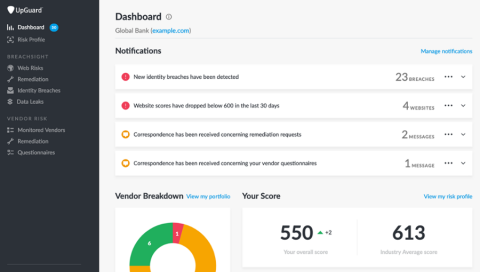
UpGuard CyberRisk enables organizations to control and monitor third-party vendor risk in real-time and improve their security posture. Since we launched CyberRisk, our team has been speaking to users and evolved the platform into two new modules, BreachSight and VendorRisk. Combined with a redesigned user experience, UpGuard is easier to use than ever.