
How Health Risk Assessments Drive Preventive Care and Lower Long-Term Costs?
Health Risk Assessments are increasingly used to support preventive care planning and population health management across healthcare systems.According to the CDC, chronic and mental health conditions account for the majority of U.S. healthcare spending, which exceeds $4 trillion annually.These assessments help identify risks earlier, when interventions are typically more effective and less resource-intensive.
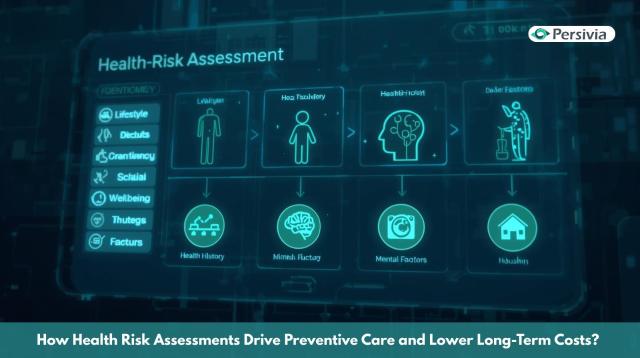
Health Risk Assessments function as structured evaluations of an individual’s current health status and future risk factors.They consider lifestyle patterns, health history, mental health conditions, and social issues such as housing stability, which affects wellness.CMS requires Health Risk Assessments as part of Medicare Annual Wellness Visits and encourages their use across Medicare Advantage and Special Needs Plans to support preventive care planning.
This approach supports earlier intervention and targeted prevention planning, which can help limit the progression of conditions that lead to higher long-term costs and poorer outcomes.
What Exactly Are Health Risk Assessments?
Health Risk Assessments HRAs are structured questionnaires used to evaluate an individual’s overall health risks. They collect data about medical history, current symptoms, lifestyle behaviors, and social determinants of health.
These assessments answer three critical questions:
- What health risks does this patient face?
- Which risks need immediate attention?
- What interventions will work best for this individual?
In Medicare Advantage and Special Needs Plans, HRAs are typically conducted shortly after enrollment and updated annually to reflect changes in health status.They are given by healthcare providers in the form of surveys that are conducted online, via telephone, paper, or home assessments conducted by qualified professionals.
How Early Detection Cuts Costs
Early detection can reduce downstream healthcare costs by identifying risks before conditions progress to advanced or emergency stages. HRAs can surface risk factors that may not be consistently captured during routine clinical visits, helping prevent conditions from progressing unnoticed.
Illustrative cost considerations often cited in preventive care research include:
- Managing established diabetes: $9,601 per patient annually
- Preventive interventions for diabetes risk are consistently shown to be significantly less costly than long-term management of established disease.
- Emergency hypertension treatment: $2,500+ per episode
- Controlled hypertension management: $600 annually
The risk is captured in the assessment process in a variety of health dimensions.The physical indicators, such as blood pressure trends and weight gain, are joined with the lifestyle information on smoking, physical activity, and alcohol consumption.Depression and anxiety are detected at an early stage during the screening of mental health.The social determinant questions disclose food insecurity, transport impediments, and housing insecurity that make medical conditions hard to manage.
An individual patient with high levels of stress, who sleeps poorly, and a family history of diabetes will be provided with specific prevention programs before blood sugar levels become problematic.Early intervention strategies reduce the likelihood of diabetes-related complications, which are associated with increased mortality and long-term healthcare costs.
Building Personalized Prevention Plans
Generic health recommendations are often less effective when they are not aligned with individual risk profiles. Personalized plans succeed because they match each patient's specific circumstances and risks.
The HRA process creates individualized roadmaps through five steps:
- Data collection across health, lifestyle, and social factors
- Risk stratification categorizes patients by urgency
- Care plan development with specific, measurable goals
- Resource allocation focuses on support where needed most
- Progress monitoring through regular reassessments
A person with several chronic issues, a disability, and food insecurity requires other interventions compared to someone with family heart disease. HRAs ensure both receive appropriate attention and resources.
Technology Makes Prevention Scalable
Paper-based tests are time-consuming and lack vital data. Digital health platforms improve the HRA process through automation and structured data capture.
Modern HRA platforms deliver:
- SOAP note integration that auto-populates assessment fields
- AI-generated follow-up questions based on patient responses
- Automatic gap identification, highlighting missing information
- Direct EHR connectivity eliminates duplicate data entry
- Real-time reporting to payers, providers, and patients
These capabilities significantly reduce administrative burden while improving the completeness and accuracy of clinical documentation.
Why CMS Promotes Health Risk Assessments
CMS promotes the use of Health Risk Assessments to support preventive care planning, care coordination, and standardized data collection across beneficiary populations. Medicare Advantage plans must attempt annual health assessments for all beneficiaries. Special Needs Plans need comprehensive HRAs at enrollment and yearly thereafter.
The policy focus reflects observed associations with:
- Higher plan quality star ratings
- Better patient satisfaction scores
- Lower total cost of care
- Improved chronic disease management outcomes
- Increased preventive service utilization
Many plans report improved operational efficiency and data visibility when using digital and AI-supported HRA platforms compared to manual workflows.
Supporting Value-Based Care Success
Value-based care rewards health outcomes over service volume. HRAs provide the data foundation, making outcome measurement and improvement possible.
Comprehensive assessments enable accurate risk adjustment for fair reimbursement, quality gap closure meeting HEDIS measures, population health management across entire patient panels, and predictive analytics for resource planning. HRAs help aggregate individual patient data into population-level insights that support care planning, quality reporting, and resource allocation.
Takeaway
Health Risk Assessments transform reactive sick care into proactive health management. They catch problems when treatment works best and costs least. Available evidence suggests that comprehensive HRAs can contribute to lower long-term healthcare costs and improved patient outcomes when paired with effective preventive care strategies.
Why Choose Persivia?
Persivia offers an evidence-informed Health Risk Assessment solution designed to simplify data collection, standardize documentation, and integrate with existing clinical workflows. Persivia’s platform provides real-time risk analytics, gap detection, and reporting of complete patient populations.Persivia’s platform is designed to support accurate HCC documentation, reduce assessment time, and integrate risk insights into existing clinical workflows.