
How Electrical Sensors Improve Accuracy, Automation and Safety in Smart Devices
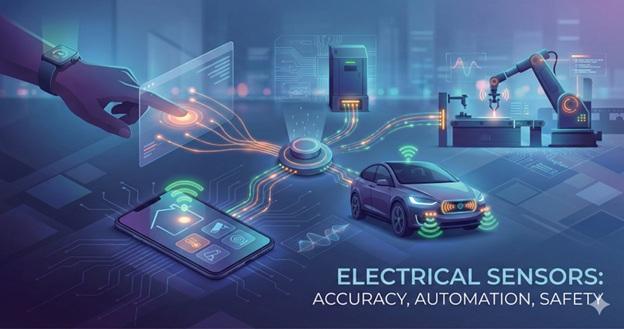
Smart devices are becoming a natural part of daily life, shaping the people's way of working, communication and monitoring their surroundings. Behind every modern feature that feels intelligent or automatic, there is an unseen foundation of sensing technology quietly collecting data and interpreting physical signals. Electrical sensors form the core of this intelligence. They observe the real world, convert physical changes into measurable electrical signals and allow a device to understand what is happening around it.
This article explores how electrical sensors improve accuracy, support automated functions, and enhance safety across smart homes, wearable technology, medical equipment, industrial automation, transportation systems, environmental monitoring and the growing world of connected IoT devices. A modern engineer cannot design a reliable product without understanding how sensing technology works. A consumer cannot appreciate how a smartwatch monitors heart rate, or how a car brakes automatically to prevent a collision, without knowing the principles that allow devices to interpret the environment. The story of smart technology is really the story of sensors turning raw signals into meaningful data.
The Role of Electrical Sensors in Smart Devices
An electrical sensor is a device that can detect a physical quantity and convert it into an electrical output that can be processed by a digital system. Temperature, light, current flow, pressure, vibration, motion, sound and chemical concentration can all be measured through specialized sensors. The core function of any sensor begins with a physical stimulus. The sensor transforms this input into an electrical signal through principles such as resistance change, inductance variation, capacitance shift, piezoelectric effect or electromagnetic induction. After that the device uses signal conditioning circuits and embedded software to interpret the signal and respond with an action.
Without sensors a device cannot perceive its environment. With sensors it becomes capable of observing physical conditions and making decisions that depend on real world data. A smart door lock knows someone is nearby because it senses proximity.
Accuracy, automation and safety all depend on how well these sensors perform.
Why Accuracy Matters in Modern Smart Devices
Accuracy is the measure of how close a sensor’s reading is to the actual value. Even slight inaccuracies can produce misleading results. A medical device that misreads body temperature by half a degree may cause incorrect diagnosis. A navigation system that incorrectly measures location may guide a vehicle off its route. A manufacturing robot that processes faulty sensor data can produce defective parts.
Electrical sensors improve accuracy through several mechanisms. Many sensors today use digital outputs to avoid analog noise. Advanced calibration techniques help maintain precision over time. AI enhanced filtering allows devices to remove environmental interference. High resolution components help capture small variations in signals.
Accuracy supports every level of device intelligence. It improves reliability, enhances user trust, enables predictive features and reduces errors in mission critical systems.
How Sensors Enable Automation in Smart Devices
Automation is possible only when a device understands its environment. Sensors provide that understanding. A system that senses motion can automatically turn on lights. A device that detects a gas leak can immediately activate ventilation. A factory machine that monitors vibration and torque can adjust speed automatically.
Automation enhances productivity in homes, industries and personal devices. It makes everyday actions faster, simpler and more efficient. Sensors create feedback loops in which a device measures a condition, processes the data and executes an action without human involvement.
These automated cycles depend on precise sensing and reliable data interpretation. Without high quality signal input an automated system cannot make good decisions. This is why electrical sensors play a central role in home automation controllers, industrial robotics and automated agricultural equipment.
How Sensors Improve Safety Across Critical Applications
Safety is one of the most valuable contributions of sensor technology. In every field where risk is present, sensors act as early warning systems.
Smart buildings use smoke detectors, heat sensors and air quality sensors to prevent dangerous conditions. These systems help identify risks early and support a safer environment. In commercial facilities, sensor data can also assist maintenance teams in monitoring fire protection systems when performance issues or faults are detected. Power systems use a Current Sensor to prevent overload situations and avoid equipment damage. Sensors do not simply collect data. They protect people by enabling rapid detection, immediate action and predictive maintenance. In many safety critical devices redundancy is used so that multiple sensors confirm the same information to avoid false signals.
As systems become more autonomous and interconnected safety features driven by sensors become even more important. A smart car that detects an obstacle and applies brakes instantly can save lives. A machine that stops when an operator is too close can prevent injury. A wearable device that detects abnormal heart rhythm can alert a doctor in time.
Applications of Electrical Sensors in Smart Homes
Smart homes rely heavily on sensors that track temperature, humidity, motion, light level, sound level and energy usage. These measurements help create a comfortable, efficient and safe living environment. A voice assistant can adjust environmental settings because sensors provide real time data. A security system can detect unauthorized movement because sensors continuously observe the surroundings.
Smart thermostats adjust heating and cooling based on temperature readings from multiple locations. Smart lighting systems increase or decrease brightness depending on ambient light. Water leak detectors sense moisture before damage occurs. This creates personalized environments without manual control.
Wearables and Personal Health Monitoring
Wearable devices such as fitness trackers and smartwatches depend on a wide range of sensors to measure body activity and health parameters. Accelerometers and gyroscopes detect movement and orientation. Temperature sensors measure skin changes. Electrodermal sensors track stress response.
These readings allow people to understand their health patterns, track exercise performance and receive alerts for unusual conditions. The accuracy of these devices has improved significantly due to advancements in sensor materials, higher sampling rates and intelligent filtering algorithms.
In many cases wearable sensors act as early indicators of medical conditions. Studies show that continuous monitoring of heart rate variability can help identify risks of arrhythmia. Sleep tracking sensors can highlight breathing irregularities that may indicate sleep apnea. These benefits depend entirely on reliable and accurate sensing.
Industrial Automation and Smart Factories
Industrial automation is built on a foundation of sensing technology. Pressure sensors, proximity sensors, strain gauges, optical sensors, thermal sensors, vibration sensors and current sensors monitor machine performance and product quality.
Smart factories use sensors to enable predictive maintenance. When a machine vibrates abnormally the sensor detects the pattern before failure occurs. This allows timely maintenance and reduces downtime.
Robotics uses sensors to maintain precision in assembly lines. Sensors help robots adjust their movement, measure applied force, recognize objects and ensure correct alignment. Automated material handling uses sensors to track placement and detect obstacles.
Sensors also ensure the safety of workers by detecting human presence near hazardous zones. Many industrial machines stop automatically when sensors detect an unsafe distance.
Transportation and Automotive Safety
Modern vehicles rely heavily on sensors for advanced driving assistance and safety control systems. Radar, lidar, ultrasonic sensors and cameras detect obstacles, pedestrians and road conditions. Speed sensors help maintain control during acceleration or braking. Tire pressure sensors alert drivers to unsafe levels.
Electric vehicles use sensors to monitor battery condition, thermal state and power flow. Autonomous and semi autonomous vehicles depend on an entire ecosystem of sensing devices to interpret surroundings in real time.
Anti lock braking systems use wheel speed sensors to prevent skidding. Stability control systems use gyroscopes and accelerometers to correct direction. Airbag systems use crash sensors to deploy instantly when needed.
These technologies demonstrate how sensor based safety can significantly reduce accidents and enhance overall transportation reliability.
Environmental Monitoring and Smart Cities
Smart cities use sensors to monitor air quality, noise levels, traffic flow, water quality and waste management. These sensors help government authorities make data based decisions and manage resources efficiently.
Air quality sensors detect pollutants and help evaluate environmental health. Water sensors track contamination. Traffic sensors regulate signal timing to reduce congestion. Structural sensors monitor bridges and buildings for early signs of stress or damage.
By integrating these data sources cities become more responsive and sustainable. The intelligence of a smart city comes from networks of sensors that send reliable and continuous information to central systems.
The Future of Sensor Driven Smart Technology
As technology evolves sensors are becoming smaller, more energy efficient and more precise. Nano sensors, flexible sensors, optical micro sensors and AI enhanced sensing systems are opening new possibilities.
Future smart devices will rely on multimodal sensing in which several types of data are combined for deeper understanding. For example a wearable may use motion, temperature, electrical signals and oxygen levels to assess health more accurately. A vehicle may combine radar, lidar, camera and ultrasound to interpret its surroundings with high confidence. A factory may combine vibration, temperature, noise and torque readings to predict machine health.
AI and machine learning will continue improving how sensor data is interpreted. Sensors will no longer be passive components but intelligent nodes that filter and analyze information at the edge of the network before sending it to cloud based systems.
The future of automation and safety depends on the continued advancement of sensor technology.
Final Thoughts
Electrical sensors form the foundation of accurate measurement, automated decision making and safe operation in modern smart devices. They convert physical signals into meaningful data that allows devices to think, react and adapt. Whether used in homes, hospitals, vehicles, industries or urban infrastructure, sensors enhance the intelligence and reliability of real world systems.
As smart technology evolves the importance of sensors continues to grow. They enable user comfort, improve industrial productivity, protect human lives and support the development of AI powered devices. The world becomes smarter only when devices gain the ability to sense and understand their environment. Sensors make that possible.