
Top 6 Hospital Valet Service Companies Compared on Safety, Speed and Cost
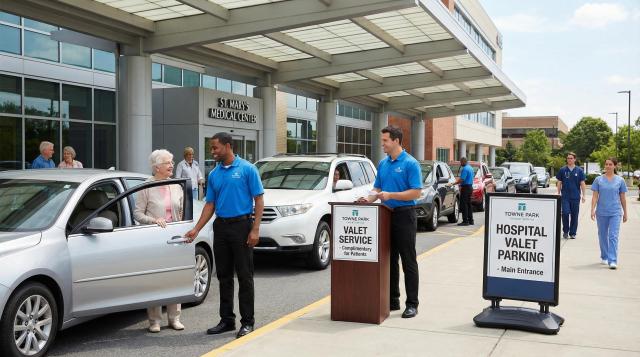
Picture this: A frail patient pulls up to your entrance, nerves jangling. The handshake that sets the tone isn't a clinician's—it's the valet's. An April 2025 Impact Wealth study shows 97 percent of seniors say a shabby parking experience taints their view of the entire hospital. In short, your curb is your public reputation.
Done right, valet service slashes missed appointments, eases traffic, and shields you from liability. Done poorly, it dents cars, blows schedules, and drains budgets.
We reviewed dozens of reports, case studies, and frontline threads to rank the six U.S. vendors that matter most. Our scorecard zeros in on what keeps administrators up at night:
- Safety protocols and rock-solid insurance
- Lightning-fast drop-off and retrieval
- Transparent pricing that proves ROI
You'll see how one hospital cut parking spend by 27 percent and shaved three minutes off curb waits after switching vendors. You'll also learn what to add to an RFP so a "lost-car" nightmare like the viral 2023 Reddit post never lands on your desk.
Ahead, we compare each provider head-to-head, supply board-ready snapshots, and answer the questions patients whisper at the entrance. Let's head to the curb and start the engines.
How we compared the valet providers
We wanted a ranking that feels like your internal scorecard, not sales copy. So we built a six-factor framework that mirrors the questions hospital executives fire at vendors during an RFP review.
First, we pulled hard numbers and best-practice checklists from recent deep dives. Impact Wealth's April 2025 buyer guide outlined the must-have safety training and insurance every legal team demands. Breaking AC's February 16, 2026 comparison delivered measurable outcomes such as budget savings and curb-wait reductions. A November 12, 2023 Reddit post about a "lost" patient car reminded us why airtight liability coverage is non-negotiable.
With those anchors in place, we graded each company on:
- Safety and liability protection: documented training hours, background checks, incident rates, insurance limits
- Speed and operational efficiency: average drop-off and retrieval times, real-time staffing agility, congestion control
- Cost transparency and ROI: pricing models, published savings, invoice clarity
- Technology and data: contactless workflows, license-plate recognition, administrator dashboards
- Healthcare expertise and compliance: HIPAA awareness, Joint Commission alignment, ADA sensitivity, bedside-manner coaching
- Scalability and service scope: geographic reach, surge staffing ability, extras such as shuttles or patient transport
Each factor carried real weight in our scoring. Safety, speed, and cost acted as tie-breakers whenever two vendors finished close together. The result is a ranked short list that rewards proven hospital performance—not flashy hotel pedigrees.
Now that you know the yardstick, let's see how the top six measure up.
A quick side-by-side look at the leaders
Before we dive into individual profiles, it helps to see the field on one page. The matrix below distills each company's performance across the six factors we just defined. Slide it across the boardroom table when the CFO asks, "Who really covers our bases?"
|
Company |
Safety & liability |
Speed & flow |
Cost & ROI |
Tech & data |
Healthcare know-how |
Reach & extras |
|
FC Parking |
✓✓ rigorous drills, top service scores |
✓✓ 60-second drop goal |
✓✓ 27 percent savings case |
✓✓ proprietary SMS app |
✓✓ hospitals only |
✓ Midwest & Florida |
|
Towne Park |
✓ Safe360 program |
✓✓ deep staffing bench |
✓ premium pricing |
✓ solid, not unique |
✓✓ 300+ hospitals |
✓✓ nationwide, concierge menu |
|
LAZ Parking |
✓ standard protocols |
✓✓ tech-driven capacity |
✓✓ cost-competitive |
✓✓ LPR plus 50k EV charger rollout |
✓ dedicated team |
✓✓ 44 states |
|
ABM Parking |
✓ robust safety record |
✓ streamlined by automation |
✓✓ bundle discounts |
✓ garage tech focus |
✓ many hospital clients |
✓✓ national, multi-service |
|
Propark Mobility |
✓ safety plus Green Garage ethos |
✓✓ agile pilots cut waits |
✓✓ shared-savings options |
✓✓ rapid tech pilots |
✓ adaptable staff |
✓ coast-to-coast metros |
|
HealthPark Hospitality |
✓✓ healthcare-exclusive training |
✓ smooth, touchless ticket |
✓✓ value pricing |
✓ text-to-retrieve |
✓✓ empathy culture |
✓ regional (Southeast & Midwest) |
Legend: ✓✓ = excels, ✓ = solid performer.
No single vendor nails every column. FC Parking leads the safety-speed-cost trifecta, while Towne Park wins on nationwide muscle and service breadth. LAZ brings cutting-edge tech at a friendly price, and ABM appeals to hospitals that love bundled contracts. Propark shines when innovation and shared upside matter, and HealthPark delivers boutique compassion where geography aligns.
Keep this grid handy as we unpack the stories behind each score.
1. FC Parking: boutique focus, big results
FC Parking specializes in hospital valet services and nothing else. That focus shows the moment you scan their safety playbook. Every valet completes hospital-specific training—HIPAA basics, wheelchair etiquette, monthly drills—before touching a set of keys. Essentia Health's flagship hospital logged a 94 percent service-score average after switching to FC in 2023.
Speed is just as disciplined. A proprietary SMS workflow logs each plate in seconds and texts guests a link to retrieve their car. Real-time dashboards track a 60-second curb-drop goal, and most vehicles roll back in under three minutes. According to the company's 2024 rollout report, hospitals using this system cut no-show appointments by roughly 10 percent while trimming average curbside wait by three minutes.
Cost control seals the deal. By right-sizing shifts hour by hour, FC trimmed one Advocate Health facility's parking spend by 27 percent while lifting patient satisfaction. Finance teams like seeing those savings line-itemed on transparent weekly reports, not buried in "miscellaneous labor."
Geography is the only catch. FC's footprint spans the Midwest and Florida, with plans to expand but no Pacific or Mountain time-zone coverage yet. Hospitals in those regions should press the team on rollout timelines.
When safety, speed, and return on investment carry equal weight—and your campuses sit in their coverage zone—FC Parking sets the standard others aim to meet.
2. Towne Park: national muscle with a hotel-grade welcome
Towne Park brings hotel polish to the hospital driveway. Its Safe 360 curriculum trains valets to greet like Ritz-Carlton bell staff while mastering HIPAA privacy and infection-control basics. Mystery shoppers audit every site, and corrective coaching follows fast. That structure matters when you oversee valet operations at more than 300 hospitals across the country.
Scale is the super-power. If a vaccine clinic requires fifty extra attendants tomorrow, regional managers pull from a deep labor bench and have them badged before sunrise. Administrators value that surge capacity because it keeps average curb waits under five minutes even when volume doubles.
Technology supports the people. Towne layers license-plate recognition and text-ahead retrieval onto proven ticketless platforms, then applies staffing algorithms to predict peaks. The tools are not flashy, yet they move thousands of cars an hour at flagship academic centers without bottlenecks.
Price runs higher than regional rivals, but buyers gain breadth. One agreement can bundle valet, wheelchair escorts, lobby concierges, and shuttle drivers into a single chain of command. Large health systems often trade the premium for simplified oversight and consolidated reporting.
The trade-off is personal attention. Smaller hospitals may feel like secondary accounts unless they secure service-level guarantees. Build wait-time targets and onsite-manager hours into the contract to protect experience.
Choose Towne Park when uniform nationwide delivery outweighs bargain rates. You receive crisp greetings, reliable manpower, and a hospitality playbook refined over three decades.
3. LAZ Parking: tech forward and budget friendly
LAZ grew up in downtown garages and brought that big-city efficiency to healthcare. The company manages more than two million spaces in 44 states, so its playbook focuses on squeezing seconds—and emissions—out of every trip.
Step one is hardware. Cameras read license plates at entry, start the valet ticket automatically, and feed occupancy data to a control center. Patients receive a text link to summon their car on departure, skipping paper stubs that vanish in washing machines.
Step two is software. LAZ overlays real-time demand heat maps on staffing rosters, shuffling attendants to the busiest bays before queues build. That nimbleness keeps retrievals under five minutes during typical clinic peaks, even at sprawling academic centers.
Hospitals value that the tech uplift pairs with competitive pricing. A 2025 agreement to deploy 50 000 Level-2 EV chargers across the network let LAZ bundle equipment, maintenance, and labor into one predictable monthly fee, often undercutting regional bids.
Safety meets a solid standard. Background checks, defensive-driving courses, and no-idle policies are baked into orientation. While LAZ lacks a hospital-exclusive curriculum, its healthcare managers translate urban-parking rigor into bedside-manner refreshers so valets respect HIPAA and mobility challenges.
If you run multiple campuses or plan new parking structures, LAZ is the partner that wires every sensor, parks every car, and still leaves room in the capital budget for the next MRI suite.
4. ABM Parking Services: the one-vendor convenience play
ABM began in janitorial work more than a century ago and kept adding expertise until it could run an entire hospital campus front to back. That breadth becomes a strategic lever when parking upgrades intersect with facilities projects, security gaps, or EV-charging goals.
A dedicated corporate risk team covers OSHA compliance, infection control, and defensive driving. Valets use the same incident-reporting software as ABM's environmental and security divisions, so near misses trigger retraining within days, not quarters.
Efficiency rides on automation. License-plate cameras open gates, cashier-less exits clear logjams, and shuttle routes shift automatically as occupancy sensors update campus maps. ABM often funds these capital items and folds repayment into a multiyear contract, letting finance leaders spread tech spend across predictable monthly fees instead of surprise capital requests.
Because ABM may already clean your ORs or service your HVAC, bundling valet into the master agreement can trim administrative overhead. One invoice, one point of accountability. Health systems that consolidated vendors after the pandemic reported lower soft costs even when ABM's hourly labor rate was not the lowest on paper.
Focus is the trade-off. Parking represents one spoke on a large wheel, so negotiate service-level commitments that guarantee a dedicated valet manager and measurable curb-time targets. Locking those metrics in advance delivers scale without diluted attention.
Choose ABM when the board asks, "Can we hand this to one proven partner and move on?"
5. Propark Mobility: the agile innovator with shared upside
Propark thinks like a startup even after forty years in the lot. Managers love pilot projects: test a sensor in Garage A this month, roll it network-wide when data proves shorter search times. That bias for rapid iteration is valuable for hospitals chasing continuous improvement.
Safety aligns with the company's sustainability DNA. Lots gain LED floodlighting, clear sightlines, and zero-idle rules that keep fumes away from entrances. Valets still complete industry-standard background checks and defensive-driving courses, but Propark publishes every safety metric on a client dashboard. You see dings, near misses, and corrective actions in near real time.
Contract creativity is the signature move. Many hospitals choose a shared-savings structure: Propark funds new guidance tech, utilization climbs, revenue climbs, and both parties split the lift. This turns a vendor fee into a performance partnership and frees capital for clinical gear.
Speed follows the data. When occupancy sensors flag an oncology rush at 7:00 am, staffing rosters auto-adjust the night before. Outpatient clinics report curb waits falling to under four minutes after dynamic scheduling went live, with no rise in overtime.
Coverage is broad but not universal. Propark is strong on both coasts and in major Midwest metros yet lighter in rural areas. Health systems can start with a flagship campus, prove the model, and expand.
Choose Propark when you want fresh ideas, transparent numbers, and a vendor willing to bet on joint success instead of flat fees.
6. HealthPark Hospitality: compassion first, curb chaos last
HealthPark began with one insight: hospital valet is patient care in street clothes. Every attendant completes HealthPark University, a program heavy on empathy, safe transfers, and privacy etiquette. Valets greet anxious families by name and ferry walkers or oxygen tanks without missing a beat.
The tech stack is lean yet effective. Touchless Ticket texts a claim link instead of handing over paper, while Tap-to-Retrieve lets visitors summon cars from the lobby. Daily dashboards track utilization and patient-satisfaction scores, giving administrators a clear view of how the service trims late arrivals.
Pricing remains friendly. As a regional provider across Florida and the Midwest, HealthPark runs with lighter overhead than national giants and passes the savings along. Contracts include explicit KPIs—average wait time, survey targets—and performance reviews happen monthly with the site manager, not a distant call center.
Scale is the limiter. If your system spans ten states, HealthPark cannot cover every campus tomorrow. Facilities inside the footprint, however, gain white-glove attention; the CEO still hands out service pins and jumps in during hurricane evacuations.
Select HealthPark when compassion and consistency outrank nationwide reach. Patients will feel the difference before they step through the sliding doors.
FAQs
Do patients need to tip the valet?
Policies vary by hospital. Many facilities fund valet as a free courtesy and post "no tipping" signs. Others allow tips, and attendants appreciate a small cash thank-you. When in doubt, ask the greeter or look for signage. A sincere verbal thank-you never goes out of style if tipping is off-limits.
What happens if a valet damages or loses a car?
Reputable vendors carry garage-keepers liability insurance that covers repair or replacement at current market value. If a scrape occurs, the attendant files an incident report on the spot and management arranges repairs at no cost to the guest. The Reddit story of a misplaced car went viral precisely because it is rare; hospitals choose partners with tight key-control systems and near-zero incident rates.
Are valet attendants screened and trained?
Yes. Hospitals run background checks, driving-record reviews, and drug screening before issuing badges. Valets complete defensive-driving courses, patient-privacy modules, and safe-assistance drills for guests with mobility challenges. Top providers refresh skills monthly and audit curbside interactions through mystery shoppers or video review.
How did COVID-19 change valet service?
The pandemic hard-wired hygiene into every step. Paper tickets became text links, attendants wore gloves for each vehicle, and steering wheels were sanitized at hand-off. Those practices cut wait times and lost-ticket hassles, so contactless workflows remain standard even as mask mandates fade.
Can valets handle special equipment like wheelchairs or oxygen tanks?
They can. Hospital valets assist with walkers, wheelchairs, and medical devices every shift. Many stands keep a spare wheelchair ready so guests avoid delays. If you have unique needs, mention them when you pull up—the attendant will coordinate the right help inside.
Conclusion
The right hospital valet vendor depends on what your facility values most. FC Parking delivers the strongest safety-speed-cost combination for campuses in its Midwest and Florida footprint, while Towne Park and LAZ cover hospitals that need nationwide reach or cutting-edge parking technology. ABM simplifies multi-service procurement, Propark shares financial upside through performance contracts, and HealthPark brings genuine patient empathy at regional scale. Start your RFP with the six-factor framework above, weight each category to match your board's priorities, and shortlist the two or three vendors whose proven strengths align with where your curb needs the most help.