Security | Threat Detection | Cyberattacks | DevSecOps | Compliance

Application Security for Cloud Native Applications

In the digital age, business leaders see software teams as core to the business and are demanding them to innovate faster in response to market and competitive demands. Organizations are on path of fast iteration - experimenting with new products or features, gauge customer feedback, adopt or drop and move to the next thing. The pace of change is not an option but existential for organizations. Organizations that can adapt will gain market shares and organizations that cannot, will cease to exist.

Illusion of Security due to similarities?

In 2019, OWASP released first version of API Security Top 10. Like the omnipresent OWASP Top 10, the API Security Top 10 delivers a prioritized list of the most critical application security issues with a focus on the APIs. In this whitepaper, we would like to share an overview of the API top 10 with comparisons to the OWASP top 10 for web applications and break any false sense of security by seeing similarities in the list.

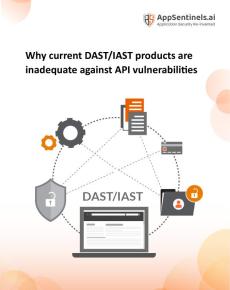
Why DAST/IAST products are inadequate against finding API vulnerabilities

During our various customer interactions, customers using Dynamic Application Security Testing (DAST) or Interactive Application Security Testing (IAST) often ask how AppSentinels solution is different compared to their existing tool: The core difference is AppSentinels API Security Platform understands the context of the Application it is protecting while DAST/IAST products unfortunately don't. Let me explain why I am saying this and why this is important.
Detect, Deflect, Protect: The Story of Third-Party Cyber Risk Management

Your business is your castle. Once upon a time, you could keep it safe by constructing strong walls, posting a few guards at the door, raising the drawbridge, and digging a deep moat around it. That's now the stuff of fairy tales. Today's networks simply can't be locked down due to the nature of business itself. The perimeter that was once contained to a single building now spreads as far as your furthest third-party connection or remote employee. And while your business benefits from this greater flexibility and increased operational efficiency, so do the cybercriminals.

Building Trust in the Supply Chain with Cyber Resiliency

When it comes to designing or improving upon your organization's security program, one key area to focus on and include is cyber resilience. Either as a complementary stand-alone program or embedded into an existing cyber defense program, cyber resilience refers to a company's ability to continue business operations and outcomes in spite of cyber attacks or events.

What Does a Third-Party Breach Look Like?

In the past few years, third-party cyber attacks have imparted financial and reputational damage to every sector, from banks to healthcare systems to governments. The average cost of a third-party data breach in 2021 was $4.33 million, according to a report from IBM and the Ponemon Institute. While CISOs are well aware of the potential supply chain devastation from attacks, preventing them has been a challenge. In this white paper, we'll walk through three third-party breach scenarios, including real-world examples, offering practical solutions to prevent such attacks.