Security | Threat Detection | Cyberattacks | DevSecOps | Compliance

Navigating the New VMware Reality: What Broadcom's Changes Mean for Your Business

When Broadcom completed its $69 billion acquisition of VMware in November 2023, most customers assumed the initial disruption would settle. Licensing models would stabilise. Partner programmes would find a new equilibrium. Pricing would normalise. Two years in, it’s clear that didn’t happen.

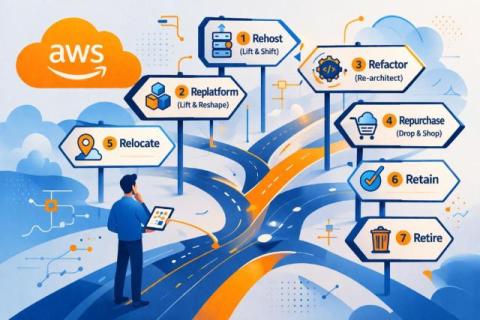
The 7 Rs of AWS Application Migration: Choosing the Right Path for Each Workload

Most application migration projects fail the same way: someone picks a single strategy for the entire portfolio, then tries to force every workload into it. Lift-and-shift everything to meet a data centre exit deadline. Refactor everything because someone read a cloud-native manifesto. Retire nothing because no one wants to make the decision. AWS’s 7 Rs framework exists to prevent that.

What AWS Transform Means for Your Application Modernization Strategy

Technical debt costs US enterprises an estimated $2.41 trillion per year, according to Accenture research cited by AWS. For most organisations, roughly 30% of engineering time gets absorbed by maintaining legacy systems – work that’s necessary, but produces no new business value. That’s the problem AWS has been trying to solve with AWS Transform, its agentic AI service for enterprise application modernization.

Lift and Shift vs. Refactor: Choosing the Right AWS Migration Strategy

The debate over lift and shift versus refactoring is one of the most persistent in cloud migration planning. It’s also frequently framed as a binary choice when it shouldn’t be. Most organizations will do both — the question is which approach applies to which workload, and in what order. Getting this decision wrong is expensive. Over-refactoring adds months to migration timelines and cost that’s difficult to justify.

Opti9 Becomes Authorized Anthropic Reseller via Amazon Bedrock

Opti9 recently announced it has been approved as an authorized reseller for Anthropic models through Amazon Bedrock, further strengthening its ability to deliver secure, enterprise-grade AI solutions on Amazon Web Services (AWS). In October, AWS enabled its Solution Provider Partners to resell Amazon Bedrock, a fully managed service that provides access to a wide range of leading foundation models from top providers.

AWS Accelerator Program: How to Move to the Cloud Faster (and Cheaper)

Cloud migrations have a reputation for running over budget and behind schedule. That reputation isn’t entirely undeserved — migrations done without structure often do. But AWS has invested heavily in programs that give businesses a faster, cheaper path to the cloud, and most organizations don’t know they exist or how to access them. The AWS Accelerator Program is one of the more practical frameworks available for SMBs and mid-market companies planning a move to AWS.

DR Testing for Law Firms: Why 'We Have Backups' Isn't Enough

“We have backups” might be the most dangerous phrase in law firm IT. According to the ABA’s 2023 Legal Technology Survey, only 34% of law firms have an incident response plan – and far fewer regularly test their ability to actually recover from a disaster. Having backups and being able to recover from them are two very different things.

Microsoft 365 Backup for Law Firms: What Microsoft Doesn't Protect

Most law firms have moved email, documents, and collaboration to Microsoft 365. And most assume Microsoft is backing up that data. They’re wrong. According to Microsoft’s own Services Agreement, “We recommend that you regularly backup Your Content and Data that you store on the Services or store using Third-Party Apps and Services.” Microsoft provides infrastructure redundancy—if their data center has a problem, your data is replicated elsewhere.

Business Continuity for Law Firms: Protecting Billable Hours and Court Deadlines

Law firm economics are unforgiving. According to the Clio Legal Trends Report, the average attorney bills only 2.5 hours per 8-hour workday. When IT systems fail, that already-thin margin disappears entirely. Consider a 20-attorney firm with average billing rates of $350 per hour.

Cybersecurity as Competitive Advantage: Why Clients Will Pay More for Secure Law Firms

Here’s a number that should change how law firms think about IT security budgets: 37% of clients are willing to pay more for firms with strong cybersecurity measures. That’s not a soft preference – it’s a purchasing decision. According to the 2025 Integris Report on Law Firms and Cybersecurity, clients are actively factoring security into their choice of legal counsel.