Security | Threat Detection | Cyberattacks | DevSecOps | Compliance

CVSS Scoring Issues: Why Your Score is Lying to You

Modern exposure management has evolved beyond vulnerability scanning and alert volume into a discipline focused on measurable risk reduction. As the exposure management market matures, security leaders are adopting cyber exposure management platforms that unify signals across vulnerability, cloud, application, and attack surface tools to prioritize what truly matters.

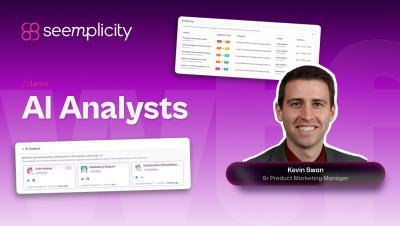
AI Analysts for Autonomous Vulnerability Response

Security teams are drowning in findings, not because scanners miss things, but because nothing confirms which ones an attacker could actually reach. Seemplicity AI Analysts run the investigation themselves, checking runtime configuration, network reachability, and exploit conditions for each finding, and re-rank your backlog by confirmed exploitability. What rises to the top is backed by evidence. What drops down has been checked and reasoned out.

How to Use AI for Vulnerability Management

With over 48,000 CVEs published in 2025 and attackers weaponizing vulnerabilities in as little as 20 hours, traditional vulnerability management is no longer enough. This post breaks down the key findings from the SANS whitepaper The Exposure Gap: From Vulnerability Management to AI-Driven Control, and what it means for security teams trying to get ahead of risk. In 2025, over 48,000 CVEs were published. That’s roughly 130 new vulnerabilities every single day.

Application Security Already Knows What's Broken. Context Is How You Fix It Faster.

While traditional security tools excel at finding vulnerabilities, the sheer volume of alerts—now accelerated by AI-driven development—has made manual triage impossible. The true value of Application Security Posture Management (ASPM) lies not in providing more visibility or creating a cleaner backlog, but in shifting from cataloging risk to taking fast, context-driven, machine-speed action to actually fix what is broken.

Vulnerability Remediation Takes More Than Just an AI Agent

AI agents can investigate a single vulnerability brilliantly, but that is only about 20% of vulnerability remediation. This post breaks down the other 80%: the data normalization, cross-tool asset identity, SLA enforcement, exception governance, and audit evidence that turn individual agent outputs into a governed, provable remediation program, and why AI and a platform like Seemplicity work better together than apart.

WTF: What's the Fix?

In the cybersecurity industry today, we are often overwhelmed by endless findings, leaving us asking: WTF?! At Seemplicity, we are shifting the conversation from identifying problems to executing solutions. Whether it's: This video captures the energy from the recent Guidepoint kickoff event in Orlando, where Guidepoint reps, integration partners, and the Seemplicity team came together to redefine what WTF means for the future of exposure management.

EDR Compensating Controls Awareness

Seemplicity’s new EDR Compensating Controls Awareness feature reduces vulnerability backlogs by embedding live, asset-level endpoint telemetry directly into remediation workflows. By automatically mapping EDR policy configurations against specific CVE attack techniques, the platform determines if an active endpoint control already neutralizes a threat. Each finding is dynamically assigned a clear protection outcome, complete with an auditable evidence trail.

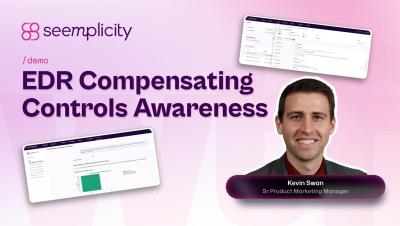
EDR Compensating Controls Awareness

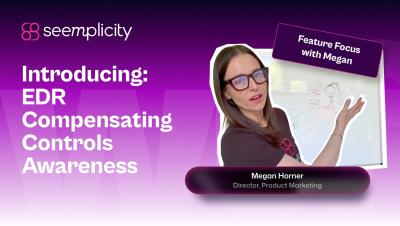
Are you tired of chasing high CVSS scores that don't reflect your actual risk? In this video, we introduce a new addition to the Seemplicity Exposure Action Platform: EDR Compensating Controls Awareness. This new feature bridges the gap between theoretical severity and verified exposure. By ingesting live telemetry from EDR platforms like CrowdStrike and Microsoft Defender, Seemplicity maps your existing security controls against the specific exploit techniques used by CVEs.

Exposure Management in the AI Era | Introducing EDR Compensating Controls Awareness

In this Feature Focus, Megan Horner, Product Marketing Director at Seemplicity, explores the evolving landscape of vulnerability management in the AI era. As the rise of AI models like Claude Mythos enables attackers to shrink exploit windows, security teams are facing an overwhelming flood of high-priority vulnerabilities.

AI vs. AI: Fighting the Next Wave of Cyber Attacks with Ravid Circus

Recently our CMO, Tony Thompson, caught up with Seemplicity co-founder and CPO, Ravid Circus, in Paris to talk about the massive shift in the cybersecurity landscape caused by Claude Mythos. As AI research models like Claude Mythos hyper-scale the ability to identify vulnerabilities and weaponize exploits in minutes rather than months, traditional risk-based vulnerability management must evolve. In this video, you will learn.