Security | Threat Detection | Cyberattacks | DevSecOps | Compliance

Membership Inference Attacks in AI: How They Expose Training Data?

AI models are becoming essential to enterprise innovation, but the sensitive data that powers them is creating new security and privacy challenges. Even when raw training datasets remain inaccessible, attackers may still identify whether specific information was used to train a model through membership inference attacks.

Global Teams, Local Languages: Closing the Multilingual Privacy Gap

A privacy policy that only works in English is not a global privacy policy. It is an English-language policy that a global company happens to be using. That distinction matters more than most teams realize. Enterprises now centralize contracts, HR files, healthcare records, and support conversations from regional offices around the world into a shared AI platform, often assuming that whatever detection and masking logic works for their English-language content will work everywhere else. It does not.

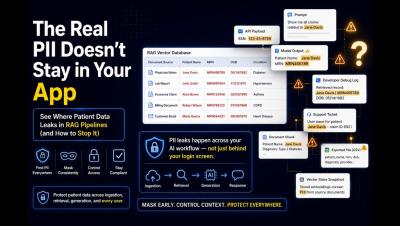
Why Your Healthcare RAG Pipeline Is Leaking PHI (And How to Fix It)

Why Your Healthcare RAG Pipeline Is Leaking PHI Most healthcare organizations believe their AI assistant is secure once they restrict who can log in. Unfortunately, that's only part of the story. Modern healthcare AI applications rely on Retrieval-Augmented Generation (RAG), where patient records, physician notes, insurance claims, and medical documents are embedded into vector databases to power intelligent search.

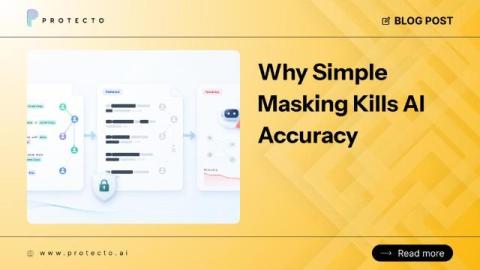
Why Simple Masking Kills AI Accuracy

Here is a document going into an AI assistant: A simple masking system produces: The information is protected, but the document has become almost impossible for the AI to reason about. It no longer knows who introduced whom, who approved the proposal, or whether the same person appears multiple times. By removing identity, we destroyed the relationships that give the document meaning.

How to Securely Roll Out Enterprise AI in 90 Days #shorts #aisecurity

Planning an enterprise AI rollout in 90 days? Establishing a robust AI Gateway Architecture is the critical first step to ensuring data compliance, enforcement, and security. Letting application traffic run straight to LLMs exposes your organization to severe security and compliance liabilities.

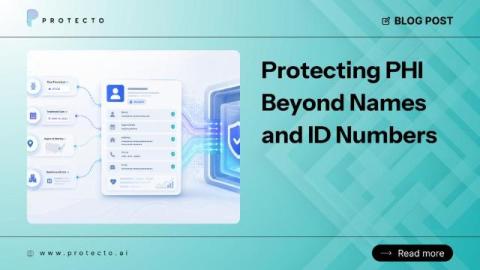
Protecting PHI Beyond Names and ID Numbers

A few years ago, an Australian government health agency released what it believed was a fully de-identified dataset covering 10% of the national population. Names, addresses, and other obvious identifiers had been stripped out. Researchers showed individuals could be re-identified using nothing more than rare medical procedure codes and treatment dates cross-referenced with publicly available information. No names were needed.

AI Traffic Security: The Hidden Risk of Unstructured Data Leakage #aisecurity

Understanding the nuances of AI Traffic Security is critical because traditional firewalls and API gateways are fundamentally ill-equipped to inspect unstructured natural language. In the past, enterprise data remained safely within the corporate perimeter. Today, employees are pasting highly sensitive information directly into external models, creating a massive vulnerability where the risk lies in the meaning and content, rather than syntax or connections.

Why Sensitive Data Detection Is Harder in AI Workflows

Sensitive data used to live in predictable places database columns, known field names, structured rows. That changed when data moved into documents. And it changed again when AI workflows arrived. In this video, we walk through why detecting sensitive data in AI pipelines is fundamentally different from traditional data discovery, and why the old approaches break. We cover the four failure modes that make detection hard in AI workflows.

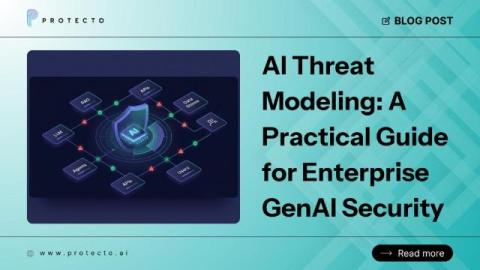
AI Threat Modeling: A Practical Guide for Enterprise GenAI Security

Here is a number that should stop every CISO cold. Gartner projects that by 2028, 25% of enterprise GenAI applications will face five or more security incidents per year, nearly triple the 9% recorded in 2025. The acceleration is not slowing. Meanwhile, research by OpenText and the Ponemon Institute finds that 79% of organizations have not yet reached full AI maturity in cybersecurity, meaning most enterprises are deploying generative AI without the foundational controls needed to govern it.

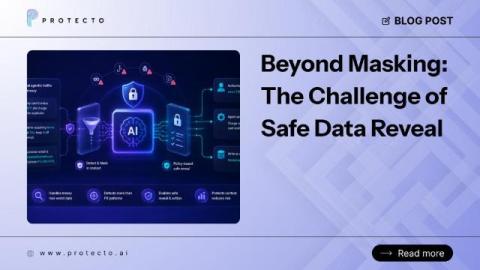
Beyond Masking: The Challenge of Safe Data Reveal

You can build a masking demo in an afternoon. Run a regex for credit card patterns, swap the match for XXXX, and ship it. The demo works, the compliance slide says “no PII sent to the LLM,” and everyone moves on. That demo is fooling you by leaving things out. It works because the input is a) clean (card 4111 1111 1111 1111), b) because the only sensitive thing in it is a textbook PII pattern, and c) because nobody downstream ever needs to use the value again.

Your AI Agent Could Leak Enterprise Data #Shorts #aiagents

AI agents don't just answer questions—they access enterprise data, call APIs, interact with MCP servers, and trigger workflows. That means sensitive information like PII, PHI, HR records, pricing data, financial information, and confidential business data can flow through AI systems. In this YouTube Short, Amar Kanagaraj explains why AI governance, data security, and data sovereignty are essential for enterprise AI deployments—and how the NetScaler × Protecto integration helps organizations secure AI workflows.

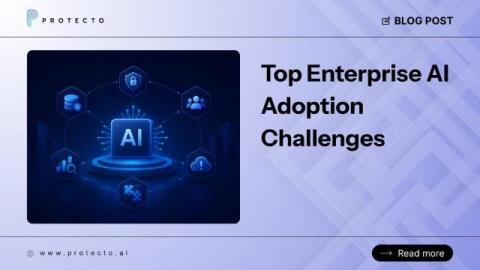
Top Enterprise AI Adoption Challenges

AI today has moved beyond experimentation. In the modern age, enterprises are embedding AI across various aspects of their businesses, including customer support, document processing, software development, healthcare, financial services, and decision-making workflows. According to a recent McKinsey report, 88% of businesses use AI in at least one business function. This reflects how AI is now becoming the center of several enterprise operations.