Security | Threat Detection | Cyberattacks | DevSecOps | Compliance

UN Convention Against Cybercrime Is a Huge Win!

One of the biggest reasons why cybercrime is so bad — and is increasing each year —is that so much of it is committed by foreign nationals who are not physically located in the country they are attacking. This makes it far harder for law enforcement to identify, stop and arrest cybercriminals, as often the victim country’s legal jurisdictions, warrants and courts do not apply in the criminal’s country.
When a "Contact Us" Form Becomes "Contact a Cybercriminal"

Cybercriminals want their payday. Unfortunately for the targets of phishing (and the organizations they work for) that means they’re constantly refining their tactics to create more sophisticated attacks that are harder to detect – by both email security products and people. Impersonation attacks enable cybercriminals to leverage the trusted relationships and – often – authority of people and brands that the recipient knows and trusts.

Report: Organizations Are Struggling to Keep Up With AI-Powered Attacks

76% of organizations are struggling to keep up with the sophistication of AI-powered attacks, according to CrowdStrike’s latest State of Ransomware Survey. “Most organizations (87%) consider AI-generated social engineering tactics more convincing than traditional methods,” the report says.

The Human-AI Partnership: Securing the New Dual-Front of Business Risk

The integration of artificial intelligence into the modern workplace represents a paradigm shift in productivity and innovation. From desktops to mobile devices, AI agents are now deeply embedded in daily workflows, augmenting human intelligence and accelerating business processes at an unprecedented scale.

Insider Risk, Ethical Walls and the Future of Data Governance in Financial Services

In the complex ecosystem of financial services, some of the greatest threats come from within. While cybersecurity for financial institutions often focuses on external threat actors, the reality is that insider risks—whether intentional or accidental—pose an equally dangerous challenge to regulatory compliance and organizational integrity.

Is It Or Is It Not an HP Scam?

These days it can be hard to tell if something is or isn’t a scam. Take this email I recently received. It claims to be from HP. It included a PDF file attachment: It would be great if it actually told me the product it was referring to beyond some obscure serial number. I checked the serial number. It didn’t match my HP printer sitting next to my desk. All my laptops and older desktop computers are Dell. I didn’t like how it didn’t have my full name. Just Roger. No product name.

Report: More Than Half of Adults Encountered a Scam Last Year

Researchers at Bitdefender warn that scams are seeing a steady increase globally. Citing a recent report from the Global Anti-Scam Alliance (GASA), the researchers note that 57% of adults worldwide have reported encountering a scam in the past year, and 13% encounter a scam at least once per day. One in four adults lost money to a scam, and annual global scam losses now exceed $1 trillion.

Phishing Campaign Impersonates Google Careers Recruiters

A phishing campaign is impersonating Google Careers to target job seekers, according to researchers at Sublime Security. “The scam is simple,” the researchers write. “An adversary sends an ‘are you open to talk?’ message impersonating an outreach email from Google Careers. If the target clicks the link, they’re taken to a landing page designed to look like a Google Careers meeting scheduler. From there, they’re taken to the phishing page.

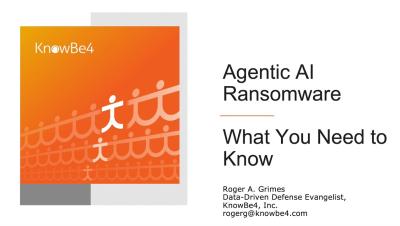
Agentic AI Ransomware: What You Need to Know

Brace yourself for agentic AI ransomware. It's a terrifying fusion of cutting-edge tech and malicious intent that's set to redefine cyber threats as we know them. Unlike traditional ransomware, which follows pre-programmed rules, agentic AI ransomware can adapt its behavior in real-time based on its environment and the defenses it encounters.

Minimizing liability is not the same as security: Lessons learned from Collin's Aerospace cyberattack

In late September 2025, several European airports reported significant delays and flight cancellations due to issues with their check-in and passenger systems. Collin’s Aerospace, the vendor of the vMUSE check-in system, had been hit by a ransomware attack. ARINC error message: Source: Cyberplace.social.

Phishing Campaign Impersonates Password Managers

A phishing campaign is impersonating LastPass and Bitwarden with phony breach notifications, BleepingComputer reports. “An ongoing phishing campaign is targeting LastPass and Bitwarden users with fake emails claiming that the companies were hacked, urging them to download a supposedly more secure desktop version of the password manager,” BleepingComputer writes.

Minimizing liability is not the same as security: Lessons from Recent Airport Cyber Disruptions

Blog post updated for clarity. In late September 2025, several European airports reported significant delays and flight cancellations due to disruptions with their check-in and passenger systems. As a global leader in aviation technology and the backbone of passenger travel, protection of systems and customer operations is paramount for Collins Aerospace. Nonetheless, the vendor of the vMUSE check-in system had been hit by a ransomware attack.

Alert: Watch Out For Phishing Attacks in the Wake of the AWS Outage

Cybernews warns that threat actors will likely take advantage of the recent AWS outage to launch phishing attacks against affected users. Attackers frequently exploit high-profile events to carry out social engineering attacks while people are confused or stressed, as these users are more likely to act without careful consideration.

Building Trust in the Digital Age: How Financial Services Can Balance Security and Speed

In the high-stakes world of financial services, trust is the cornerstone of every client relationship. But here's the challenge that keeps financial leaders up at night: how do you maintain the stringent security clients demand while delivering the rapid response they expect? It's a delicate balancing act that has become increasingly complex in our digital-first world. The reality is stark. A data breach can trigger a mass exodus, with 33% of clients saying they'd switch providers after a data incident.

Attackers Abuse Grok to Spread Phishing Links

Threat actors are abusing X’s generative AI bot Grok to spread phishing links, according to researchers at ESET. The attackers achieve this by tricking Grok into thinking it’s answering a question, and providing a link in its answer. “In this attack campaign, threat actors circumvent X’s ban on links in promoted posts (designed to fight malvertising) by running video card posts featuring clickbait videos,” ESET says.

[Cybersecurity Awareness Month]: Keeping Enkryptor at Bay: How We All Can Help Beat Back Ransomware

Ransomware is the gift that keeps on giving… and taking. I’ve been tracking ransomware for almost nine years now, and I’ve seen it progress from simple and annoying malware to an organization-ending threat for many. I’m not big on pushing FUD (Fear, Uncertainty and Doubt), so when I say that it is one of the biggest cyberthreats to organizations in the small and medium-sized business space, I am not exaggerating.

Half of Young People in the UK Cite Non-Consensual Deepfakes as a Top Fear

A new survey found that 50% of UK residents aged 16 to 34 cite deepfake nudes as their top worry related to AI technology, SecurityBrief reports. The survey, published by VerifyLabs, found that 35% of Brits across all age groups said sexualized deepfakes of themselves or their children were their top concern. “The study indicated that more than one in three respondents (36%) are also worried about the impact deepfakes could have on their family and friends,” SecurityBrief writes.

Phishing Remains the Top Initial Access Vector in Cyberattacks Across Europe

Phishing was the initial access vector for 60% of cyberattacks across Europe between July 2024 and June 2025, according to the European Union Agency for Cybersecurity (ENISA). “With regards to the primary method for initial intrusion, phishing (including vishing, malspam and malvertising) is identified as the leading vector, accounting for about 60% of observed cases,” the agency says.

The Compliance Catch-22: How Financial Institutions Can Master Data Governance and Regulatory Risk

The financial services industry operates in one of the most heavily regulated environments in the business world. With sensitive client data flowing through every transaction and communication, financial institutions face an increasingly complex web of compliance requirements that can make or break their operations. Traditional approaches to data governance simply aren't cutting it anymore. The Perfect Storm of Regulatory Challenges.

Protect Yourself From Voice Phishing Attacks Targeting Salesforce Instances

Google’s Mandiant has published guidance on defending against an ongoing wave of social engineering attacks targeting organizations’ Salesforce instances. The organized criminal gang tracked by Google as “UNC6040” has been using voice phishing attacks to trick employees into granting access.

We Need to Teach Our AIs to Securely Code

I have been writing about the need to better train our programmers in secure coding practices for decades, most recently here and here. At least a third of data compromises involved exploited software and firmware vulnerabilities and we are on our way to having over 47,000 separate, publicly known vulnerabilities this year. There are at least 130 new vulnerabilities learned and publicly reported every day, day after day. That is a lot of exploitation. That is a lot of patching.

The Engine Room: Powering Your Human Risk Management Strategy with Intelligent Tech

We’ve come a long way. We’ve deconstructed the problem, explored the complexity of humans, and laid out a strategic framework and a practical map—all of which can be explored in more detail in our Human Risk Management (HRM) whitepaper. Now for the final piece of the puzzle: the engine. A strategy this dynamic and personalised can't run on spreadsheets and manual effort alone. It needs to be powered by an intelligent, integrated platform.

Warning: Job Scams Surge by More than 1000%

Job-related scams surged by more than one thousand percent between May and July 2025, according to new research from McAfee. Job seekers are particularly vulnerable to scams, since they’re expecting to receive unsolicited messages and are more likely to overlook red flags. The researchers offer the following advice to help users avoid falling for these attacks: The researchers conclude that awareness is an essential layer of defense against social engineering attacks.

A Surge in Text Message Scams Targets Younger Americans

A new report warns of a significant spike in SMS phishing (smishing) scams targeting younger Americans between 18 and 29 years old. The report, released by Consumer Reports, Aspen Digital and the Global Cyber Alliance, also found that 30 percent of people who experienced a cyberattack or scam this year said it began over a text message or a messaging app, compared to 20 percent last year.

The Hidden Cybersecurity Threat: Securing the Human-AI Relationship

The conversation about AI in cybersecurity is missing the point. While the industry has been focused on the emergence of AI-generated phishing emails, perhaps a far more profound shift has been somewhat ignored. Your workforce is no longer just human. It's a hybrid team of people, AI agents, copilots, assistants and digital partners. This creates a new and complex attack surface. The next great security challenge isn't just protecting a human from a machine.

If You Have Not Realized It, Vishing Is Really Taking Off

Fighting voice-based phishing needs to be a big part of your human risk management (HRM) plan. KnowBe4 and the HRM industry have been warning about voice-based social engineering and phishing for decades. Some of the biggest and most notable hacks have long been based on it. Stories have often been told of brazen calls that resulted in big hacks.

Multitasking Employees Are Particularly Vulnerable to Phishing Attacks

Employees who multitask are significantly more vulnerable to phishing attacks, according to a study from the University at Albany published in the European Journal of Information Systems. “In real-world settings, users are frequently engaged in other digital tasks when a suspicious message appears, requiring them to momentarily interrupt their workflow,” the researchers write.

Cyber Risk Still #1: Why AI Is Raising the Stakes - and the Opportunities

If you’re wondering what keeps business leaders up at night, the latest Aon Global Risk Management Survey has a clear answer: cyber attacks and data breaches. Once again, they top the list as the risk to organizations worldwide — and the problem isn’t getting any smaller. In fact, Aon’s Cyber Risk Report shows incidents jumped 22% in 2025 alone.

Securing the Human-AI Boundary: Why the Future of Cybersecurity Must Train People and AI Agents

The cybersecurity landscape is undergoing its most dramatic transformation since the dawn of the internet. AI has become integral to business operations. Goldman Sachs estimates that agentic AI/AI agents will account for approximately 60% of software market value by 2030, and Gartner predicts that 40% of enterprise applications will integrate task-specific AI agents by 2026, up from less than 5% today.

New Phishing Campaign Uses AI Tools to Evade Detection

Microsoft warns that a recent phishing campaign used AI technology to obfuscate its payload and evade security filters. “Appearing to be aided by a large language model (LLM), the activity obfuscated its behavior within an SVG file, leveraging business terminology and a synthetic structure to disguise its malicious intent,” the researchers write.

Security Leaders Cite AI-Driven Phishing Attacks as a Top Concern

A new report has found that nearly 40% of security leaders believe their organizations are least prepared for phishing and other social engineering attacks, Help Net Security reports. According to the report from VikingCloud, these concerns are driven by the increasing use of AI tools to assist in cyberattacks. “Generative or agentic AI-driven phishing attacks (51%) are leadership teams’ top concern when it comes to new cyberattack techniques,” the report says.

Report: Deepfake Attacks Have Targeted Nearly Two-Thirds of Organizations

A survey by Gartner found that 62% of organizations have been hit by a deepfake attack in the past twelve months, Infosecurity Magazine reports. Akif Khan, senior director at Gartner Research, told Infosecurity Magazine that deepfakes are currently being used in social engineering attacks to impersonate executives and trick employees into transferring money. “That’s trickier because social engineering is a perpetually reliable thing for attackers to use,” Khan said.

The Future of Human Risk Management is KnowBe4

KnowBe4 is the most advanced human risk management platform. Our platform measures human risk in real time. monitors behavior to avert disaster, and mitigates with actual intelligence. It's your complete human security platform. Leveraging the data of 13 million users and 70 thousand to protect your organization.

Going DEEP: A Simple Framework for a Complex Problem

In our previous blog post, we discussed the behavioral science behind why people click on malicious links. So far in this series, we’ve established that our old security playbooks are broken and that we’re dealing with the complex psychology of the human brain. Trying to tackle that all at once can feel like herding cats. What we need is a simple, memorable mental map to bring structure to the chaos. Let’s go DEEP.

Building Trust in AI: KnowBe4's Journey Toward ISO 42001 Certification

At KnowBe4, everything we do is built on a foundation of innovation and trust. As we bring more artificial intelligence (AI) into our human risk management platform, we believe it’s essential to be transparent and responsible every step of the way. That's why we're proud to announce that we are pursuing ISO 42001 certification, the world's first standard for managing AI systems.