Security | Threat Detection | Cyberattacks | DevSecOps | Compliance

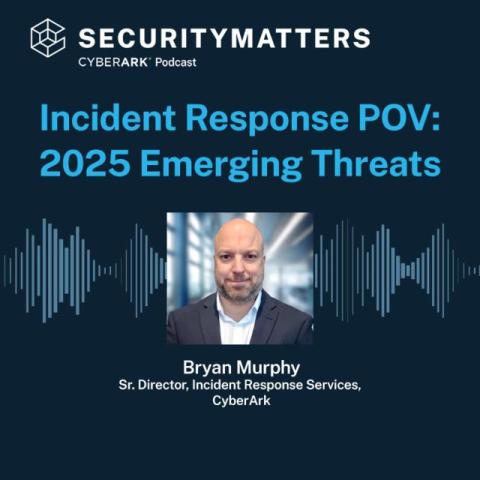
EP 6 - Incident Response POV: 2025 Emerging Threats

In this episode of Security Matters, host David Puner, dives into the world of evolving cyberthreats with Bryan Murphy, Senior Director of CyberArk's Incident Response Team. Imagine a scenario where an attacker uses AI-generated deepfakes to impersonate your company's VP of finance, gaining unauthorized access to your environment. Bryan Murphy shares insights on how these sophisticated attacks are turning identity into the attack surface and why your first line of defense might be as simple as a video call.

EP 6 - Incident Response POV: 2025 Emerging Threats

In this episode of Security Matters, host David Puner, dives into the world of evolving cyberthreats with Bryan Murphy, Senior Director of CyberArk’s Incident Response Team. Imagine a scenario where an attacker uses AI-generated deepfakes to impersonate your company’s VP of finance, gaining unauthorized access to your environment.

Whole-of-State Cybersecurity: A Unified Approach to Protecting Government

In today’s era, where the digital landscape is as critical as the physical, the urgency to adapt and reinforce our cybersecurity infrastructure is more pressing than ever. For government operations, where data breaches and cyberattacks frequently make the headlines, adopting a whole-of-state approach to cybersecurity isn’t just a precaution—it’s a strategic imperative to protect our communities and safeguard our future.

Unlocking New Jailbreaks with AI Explainability

In this post, we introduce our “Adversarial AI Explainability” research, a term we use to describe the intersection of AI explainability and adversarial attacks on Large Language Models (LLMs). Much like using an MRI to understand how a human brain might be fooled, we aim to decipher how LLMs can be manipulated.

TLS Certificate Validity Cut to 47 Days: What You Need to Know

The CA/Browser Forum’s recent unanimous vote to reduce maximum public TLS certificate validity to just 47 days by March 2029 marks a seismic shift in the digital security landscape. This new standard isn’t a proposal—it’s an approved policy. And every organization that issues or relies on public TLS certificates must begin preparations today. Because it’s no longer about watching Apple’s early lead in reducing lifespans but following an industry-wide mandate.

The Cybersecurity Investment Most Organizations Are Failing to Secure

Welcome to the 2025 Identity Security Landscape rollout—and to the “it’s complicated” phase of our relationship with AI. Each year, CyberArk surveys security leaders across the globe to understand their top identity security concerns. This year, AI delivered the trifecta: attack weapon, defense tool and risk multiplier.

Modern Cybersecurity Strategies for Linux Servers

Linux servers have become widely adopted across organizations of all sizes. However, the frustrations of integrating these servers have left organizations struggling to implement strong security procedures, which cyberattacks have exploited for years. For instance, the “perfctl” malware family has been targeting Linux servers and attempting to escalate privileges for over three years.

CIEM and Secure Cloud Access: Best Practices From Wiz and CyberArk

Let’s cut the fluff out of cloud security. As you build and innovate in the cloud, you create a maze of roles, permissions and resources that you must secure thoughtfully. The dirty secret is that as organizations launch and build new infrastructure, they also create a labyrinth of permissions that attackers can exploit if they get their hands on a valid password or credential.

CyberArk's Vision to Pioneer Secure Access for Workloads

Modern workloads operate across a complex landscape—cloud platforms, virtualized environments, data centers and SaaS applications. Each requires its own authentication method, from static credentials and PKI certificates to cloud service account tokens. The rapid growth and diversity of workloads across various cloud platforms and infrastructures—each relying on a mix of secrets, API keys, access tokens and passwords—have pushed workload access complexity to the limit.

Proactive Identity Security: Addressing Unmanaged Endpoint Risks

When an electrician comes to fix something in your house, you wouldn’t just hand over the keys and leave. Instead, you’d stay to supervise and ensure everything is done correctly. Similarly, unmanaged endpoints accessing sensitive corporate data, such as contractor laptops, personal computers and call center systems, require the same level of oversight.

Securing Identities for the Agentic AI Landscape

Twenty-five years ago, we set out to tackle one of the most challenging problems in identity security: Securing privileged access. Today, CyberArk takes another giant step forward, extending our leading identity security to the rapidly evolving challenge of securing AI agents. And this is no small undertaking. Due to their autonomous mandate, AI agents are growing to be among the most privileged machine identities that enterprises have ever seen.

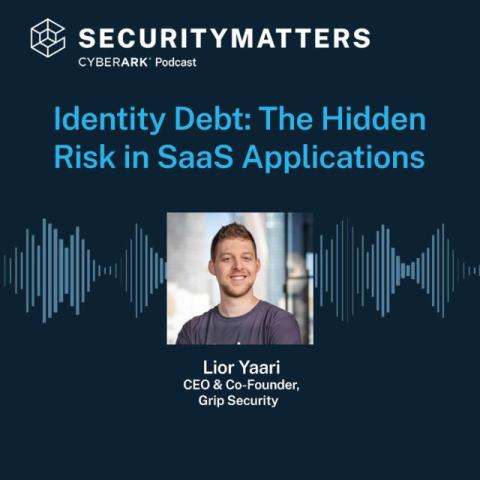
EP 5 - Identity Debt: The Hidden Risk in SaaS Applications

In this episode of the Security Matters podcast, host David Puner sits down with Lior Yaari, CEO and co-founder of Grip Security, for a discussion that covers the concept of identity debt and its implications for modern cybersecurity. Lior shares insights from his experience in Israel’s elite Unit 8200 and explains why identity is now the new security perimeter.

EP 5 - Identity Debt: The Hidden Risk in SaaS Applications

In this episode of the Security Matters podcast, host David Puner sits down with Lior Yaari, CEO and co-founder of Grip Security, for a discussion that covers the concept of identity debt and its implications for modern cybersecurity. Lior shares insights from his experience in Israel's elite Unit 8200 and explains why identity is now the new security perimeter. They delve into the challenges organizations face in managing SaaS applications, the impact of generative AI on cybersecurity and the importance of proactive identity governance.

Discovery Alone Is Not Enough: You Need Context to Secure Machine Identities

The digital landscape continues to undergo dramatic transformations. Long gone are the days when software, servers and infrastructure were monolithic and centralized. Today, organizations operate in a distributed and modular world, where machine identities are everywhere and environments are in various states of flux. AI and agentic AI are already starting to expand the volume and complexity of machine identities.

CIO POV: Identity and the Unbalanced Tension Between Attacker and Defender

Protecting a large enterprise is like playing goalkeeper in a soccer match. A CISO’s job is to keep the net clean while multiple attackers close in from various angles, aiming to score. No matter how many shots the goalie blocks, a single goal can win the game for the opposition.

Quantum Chip Breakthroughs: Why Machine Identity Resilience Can't Wait

Quantum computing isn’t just coming—it’s barreling toward us, flipping the rules of cybersecurity like a table in a bad action movie fight scene. And it begs the question every CISO and IT security professional should be asking right now: Are we ready for the quantum leap? While this groundbreaking technology promises extraordinary advancements, from AI breakthroughs to disease modeling, a darker shadow lurks beneath its potential.