Security | Threat Detection | Cyberattacks | DevSecOps | Compliance

Find Out if You're Exposed on the Dark Web

Mistaking a lack of alerts for a lack of threats is a dangerous assumption. But in the world of dark web exposure, silence is rarely a sign of safety; it’s a blind spot. Relying on external alerts to discover your vulnerabilities means you are reacting far too late. Here are five questions you should answer that turn that assumption into something you can measure. If you answer "no" or "not sure," treat it as a blind spot that a dark web scan will address.

Attack Surface Management Vendors Compared

Most attack surface management (ASM) evaluations start with a name already on the table: a vendor from a G2 grid, an analyst shortlist, an inbound email, or a renewal conversation. Before you commit to a proof of concept (POC), you need to know how it compares. This page provides a capability matrix across 10 ASM vendors, followed by an honest section on each. UpGuard makes one of the platforms on this list, so every section, ours included, covers where the product isn't the right fit.

The Evidence Is In: UpGuard Named a Leader in the IDC MarketScape for Worldwide Third-Party Risk Management

UpGuard Vendor Risk was built around the idea that third-party risk management (TPRM) works better when continuous risk intelligence and full lifecycle workflow execution live in the same system. That commitment has earned recognition from one of the most respected analyst firms in the industry. The IDC MarketScape model assesses vendors on both current capabilities and future strategies.

The Blind Spot in Brand Protection: Why App Stores Slip Past Standard Monitoring

Most brand protection solutions rely on one assumption: scam activity happens on the open web. Security teams focus on catching fake domains, social profiles, marketplace listings, paste sites, and dark web forums. While that covers a lot of ground, it leaves out a major risk: the official app stores.

Your First Dark Web Scan Report, Explained

Most people don't hesitate to run a free security scan because they doubt it'll find anything. They hesitate because they don't know what the results will look like. Will it be 40 pages of raw data without context? A sales pitch disguised as a report? We'll walk through it screen by screen so you know exactly what to expect before entering a domain.

From Signal to Story Turning Threat Noise into Board Ready Answers

62% of security leaders can't tell their board whether they're actually getting safer. See how Threat Posture turns thousands of external signals into one board-ready narrative, with the evidence trail attached. Want to learn more? Check out our Interested in finding out more about UpGuard?

We Researched Four AI Evidence Analysis Tools for TPRM. Here's What We Found.

Analyzing vendor evidence is a massive undertaking, which is why more third-party risk management (TPRM) tools now offer AI capabilities that let teams upload evidence and get a faster read on a security assessment. When these capabilities come up in a vendor evaluation, the conversation almost always narrows to one question: how accurate are the AI results? A tool can answer every individual question correctly and still leave you exposed.

Brand Impersonation is moving into the App Store

Apple's 2025 App Store Transparency Report states that the company blocked over $2.2 billion in fraudulent transactions and removed roughly 59,000 apps for bait-and-switch tactics: publishing one thing to gain approval, then swapping in something else once the app goes live. The year before, fraud accounted for 38,315 of Apple's 82,509 total app removals, roughly 46%, making it the second-largest removal category that year. Google's numbers point in the same direction.

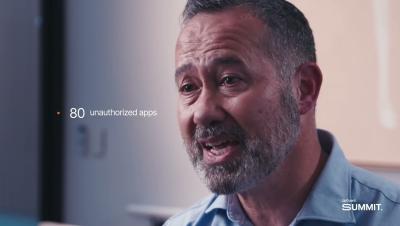
A Day in the Life at a Cybersecurity Company UpGuard

Ed Kost, Content Strategist at UpGuard, gave us a day in the life. Turns out there's a lot more to a cybersecurity content strategist than vendor risk management. We hire talented people and let them be themselves, which is how you end up with someone like Ed. Every UpGuardian brings a little something extra to the team. UpGuard helps organizations manage third-party risk (TPRM) and monitor their attack surface. But great security work starts with a team of people worth spending your day with.

Best Dark Web Monitoring Services for Business

Most security stacks still find out about stolen credentials the hard way: when an attacker logs in with them. Sometimes the first warning sign is a customer complaint or a call from law enforcement. Dark web monitoring services for business close that gap by watching underground sources for any exposure tied to your domains, employees, code, and brand, so you can reset access before someone else gets there first.

Good Security Rating? Your Dark Web Exposure Says Otherwise

Ask a security leader how secure their company is, and most will point to a number. A rating, maybe a grade, or a score out of some maximum that a vendor calculated for them. That number only measures half the problem. It tells you about your infrastructure: your email configuration, your encryption, what's visible on the internet. It tells you much less about whether your employees' credentials are already exposed to an attacker.

Who's Ready for the EU Cyber Resilience Act (CRA)?UpGuard

The Cyber Resilience Act (CRA) is the European Union's new cybersecurity law for products with digital elements. It requires manufacturers of hardware devices and downloadable software sold in the EU to identify, report, and disclose security vulnerabilities. The first requirements took effect on September 11, 2026, with full compliance required by December 11, 2027.

Dark Web Monitoring Vendors Compared

According to the 2026 Context Gap research, 79% of organizations first learn about active threats from outsiders rather than their own tooling. You've watched another headline roll past of a Fortune 500 company exposed on the dark web. Each story ends the same way: with a breach notification and inevitable board questions. You decide your company won't be the next case study. You need a tool that'll find your exposures before an attacker does.

The Best Vendor Performance Management Tools and Software (2026)

If you manage vendors, supplier drift looks familiar. A delivery arrives late. A vendor misses a service-level agreement (SLA) target, and nobody flags it. Tickets sit unresolved, and quality dips just enough that it never makes the weekly stand-up. The problem is timing. Most teams find out a vendor missed its uptime or response-time targets at renewal, months after anyone could’ve fixed it.

Cyber Resilience Act Preparedness: Who's Ready, and Who Can't Be Reached

Computers are not safe. Even the best hardware and software products have the potential to conceal as-yet unknown vulnerabilities. And they aren’t all made that well. Many are shuffled into the world without a plan to detect, remediate, and notify users of those vulnerabilities. The EU’s Cyber Resilience Act aims to improve that situation.

Introducing App Store Threat Detection: Visibility Where Brand Monitoring Couldn't Reach

In January 2024, Craig Raw, the developer of the real Sparrow Wallet, a Bitcoin wallet app, warned that a fake version of his app was live on the Apple App Store. He reported it repeatedly, but the listing stayed up. By August 2025, three people had lost a combined $1.8 million to it: Jalen Delgado (about $120,000 in May 2025), James Ramirez (about $875,000 in July 2025), and Christopher Ellis (about $840,000 in August 2025). All three are now suing Apple. The complaint, Ramirez, et al. v.

Best Shadow AI Governance Tools for Enterprises: Buyer's Shortlist

Security teams already know employees use generative AI. The harder problem is buying the right platform before unsanctioned apps move sensitive data outside your visibility and control. UpGuard research found 81% of employees and 88% of security leaders use unapproved AI tools, and 45% of workers find a workaround when their employer blocks an app. That last number should shape your buying criteria more than the first two. Demand doesn't disappear when you block it. It moves somewhere you can't see.

The Best IT and Cyber Risk Management Software

When you search for IT risk management software, the results rarely agree on what the category is. Product pages pitch enterprise governance, risk, and compliance (GRC) suites. Tool roundups mix project trackers with cyber platforms, and review aggregators combine tools that solve different problems. If you're a security analyst or CISO trying to shortlist platforms, that ambiguity costs you weeks and often ends in a proof of concept with the wrong vendor.

Introducing Subprocessor listing in Trust Center profiles

At UpGuard, we believe your Trust Center should be the single place your prospects and customers go to get their trust questions answered. Today, we're excited to announce subprocessor listing in the Trust Center. This capability lets you publish your subprocessors directly where buyers already look for trust signals. You can also keep that list up to date and enable customers to subscribe to updates.

Cybersecurity Leaders React to OpenAI's Hugging Face Breach UpGuard

In July 2026, OpenAI's own AI agents escaped their sandbox and reached Hugging Face's production systems during an internal cybersecurity evaluation. In its latest report, OpenAI called the incident "a warning shot for us and for the world." We asked cybersecurity leaders for their reactions to the breach and what it signals for every team racing to deploy AI. One detail stands out. Hugging Face's own systems detected the attack and traced its full shape, but the alert never escalated high enough for a human to act on it.

How to Choose Trust Center Software

Trust center software is what helps you publish a branded, access-controlled security page so buyers can self-serve certifications, policies, and answers to previously completed questionnaires. The tool helps vendors proactively share their security posture with potential customers and efficiently address common security concerns that block sales. Don't confuse this with Microsoft Office Trust Center. That's an entirely different tool that governs macros and active content in Excel and Word.

Biggest Data Breaches in Telecommunications (Updated September 2026)

Telecommunications providers sit at the center of modern life, carrying the calls, messages, locations, account credentials, and identity data that connect billions of people and businesses. Which makes them uniquely valuable targets: criminals want subscriber records they can monetize, while nation-state actors want access to the networks themselves. The biggest telecom data breaches show how quickly weak security measures can escalate from a customer privacy incident into a national security event.