Security | Threat Detection | Cyberattacks | DevSecOps | Compliance

How leveraging Address Resolution Protocol ensures seamless networking

Let’s start with the fundamentals: What is Address Resolution Protocol (ARP)? ARP is a vital networking protocol that ensures effective communication between devices on a local-area network (LAN). Its primary function is to map IP addresses to MAC addresses, allowing devices to recognize and communicate with each other within the network. ARP bridges the gap between the logical layer (IP addresses) and the physical layer (MAC addresses).


Top tips: Four ways to minimize your digital footprint

Top tips is a weekly column where we highlight what’s trending in the tech world and list ways to explore these trends. This week, we’re looking at how you can reduce the amount of data you share online and minimize your digital footprint. How would you like it if someone followed you throughout the day, noting every single action you perform, every place you visit, and every interaction you have? Think about it; isn’t this exactly what happens when you use the internet?

Beyond security: The role of network port scanners in efficient network management

Imagine you’re a network administrator responsible for maintaining a large enterprise network. While your IPAM tools help you track IP addresses, monitor DHCP and DNS, and manage subnets, there are times when these tools alone don’t provide you with the complete picture. For instance, you might encounter connectivity issues or unexplained slowdowns that don’t seem to be tied to any specific IP address or subnet. This is where a network port scanner is essential.

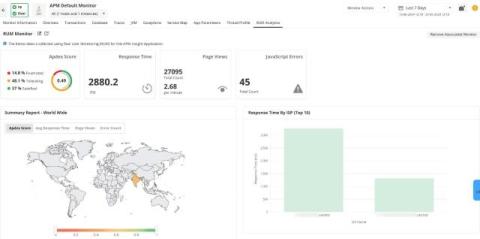
Introducing the RUM analytics dashboard in Applications Manager

We’re excited to announce the new RUM analytics dashboard in Applications Manager, integrating Real User Monitoring (RUM) with Application Performance Monitoring (APM Insight). This enhancement provides a unified view of server-side and client-side performance metrics, streamlining application monitoring and troubleshooting.

Centralize and conquer: Why multi-site DDI Central is a game changer for managing distributed on-premises networks

Managing distributed IT environments is no easy task. As networks grow increasingly complex and interconnected, centralizing their management becomes a daunting challenge. Traditional tools often fall short, struggling to balance centralized control with the unique configurations and autonomy required at each location. This challenge only amplifies as operations scale, leading to inefficiencies, inconsistencies, and operational silos that hinder productivity.

Top tips: Are you using cyber deception? Here's why you should

Top tips is a weekly column where we highlight what’s trending in the tech world and list ways to explore these trends. This week, we focus on ways to stop attackers and safeguard your organization. It’s a classic warfare method to thwart attacks: deception. Enemies use deception tactics to combat their foes on the battlefield, and it’s a method that’s all too common. But deception in technology? What exactly is that? Is it even a standard practice? It very much is.

Notable zero-day vulnerability trends in 2024: Insights and implications

2024 has seen a significant uptick in the discovery and exploitation of zero-day vulnerabilities. These unpatched security flaws present a serious challenge to cybersecurity teams, as attackers can exploit them before any patches are available. As a result, zero-day vulnerabilities have become a go-to tool for cybercriminals aiming to infiltrate enterprise networks.

Unlocking the power of Amazon VPC: Transforming security and efficiency across sectors

The rise in cyberattacks has become a pressing concern for organizations worldwide, threatening sensitive data, operational continuity, and trust. Cybercriminals are using increasingly complex strategies to attack vulnerabilities in systems and networks in a variety of organizations. By offering safe, segregated virtual networks in the cloud, Amazon Virtual Private Cloud (Amazon VPC) provides a strong defense against these attacks.

What is a VLAN? How does it simplify segmenting the network into smaller sections for easy monitoring?

A virtual local area network (VLAN) is the network segmentation method where administrators can divide one large network into smaller sections. This differs from physical segmentation, as it doesn’t require any hardware like routers, switches, and firewalls. Network resources of the organization can be virtually divided and monitored, which helps simplify management.