
Why Do Security Devices Fail in Heat and Vibration-and How Do You Design for Reliability?
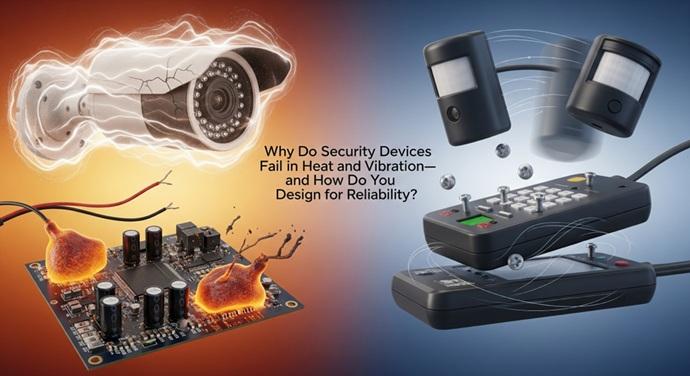
Security systems should be functioning at the time you need them the most. However, the point is that in this case, they tend to work in environments that would make the majority of electronics give up.
Imagine a surveillance camera on a desert highway, where it is 120°F and the sun is blaring. Or a movement detector in a factory store, which is shook by machinery all the time. These aren't edge cases. They are daily facts to security equipment.
When gadgets break down under these conditions, it is hardly a big bang or a visible collapse. Rather, they wear out gradually:
- A sensor begins to give false data.
- A connection becomes loose enough to induce periodic failures.
- A part simply ceases operation after months of thermal cycling.
Knowing why they occur and more importantly how to avoid them can be the difference between a security system that will last years and one that becomes a nightmare to maintain.
The Actual Effect of Heat on Electronic Parts
It is not just that heat makes things uncomfortable but it radically alters the behavior of materials. Electronic components have special operating ranges, but when the temperature goes beyond these ranges physics does its thing in a manner that is not very nice to your equipment.
Internal Component Failure
Think of what goes on within a normal security controller. With an increase in temperature:
- Conductors have an increase in resistance.
- Semiconductors begin leaking current.
- Capacitors lose charge holding capabilities.
Thermal Expansion: The Silent Killer
However, thermal expansion is usually the true murderer. Different materials expand at different rates when heated, and when you've got a circuit board with copper traces, an SMD component soldered to the surface, and a plastic housing holding everything together, those mismatched expansion rates create mechanical stress.
Eventually, this pressure causes microscopic cracks in solder joints—the most prevalent breakage in electronics that encounters temperature changes. A solder joint which appears flawless at room temperature may fracture in a hairline after a hundred heating and cooling cycles. It is sometimes still possible that the device does not stop. Sometimes it doesn't, and it only works, at times, when it is warm, and then the faults it produces are infuriatingly intermittent, and almost impossible to trouble-shoot.
When Vibration Becomes the Enemy
The other problem is that of vibration, and it is no less serious. The security apparatus on the poles, on the moving vehicles, or at the places close to the industrial machinery are under continuous mechanical stress. Vibration is recurrent and unlike a single drop or impact, it takes advantage of any vulnerability in the construction of a device.
Resonance and Mechanical Stress
The frequency is more than you may imagine. All physical structures resonate - they have a certain rate of vibration that causes them to vibrate with ever-increasing intensity. When the external vibration is same frequency as the resonant frequency, the movement due to the smallest forces is noticeable. I have witnessed camera housings literally shaking to pieces due to the mounting system coincidentally increasing vibrations at the inopportune frequency.
Wear and Tear on Connections
In-house elements have their struggles:
- Loose screws loosen out with time.
- Connections of wire wear and lacerate.
- Connectors which were not intended to move continuously form discontinuous contacts.
Here is where design decisions are critical; a part that is all fine on a lab bench may fail in weeks when it is subjected to the real world vibration.
The Design Strategies that Work
Reliability in harsh environments is not the aspect of design that is aimed at overbuilding everything and utilising the most expensive parts. It is regarding the knowledge of failure modes and tackling them in a systematic way.
1. Component Selection
Begin with the selection of components. Commercial components are more expensive than industrial grade, but they have broader temperature limits and are constructed to stricter tolerances. A car-grade capacitor, e.g. -40°C to +125°C, may be used, whereas a generic part may only work in 0°C to +70°C. That difference is all in a desert installation or a freezing northern climate.
2. Thermal Management
Active attention should be paid to thermal management. This does not only involve the addition of a heatsink. Consider airflow, thermal conductivity of housing material, and heat spread on the circuit board. Passive solution sometimes is the best, which is to use the metal housing of the device as a heat spreader. Other occasions, active cooling is required, but moving components have their own reliability issues.
3. Specialized Wiring
Working with a reputable wiring harness provider becomes crucial when you're designing connections that need to survive in challenging conditions. Off-the-shelf cables may be insulated with material that is brittle in low temperature (when cold) or sticky (when hot). The stress relief could not be sufficient in the case of moving installations. A properly designed harness employs materials that are chosen to suit the environmental conditions, has good strain relief, shielding where necessary and connectors that are rated to the anticipated temperature and vibration.
The Importance of Quality in Assembly
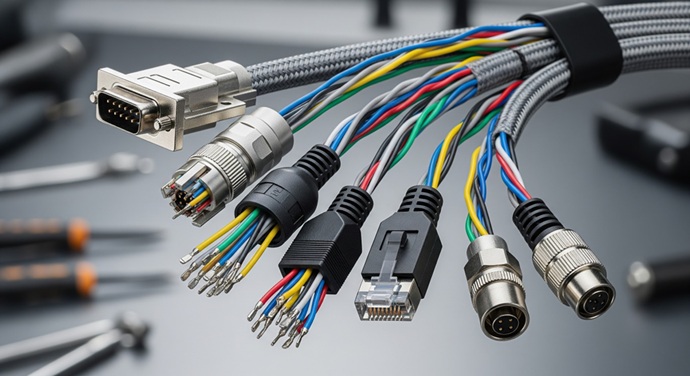
The most perfect design will not perform because the process of assembly may create weaknesses. This is where custom cable assembly expertise makes a tangible difference. It is not a matter of plugging wire A in terminal B—it is a matter of managing all the variables that influence long-term reliability.
- Solder Joint Quality: The quality of solder joints, e.g. is a factor of controlled temperature, correct application of flux, and sufficient wetting time. Excessively hot, and you may destroy parts. Too cold, and you are weak-jointed, and liable to crack.
- Protective Coatings: The coating that is used on boards to prevent moisture and contaminants must have an even coating without holes or excessive layers.
- Torque Precision: Torque requirements on mechanical fasteners are not a recommendation, but rather a carefully determined figure which makes connections firm without excessive straining of the element.
Testing: Before the Real World Tests Your Device
It is a fact that many manufacturers discover only too late: it is impossible to know whether your design will work or not, until you subject it to realistic conditions.
- Temperature Cycling: Tests indicate the weaknesses of solder joints.
- Vibration Testing: Mechanical design defects are revealed through vibration testing.
- Collective Environmental Testing: Exposing a device to extreme temperatures while it is vibrating can frequently reveal failure modes that theory alone would not have suggested.
- Accelerated Life Test: This method condenses years of environmental pressure into weeks or months of rigorous test. It is not flawless, but it detects most of the problems even before they make it to the field.
Building Reliability Into Your Security Infrastructure
Reliability does not happen by chance. It is the outcome of the conscious decisions of the design, choice of components used, production and installation. When defining security equipment in a tough environment, go beyond the spec sheet:
- Inquire of operating temperature ranges, not just of storage ranges.
- Inquire about the vibration response of the device.
- Know the type of testing done by manufacturer.
Please pay attention towards subtle details that make a difference-they may involve cable routing in such a way that no strain is placed on connectors; mounting the device in ways that separate it from vibration sources; providing the proper thermal management in housings, without throwing up further problems!