
From Static to Lively Pages: How Real-Time Communities Boost Engagement and Conversions
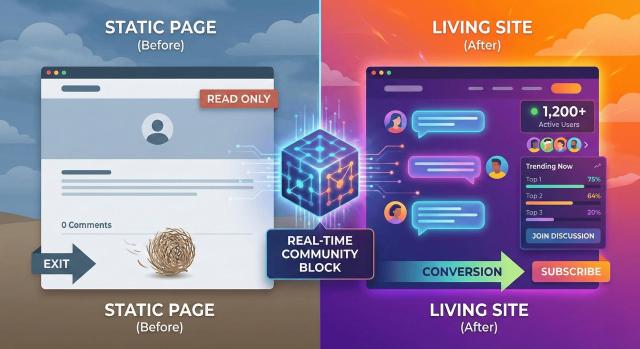
Whether you are running a media site, a niche market, or a streaming site, you are probably seeing the same thing: people are coming and viewing the particular piece of data that they were looking for and then leaving. Instead of sending them to Discord or Telegram, more teams are looking for a community chat software they can plug directly into their existing pages.
It’s not because the content is bad that they leave; it’s because it’s a lonely experience. Today’s user is trained to respond to feedback and debate from their experiences with social media sites such as Facebook and Twitter. They arrive at a page that looks like a "digital ghost town" and automatically go to X (Twitter) to find the conversation.
The transition that the top product groups are undergoing at the present time is the transition from Static Pages to Living Sites. Through the inclusion of live community elements right into the interface, they are converting passive visitors into active audiences.
This is how the addition of a social element affects the economics of a unit of your platform.
The Psychology of a “Living” Site
Static websites and apps require a decision from the user alone. A living one offers the user Social Proof.
If a visitor arrives on a page and notices a counter indicating "1,200 fans are talking about this match" or "50 traders are evaluating this asset," the psychology of the visit will change.
- FOMO (Fear of Missing Out):
The user feels that something is happening at this very moment. - Validation:
It is very important to note that the presence of active discussion serves as a form of validation in the sense that it confirms that other people consider this topic important and worth their time. - Session Depth:
Rather than reading an article and leaving, the person remains to view comments, answer a question in a poll, or pose another question.
Converting Engagement into Revenue
However, the point about on-site chat has always been that it’s “just noise.” “How does it make money?” Well, with social tools of today, such as Watchers, community blocks are no longer just boxes of text, but rather engines of conversion.
- Contextual Conversion
When it comes to subscription or product inquiries on a static site, users have to go to an FAQ or contact support via email. In a living community, they can pose their questions to experts or other users in the sidebar itself.Example: A user on a trading site is reluctant to make a trade in a market. Noticing a "Pro" analyst talking about a trend on live chat helps him make his move.
- Gamification and Loyalty
Static loyalty programs (points earned, discount awarded) often feel flat. Living sites leverage social signaling. We integrate with your loyalty program and use badges (such as "Top Predictor" or "Verified Holder") alongside the individual's name. The individual will be motivated to take additional actions that create value (view additional streams, make additional trades) in order to achieve the next level of social status.
- The "Copy" Mechanic
In transactional platforms, users have the ability to share their activity. A user can share their trading setup inside the chat. Another user can simply click on one button "copy" to repeat after a preferred action. This way, social interaction becomes directly related to the business's revenue.
The Safety Barrier: Why Brands Hesitate
Why most brands have not transformed their websites and mobile apps into “living” platforms so far is fear. Online can be an unpleasant place, and no business wants to have a hate speech scandal on the front page.
This is an area where technology has evolved considerably. "Brand-safe" is a requirement in a modern community blockWhat’s important to do for treating safety as an underlying layer:
- Zero Delay Moderation:
Our AI models aim to remove aggression and spam in milliseconds. In many cases, the offending message will be filtered out before it reaches the screen. - PII Security:
In High-Risk Industries (Fintech/Gaming), users tend to inadvertently leak personal data. Our solution automatically identifies and masks phone numbers/cards to safeguard both the user and the status of the platform's compliance. - Self-Cleaning Communities:
The reporting/hiding functionality gives the community the ability to police itself, thus decreasing the burden on your support team.
Integration: Do Not Rebuild Your Platform
The biggest misconception is that "making your site 'social' means you need to completely re-platform."
Watchers has been developed exactly for this purpose. In most cases, you won't have to refactor your backend code or migrate your databases. You embed the community block into your existing design, whether it's in a sidebar in your desktop site or in a drawer in your mobile application.
Conclusion
One of the metrics that matters most today is not just DAU (Daily Active Users), but Time Spent and Retention. A static page can receive clicks, but it cannot retain viewers' interest for long. With the help of this strategy, you can turn your platform into a lively platform where people can communicate, learn, and respond in real time, thus not only being a source of content but also a destination.
Stop sending your traffic to social media sites. Keep conversations at your own URL