
A Look Into the Dark Web's Evolution: Leading Marketplaces to Monitor in 2025

Image Source: depositphotos.com
The dark web is anything but stagnant. One second, a marketplace is flooded with activity; the next, it may have completely disappeared.
Such is the nature of this rapidly changing underground economy, and that is why we believe it's more important than ever to remain current on the major players in 2025.
New markets emerge quickly, and they can catch traction very fast—sometimes within a matter of weeks—as old ones disappear without notice, taking substantial amounts of cryptocurrency with them (into the millions).
For cyber threat teams, investigators, or any other interested individuals monitoring emerging threats, watching dark web marketplaces should not be optional, but a must in 2025.
This is why we have put together a new list of five dark web marketplaces that are worth watching right now.
Whether you are tracking threat actor behaviors, monitoring for stolen data, or just trying to keep pace with the times, these are the five dark web marketplaces where a lot of illicit activity is occurring currently.
What is Found in the Dark Web Marketplace and How Does it Operate?
To put it simply, dark web marketplaces operate like an underground Amazon or eBay; however, instead of everyday products that may be purchased, what is being traded is decidedly more dangerous.
We are talking about credentials for applications, banking information, malware kits, exploits, and ransomware-as-a-service offerings.
Some listings even offer access to botnets, servers that have been hacked, and sometimes databases of leaked information, and sometimes fake IDs.
Hence, privacy is a major consideration, and Payment systems and the transaction itself are done in complete anonymity by using cryptocurrencies.
Bitcoin and Monero are the most popular, since they require information about buyers and sellers to be obscured to make tracing payments more difficult.
This anonymity is very appealing for buyers and sellers, many of whom are experienced cybercriminals, and some low-level actors.
Access is also important. Some illegal markets have started using traditional web domains as mirror sites to attract users— this provides better avenues for less tech-savvy attackers or new attackers to begin.
Only some illegal dark web marketplaces run on .onion domains and require users to use the Tor Browser to access; Access has a certain role in increasing perceived activity.
Current Conditions of the Dark Web Economy
In recent years, the estimated revenue of sales in these marketplaces has seen a major decline.
According to a report by the blockchain data company Chainalysis, the estimated revenue of these illicit markets decreased from a lofty $3.1 billion in 2021 to just above $2 billion in 2024.
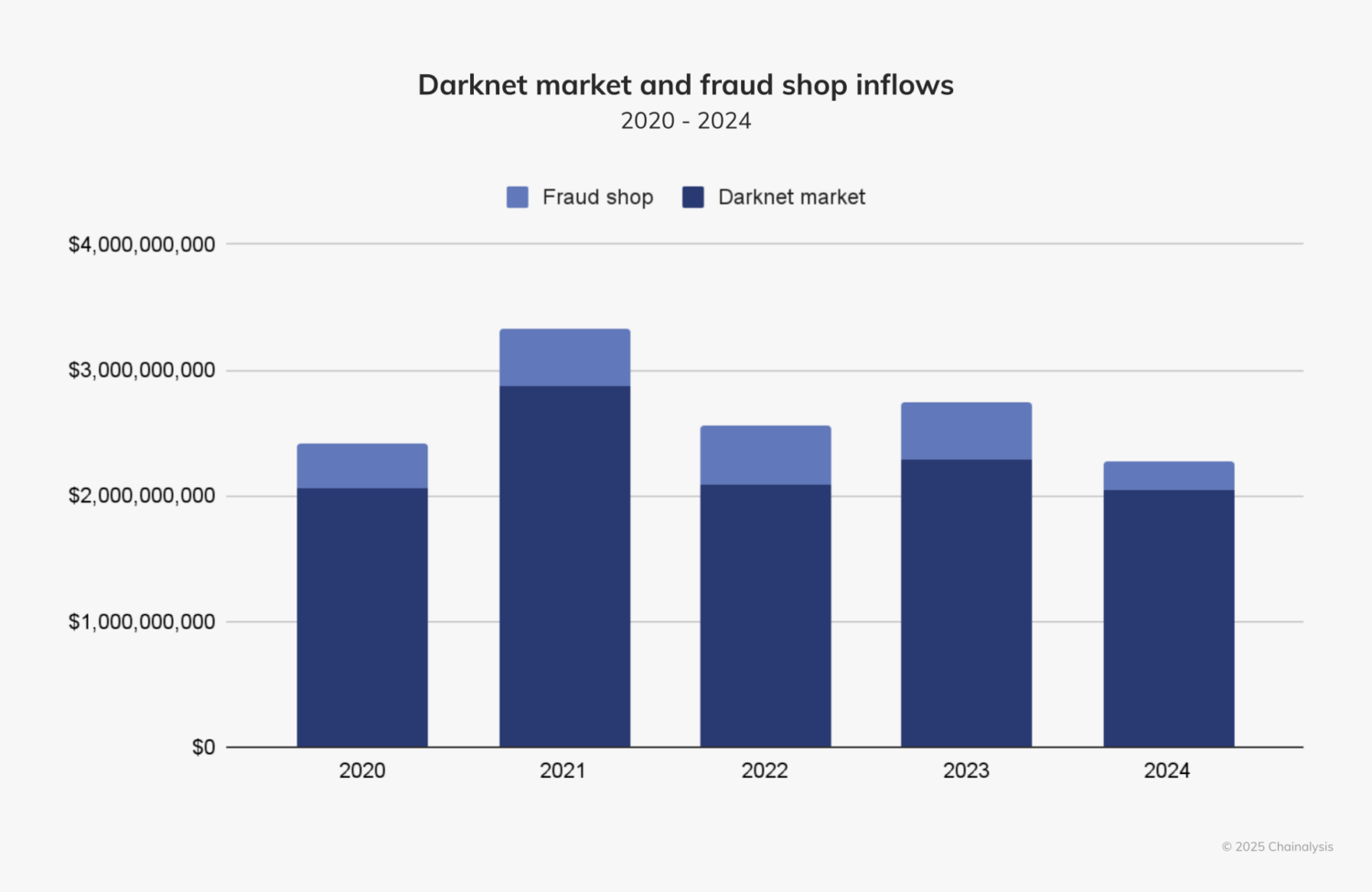
This trend can be linked to successful international law enforcement efforts over many years.
A significant blow to the dark web economy was the popular Hydra Market Russian-language platform, which shut down in 2022.
Law enforcement actions have continued to be successful, including the takedowns of Genesis Market (2023) and BidenCash (2025).
Still, the work is not finished. The challenge is that law enforcement may successfully take down a market, but it often re-emerges elsewhere.
For example, while the Genesis Market shut down, the website was active and accessible again in a matter of weeks.
In these situations, the presence of the market's underlying code facilitated the creation of the infrastructure on another server.
Nevertheless, successful law enforcement actions succeed in damaging the providers' trust in the marketed product at least in some way.
This will have a deterrence and representation impact on whether or not they will reclaim lost stature.
Another trend that is affecting traditional dark web markets is the rise of Telegram as another funnel for cybercriminals.
Many threat actors are rushing to Telegram channels and groups in order to leverage their anonymous profiles and end-to-end encryption.
While Telegram is a supplement to dark web markets' activities, individuals will always be inclined to the dark web as an avenue to prop up anonymous exchange of illicit goods, malware, and data.
As long as the dark web is a domain of goods and services, new marketplaces can arise and thrive.
5 Dark Web Marketplaces to Follow in 2025
While several dark web marketplaces provide illegal drugs or counterfeit goods, others are directly intended to allow threat actors to compromise an organization.
Dark web marketplaces provide a wide selection of malicious products, including stolen credentials and hacking resources, alongside the more traditional malware and ransomware products.
Here are five notable dark web marketplaces worth monitoring for advance cybersecurity threats alerts:
1. Awazon Market
- Status: Offline
- Onion link 1: awazonhndi7e5yfaobpk7j2tsnp4kfd2xa63tdtzcg7plc5fka4il4ad.onion/auth/register_now
- Onion link 2: awazonmphskqrqr5fquam6h24dcifybo4wlzqzlw52edkn3nzfnmh6qd.onion/auth/register_now
Awazon Market is a popular and active marketplace that was established in 2020. It distinguishes itself by claiming to provide a "revolutionary" variation on safe anonymous commerce.
Awazon offers robust DDoS mitigation and military-grade security protocols, and its distinct add-on is its construction without JavaScript support.
The market is user-only, which means you need to register to get in.
Our research revealed that the registration process is both straightforward, requiring only an untraceable email and a random username, and does not require you to confirm your email.
Awazon's user-friendly interface, search functions, and verified vendors give it a trusted reputation as a safe marketplace that serves as a replacement for Alphabay Market, which is no longer functioning.
2. Exploit
- Status: Offline
More of a forum than a traditional vendor market, exploit facilitates cybercriminals' ability to transact.
The forum is a Russian-language-based forum where initial access brokers (IABs) monetize a description of the organization's network environment.
Exploit is widely regarded as a hotbed of the underground economy, where threat actors can secure stolen personal information, ransomware, botnets, and phishing kits.
It’s a private group commonly associated with larger-scale operations such as attacks with motivations targeting critical infrastructure for NATO member states.
3. BriansClub
Status: Offline
This is a credit card fraud and personal information marketplace. BriansClub is also one of the largest dark web marketplaces that is also available on the clear web.
BriansClub sells not only full credit card information but also sensitive information such as Social Security numbers and birth dates.
Although there was a law enforcement sweep of BriansClub in 2019 that showed the platform had earned more than $126 million, the site continues to exist and advertise stolen data.
4. Russian Market
- Status: Active
- Onion link: http://rumarkstror5mvgzzodqizofkji3fna7lndfylmzeisj5tamqnwnr4ad.onion/
Contrary to its name, the Russian Market is an English-language market that holds a vast amount of stolen data.
Signing up is simple, and both the dark and clear web can access the platform.
However, newly registered users require at least a $50 cryptocurrency deposit to access any listings.
Hackers are able to obtain credit card dumps, stolen credentials, access to specific Remote Desktop Protocol clients, and compromised cookies, amongst whatever else they could be buying stolen data.
Prices for this stolen data can vary, from as little as $10 to more than $500.
5. Exodus Marketplace
- Status: Active
- Onion link: http://dwltorbltw3tdjskxn23j2mwz2f4q25j4ninl5bdvttiy4xb6cqzikid.onion/blog/exodus-market
Exodus is a new dark web market that originated in 2024, intending to be a quick way for the growing dark web market to flourish.
Currently, designated as an invite-only marketplace, the developers of Exodus specialize in selling "stealer logs," which are a deadly little files with tons of malicious information, such as stolen logins, personal information, and financial information, harvested by infostealer malware.
They claim to have over 7,000 bots, with each bot listed between $3 and $10. The low price of the bot will encourage further acts of cybercrime.