
Key Technologies Driving Industry 4.0 Adoption
Welcome to the future—where factories think, robots collaborate, and supply chains practically run themselves. Industry 4.0 isn’t just a buzzword; it’s the dawn of a new era in manufacturing and beyond. From AI-powered automation to hyperconnected industrial ecosystems, businesses embrace cutting-edge technologies to stay ahead of the curve. At the forefront of this revolution are artificial intelligence solutions for factories, which are transforming traditional operations into intelligent, self-optimizing systems. But what’s driving this revolution? Let’s break it down into the key technologies shaping the Fourth Industrial Revolution and why they matter.
1. Artificial Intelligence (AI) and Machine Learning (ML)
If Industry 4.0 were a movie, AI and ML would be the main protagonists. These technologies help machines learn from experience, optimize production, and predict maintenance needs before breakdowns happen. AI-driven analytics offer real-time insights, reducing errors, improving efficiency, and cutting costs. A vital component of this AI-driven transformation is the implementation of artificial intelligence solutions for factories, which allow for sophisticated automation, predictive quality control, and real-time process optimization. Whether it’s a self-learning robot on the assembly line or an AI-powered chatbot managing customer queries, smart automation is reshaping industries at an unprecedented scale.
2. The Internet of Things (IoT)
Ever wish your coffee machine could talk to your alarm clock? Well, in Industry 4.0, machines aren’t just talking—they’re making decisions. IoT enables devices, sensors, and systems to communicate and exchange data, creating smarter, more responsive production environments. A connected factory means real-time monitoring, predictive maintenance, and seamless coordination between equipment, ensuring minimal downtime and maximum efficiency.
3. Big Data and Analytics
Data is the new oil, but without analytics, it’s just a messy spill. Big Data, coupled with powerful analytics tools, helps businesses make data-driven decisions that improve operations. With real-time analysis, companies can detect inefficiencies, anticipate demand, and customize production based on consumer preferences. It’s like having a crystal ball—but powered by algorithms instead of magic.
4. Robotics and Automation
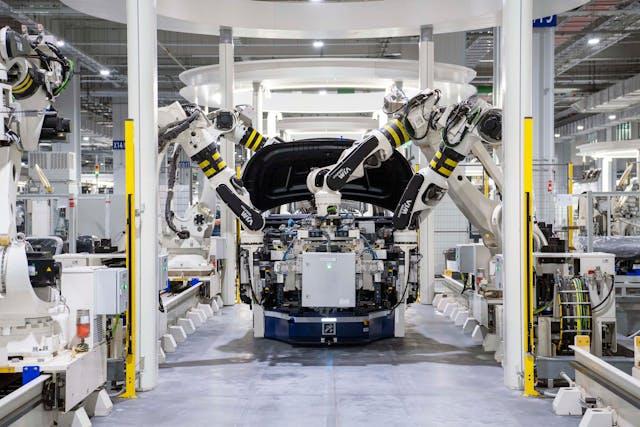
Move over, sci-fi—robots are already here, making factories smarter, safer, and more efficient. Unlike traditional industrial robots, Industry 4.0 introduces collaborative robots (cobots) that work alongside humans rather than replace them. These intelligent machines handle repetitive tasks, reduce workplace injuries, and boost productivity. At the heart of this robotic revolution is the implementation of AI in manufacturing, which enables these machines to learn, adapt, and optimize their performance. Automation-driving efficiency allows businesses to scale operations without overworking their human workforce.
5. Cloud Computing
Remember when saving files meant carrying a USB stick like a national treasure? Those days are long gone. Cloud computing allows industries to store, manage, and process vast amounts of data remotely, making real-time collaboration and decision-making easier. Whether it’s a global supply chain relying on shared insights or remote machine diagnostics, cloud platforms provide the flexibility and scalability that Industry 4.0 demands.
6. 5G and Edge Computing
Speed and efficiency are the lifeblood of Industry 4.0, and that’s where 5G and edge computing step in. 5G delivers ultra-fast, low-latency communication, ensuring seamless data flow between connected devices. Meanwhile, edge computing processes data closer to the source rather than relying on centralized cloud servers. The result? Faster decision-making, reduced network congestion, and enhanced security. Whether autonomous vehicles in a warehouse or real-time quality control on an assembly line, 5G and edge computing are the digital arteries keeping Industry 4.0 alive.
7. Augmented Reality (AR) and Virtual Reality (VR)
What if workers could receive real-time guidance without flipping through manuals? AR and VR are revolutionizing training, maintenance, and even product design. AR overlays digital instructions onto physical objects, allowing technicians to troubleshoot machinery hands-free. Meanwhile, VR is being used to simulate real-world training environments, improving worker efficiency and safety. It’s like having an expert whispering in your ear—minus the creepy factor.
8. Cybersecurity
With great connectivity comes great responsibility. As industries become more connected, cybersecurity threats multiply. Hackers are always looking for vulnerabilities, making industrial cybersecurity a non-negotiable aspect of Industry 4.0. From AI-powered threat detection to blockchain-secured transactions, businesses must invest in robust security frameworks to protect their networks, data, and operations from cyberattacks.
Final Thoughts
Industry 4.0 isn’t a distant dream—it’s happening right now. Businesses that embrace AI, IoT, Big Data, and other transformative technologies will gain a competitive edge in an increasingly digital world. While challenges like cybersecurity and workforce adaptation remain, the benefits of enhanced efficiency, reduced costs, and smarter operations far outweigh the risks. The question isn’t whether Industry 4.0 will revolutionize industries—it’s whether you’re ready to participate. So, are you in?