
How X-Design's AI Agent Is Replacing Drag-and-Drop Branding Tools

Image Source: depositphotos.com
The timeline for launching a brand has crashed. Two years ago, building an identity was a month-long slog of negotiations and revisions. Today, it happens in the afternoon. The old method of stitching together disjointed tools is dead; the market simply moves too fast for that.
Founders can't wait weeks for a favicon. They need an AI logo maker that acts as an immediate cornerstone for their business. Just as creators use a video quality enhancer to salvage grainy footage, businesses demand tools that polish raw concepts instantly. X-Design steps in here, not just as a tool, but as an engine that eliminates the friction between the idea and the execution.
Replacing the Blank Canvas With a Real Conversation
The most intimidating thing in design is the empty white square. Most software hands you this void and a set of brushes, expecting you to know what to do. That is a flaw. X-Design operates on the premise that you are not a designer and you probably shouldn't try to be one. You are a business owner with a specific intent. The platform replaces the blank canvas with a conversation. You don't drag shapes; you explain your business.
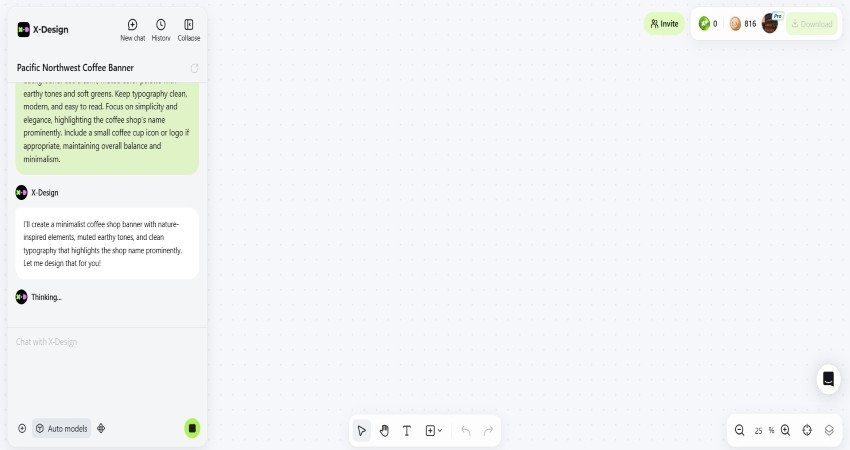
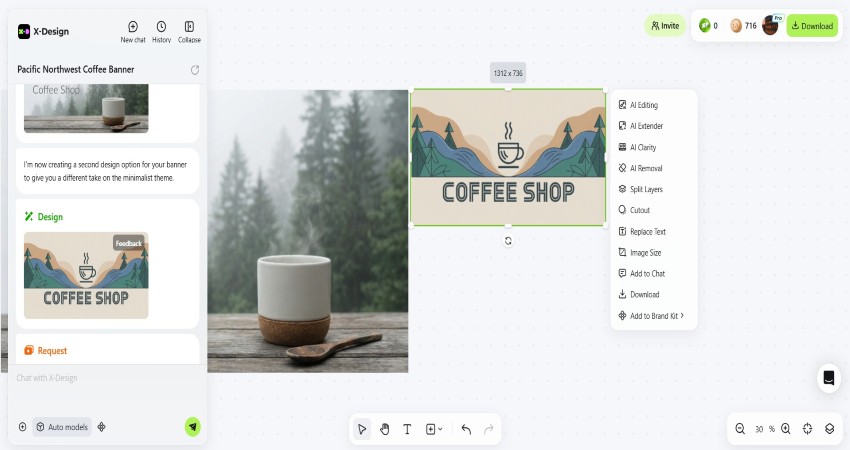
This semantic approach changes the output quality. Type "minimalist banner for a coffee shop in the Pacific Northwest," and the agent grasps the shorthand immediately. It knows this means sans-serif and earthy tones, not just a generic clip-art mug. It reads the room, not just the keywords. It constructs a visual identity based on the logic of the prompt. This prevents the user from making fundamental design errors.
How X-Design Creates Branding Instead of Templates
Templates are the fast food of the design world. They differ little from one another and leave you feeling unsatisfied. If you use a standard template site, you run the very real risk of launching your brand with the exact same visual structure as a plumber in Ohio and a bakery in London. It dilutes identity but X-Design agent generates the identity in real-time. This means the combination of iconography, typography, and color is unique to the session.
The agent allows for rapid iteration without starting over. In a traditional workflow, if you decide you hate the font halfway through, you often have to manually update every single asset. Here, the feedback loop is linguistic. You tell the agent the text feels "too aggressive" or "too hard to read," and it adjusts the typography globally. It interprets the emotional weight of the feedback. This back-and-forth mimics the relationship with a human art director, where the goal is to refine the "vibe" rather than just moving pixels three spaces to the left.
Brand Consistency is the Key
The hardest part of branding isn't making the logo. It is using the logo. A hex code gets typed wrong, a font gets substituted, or the padding gets ignored. After three months of these mistakes, the brand starts to look sloppy.
X-Design solves this by creating a "Brand Kit" that functions as the brain of the operation. Once the identity is approved, the agent locks the rules. It remembers the primary color and even the secondary font. When you return to the platform two months later to generate a sale flyer, the agent retrieves these rules automatically. You don't have to monitor the design for consistency because the software does it for you.
Solving the Professional Product Photography Problem
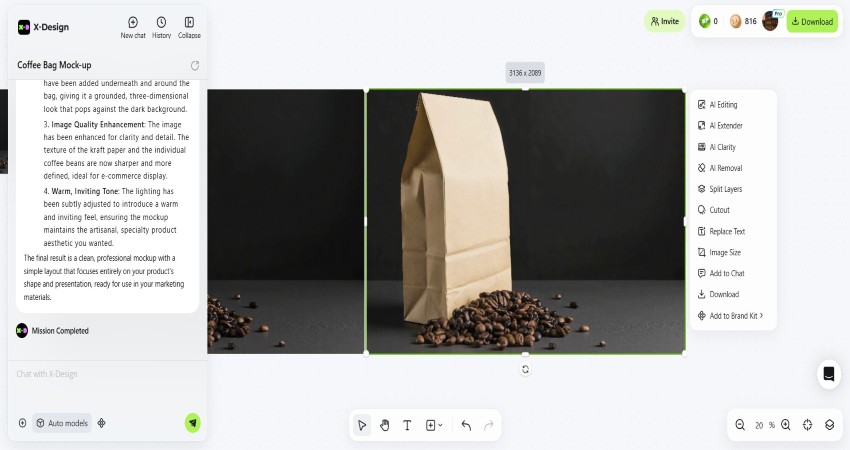
X-Design integrates a generative photography engine that attacks this problem head-on. The system removes the original background and generates a new, brand-appropriate environment. This goes beyond simple background replacement. If you are selling a rugged outdoor watch, the agent can place it on a slate rock with moss, adjusting the lighting and shadows so the product looks like it is physically sitting in the scene.
If you are selling luxury cosmetics, X-Design generates product photos that place the bottle on a reflective water surface. This capability democratizes "studio quality." It removes the need for expensive lighting rigs and prop rentals. You control the narrative of the product by controlling the environment it sits in.
Furthermore, the layout limitations of social media often ruin great photos. A horizontal photo looks terrible in a vertical Story. The X-Design platform includes generative expansion tools that solve this geometry problem.
It creates new pixel data to extend the background of an image. A tight shot becomes a wide shot. A square becomes a vertical. This allows a single asset to be deployed across every marketing channel without awkward cropping or white bars. It maximizes the utility of every image you have.
Adjust Images for Different Formats and Platforms
Digital brands eventually have to live in the physical world. You need to know if your logo works on a cardboard box before you order five thousand of them. The platform includes a mockup engine that projects the generated identity onto 3D objects. This is a reality check. It helps you spot legibility issues. A thin font might look elegant on a Retina screen but disappear completely when printed on a textured surface.
Simulating signage or packaging forces a reality check. It makes you treat the brand as a physical object, not just a digital avatar. And when it’s time to build, the system hands over the raw files to make it happen. It exports vectors. This is a crucial detail. Professional print shops cannot use JPEGs. They need SVGs or PDFs to ensure sharp lines at any scale. By providing these formats by default, X-Design ensures the transition from screen to print is frictionless.
Bridging the Gap Between Automation and Manual Design
There is a fear that AI tools make the user passive. X-Design avoids this by keeping the generated assets editable. The agent does the heavy lifting—the construction, the pairing, the resizing—but the user retains the right to veto. You can open the editor and tweak what you don’t like.
This hybrid model is the future of work. Lean on the machine for speed, but keep the nuance for yourself. An algorithm can spit out a thousand options, but only you know which one actually lands. The editor offers the muscle to tweak details without drowning you in buttons you’ll never touch.
Conclusion
The market rewards velocity. While competitors rot in a freelancer's inbox, smart founders are launching cohesive brands in days. X-Design fixes the mess, turning the fragmented branding process into a single, sharp workflow.
The "I don't have a logo" excuse is officially dead. You can build a pro-level identity before lunch. So why are you still staring at a blank canvas? Stop pushing pixels manually and let the agent handle the grunt work. The era of the slow launch is over; start directing and stop waiting.