
Cyber Warfare Comes to West Michigan: What the Stryker Cyberattack Means for Manufacturing
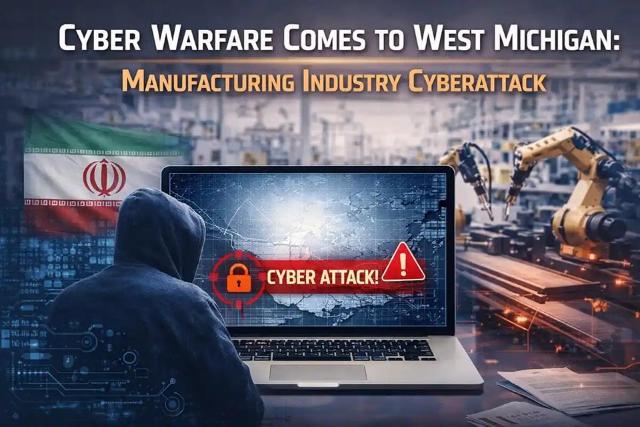
In March 2026, one of West Michigan’s most recognizable manufacturers found itself at the center of a major cybersecurity incident. Medical technology company Stryker, headquartered near Grand Rapids, experienced a widespread cyberattack that reportedly disrupted systems across its global network.
A hacker group linked to Iran later claimed responsibility, alleging that tens of thousands of systems were wiped and large volumes of corporate data were exfiltrated. While the company continues to investigate the full scope of the incident, the message is clear: modern cyber conflict increasingly targets private industry.
For manufacturers across the United States, the Stryker attack underscores a growing reality: cyber warfare is now touching the private sector, including companies far from traditional geopolitical hotspots.
Manufacturing Has Become a Prime Target
Manufacturing has quietly become one of the most targeted sectors in cybersecurity, and recent data shows the problem is accelerating.
According to a 2025 Industrial Cyber report citing KELA research, nearly half of all ransomware attacks now target critical infrastructure sectors, with manufacturing, healthcare, and energy among the leading targets globally.
The same reporting notes that ransomware attacks against manufacturing surged 61% in 2025, rising from 520 incidents to 838. That is a meaningful signal for manufacturers that rely on uptime, logistics continuity, and interconnected production environments.
KELA’s 2025 ransomware research frames this shift in even broader terms, arguing that ransomware has evolved from an enterprise risk into a national security threat. This shift signals that ransomware is no longer purely financially motivated; it is increasingly intersecting with geopolitical strategy.
IBM’s X-Force Threat Intelligence Index has also continued to position manufacturing as one of the most exposed industries, reinforcing the sector’s ongoing risk profile.
Why are manufacturers such attractive targets?
The answer lies in a combination of operational urgency and technological complexity.
Manufacturers often operate in environments where downtime can cost hundreds of thousands of dollars per hour. When production lines stop, revenue stops immediately. This urgency creates pressure to restore operations quickly, something ransomware groups and other threat actors frequently exploit.
At the same time, manufacturing networks often contain a mix of modern cloud systems and legacy operational technology (OT) that can be difficult to patch or secure without interrupting production.
When Cyberattacks Become Geopolitical Tools
What makes the Stryker incident particularly noteworthy is the alleged geopolitical connection.
The hacker group claiming responsibility reportedly framed the attack as retaliation tied to broader geopolitical tensions involving Iran. While attribution in cyber incidents is often complex, the messaging surrounding the attack reflects a broader trend: nation-state actors and state-linked groups increasingly use cyber operations as instruments of influence and disruption.
Cyber operations allow adversaries to create disruption without traditional military escalation. Attacks can be launched remotely, often with plausible deniability, and can impact organizations anywhere in the world.
For global manufacturers, this means that geopolitical tensions can suddenly translate into operational disruptions, even for companies located thousands of miles from the conflict itself.
The Expanding Digital Battlefield
Modern manufacturing organizations operate in highly interconnected environments. Corporate networks, cloud platforms, remote employees, supplier systems, and industrial control networks are all part of the same digital ecosystem.
This connectivity improves productivity and innovation, but it also dramatically expands the attack surface.
In incidents like the one reported at Stryker, attackers often target identity systems, endpoint management tools, or collaboration platforms. Once attackers gain access, they can quickly move across networks, disable devices, or exfiltrate data.
The result can be a cascading disruption affecting thousands of systems across multiple locations.
Key Lessons for Manufacturers
Cybersecurity is no longer simply an IT responsibility. For manufacturers, it has become a core operational risk.
Organizations should focus on several foundational security strategies.
Strengthen Identity Security
Many breaches begin with compromised credentials or phishing attacks.
- Multi-factor authentication (MFA)
- Privileged access monitoring
- Conditional access policies
- Identity governance tools
Secure Endpoints and Devices
Attackers frequently spread malware through compromised endpoints.
- Endpoint detection and response (EDR)
- Mobile device management security
- Zero-trust access controls
- Continuous monitoring tools
Segment Operational Networks
Manufacturing environments often combine corporate IT systems with operational technology controlling production equipment.
Network segmentation can help prevent attackers from moving laterally between these environments.
Prepare for Incident Response
Even organizations with strong defenses can experience breaches.
- Tested incident response plans
- Offline and immutable backups
- Cyber insurance readiness
- Regular disaster recovery exercises
Prepared organizations typically recover faster and with less business disruption when incidents occur.
A Local Incident with Global Implications
West Michigan has long been known for its strong manufacturing sector, from automotive suppliers to medical technology innovators.
The Stryker cyberattack demonstrates that regional companies now operate in a global digital environment where geopolitical tensions, cybercrime, and technological complexity intersect.
Companies that once viewed cybersecurity as a technical concern must now recognize it as a strategic business risk affecting operations, reputation, and supply chains.
Looking Ahead
Manufacturing has always been defined by precision, resilience, and innovation. Those same principles must now extend into cybersecurity.
Organizations that invest in proactive security strategies, including identity protection, network monitoring, employee training, and incident preparedness, will be far better positioned to withstand future cyber threats.
Events like the Stryker incident remind us that the digital battlefield continues to evolve.
For manufacturers, the critical question is no longer whether cyberattacks will occur, but how prepared organizations will be when they do.
About the Author
Matt Kahle is President and Co-Owner of Real IT Solutions, a Michigan-based managed IT services provider specializing in cybersecurity, risk management, and proactive technology strategy for businesses across the Midwest. Matt works closely with manufacturing companies to help them strengthen their cybersecurity posture and protect critical operations.
References
https://industrialcyber.co/reports/half-of-2025-ransomware-attacks-hit-critical-sectors-as-manufacturing-healthcare-and-energy-top-global-targets/
https://www.kelacyber.com/resources/research/escalating-ransomware-threats-to-national-security/
https://www.ibm.com/reports/threat-intelligence
https://www.reuters.com/technology/stryker-shares-fall-after-report-suspected-iran-linked-cyberattack-2026-03-11/
https://abcnews.go.com/International/pro-iran-hacking-group-claims-responsibility-cyberattack-stryker/story?id=130979414